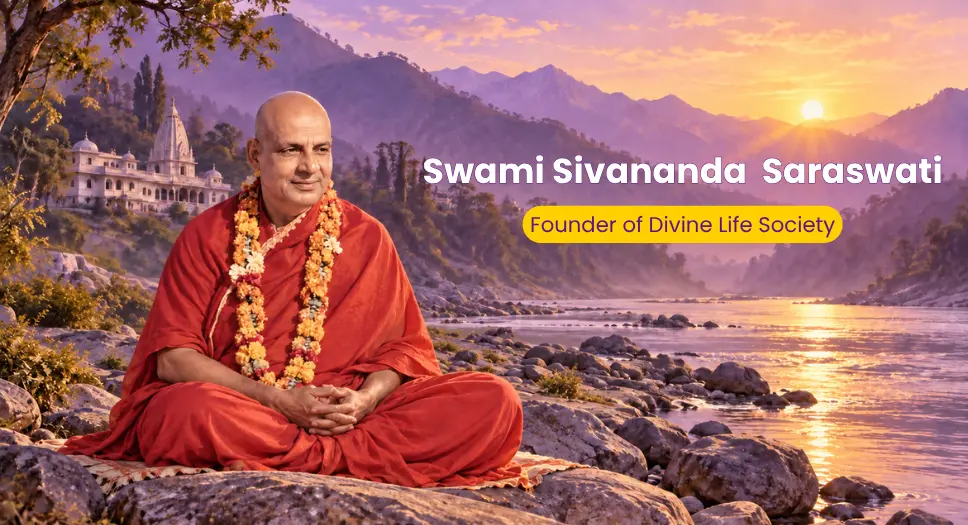
Few names in the world of modern spirituality carry as much weight as Swami Sivananda Saraswati. A physician who became a monk, a healer who became a sage, and a teacher whose students carried his message across every continent, his life remains one of the most inspiring stories in the history of yoga. Today, more than six decades after his passing, the philosophy of Sivananda Saraswati continues to guide millions of practitioners toward a healthier body, a calmer mind, and a more meaningful life.
In this article, we will explore the early life of this remarkable saint, the philosophy he built, the organizations he founded, and how Sivananda Saraswati yoga continues to shape the global yoga movement today.
Early Life: From Physician to Monk
Born Kuppuswami on 8 September 1887 in Pattamadai, a small town in the Madras Presidency (present day Tamil Nadu), young Kuppuswami showed early signs of intelligence, discipline, and compassion. He pursued a career in medicine and went on to practice as a doctor for over a decade in Malaya (modern day Malaysia).
During his years as a physician, he noticed something that would shape the rest of his life: many of his patients suffered not only from physical ailments but from deep spiritual emptiness. Medicine could heal the body, but it could not heal the soul. This realization planted the seed for his eventual renunciation of worldly life.
Key milestones of his early journey include:
- Published a health journal called Ambrosia while working as a doctor.
- Served as a medical practitioner in Malaya for more than ten years.
- Renounced worldly life and returned to India in 1923.
- Took formal initiation into Sannyasa (monastic life) in 1924, adopting the name Swami Sivananda Saraswati.
- Settled near Rishikesh on the banks of the Ganges, where he spent the rest of his life in study, service, and teaching.
This transformation from a medical doctor to a spiritual master is one of the reasons his teachings resonate so strongly even today. He understood both the science of the body and the science of the soul, and he built a philosophy that honored both.
The Birth of the Divine Life Society
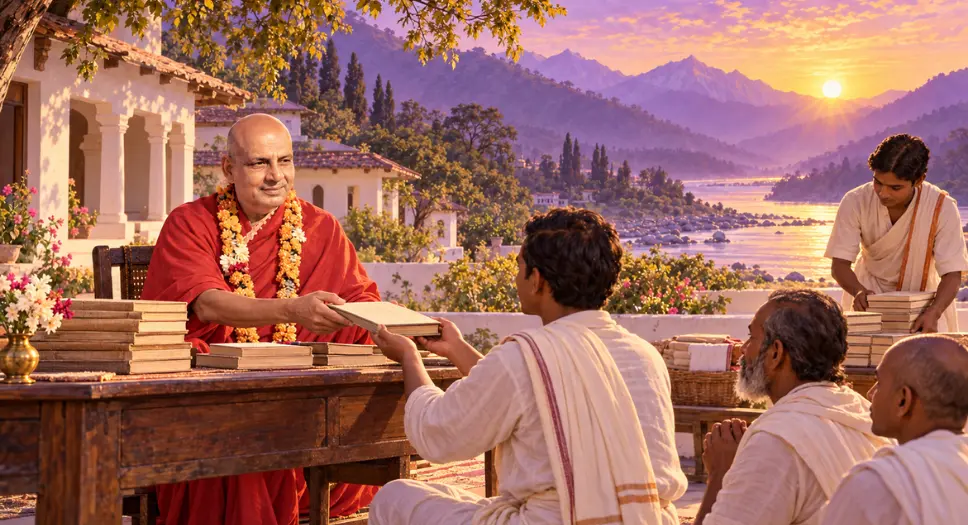
After years of intense austerity and self discipline on the banks of the Ganges, he founded the Divine Life Society (DLS) in 1936. The organization was created with a simple but powerful mission: to help humanity realize its inner divinity through selfless service, right living, and spiritual practice.
The Divine Life Society grew rapidly, and some of its key achievements include:
- Establishment of the Sivananda Ashram at Muni Ki Reti, close to Rishikesh.
- Founding of the All World Religions Federation in 1945, promoting harmony among different faiths.
- Creation of the Yoga Vedanta Forest Academy in 1948, which trained thousands of students in yoga and philosophy.
- Publication of over 200 books on yoga, Vedanta, health, and spiritual living, many of which are still widely read.
- Formation of branches across the globe, spreading his teachings to the West long before yoga became a household word.
The Divine Life Society still operates today, continuing to serve as a spiritual and humanitarian institution rooted in the vision of its founder.
The Core Teachings of Swami Sivananda Saraswati
What made Swami Sivananda Saraswati so influential was not just his organizational achievements but the practical simplicity of his teachings. He believed that spirituality should not be reserved for renunciates alone. It should be woven into everyday life, regardless of a person’s profession, religion, or background.
His most famous teaching can be summarized in a short, memorable instruction that he gave to thousands of students:
Serve, love, give, purify, meditate, realize.
This six word formula became something of a spiritual roadmap for his followers, encouraging them to combine selfless service with inner reflection.
Some of the foundational principles he emphasized include:
- Synthesis of Yoga: He taught that no single path of yoga is sufficient on its own. Instead, he encouraged a combination of four major paths.
- Karma Yoga (the path of selfless action and service to others).
- Bhakti Yoga (the path of devotion and love toward the divine).
- Raja Yoga (the path of meditation and mental discipline).
- Jnana Yoga (the path of knowledge and self inquiry).
- Health as a foundation for spirituality: Drawing on his medical background, he insisted that physical wellness supports spiritual growth, not the other way around.
- Simplicity and daily discipline: He encouraged practices like early rising, regular meditation, selfless service, and a wholesome diet as the building blocks of a spiritual life.
This blend of practicality and depth is one of the reasons his teachings traveled so far beyond India’s borders.
Sivananda Saraswati Yoga: A Global Movement
Perhaps the most visible part of his legacy today is the system known as Sivananda Saraswati yoga, more commonly referred to simply as Sivananda Yoga. This style was formally established in 1959 by his close disciple, Swami Vishnudevananda, who named the system after his guru in gratitude for the wisdom he received.
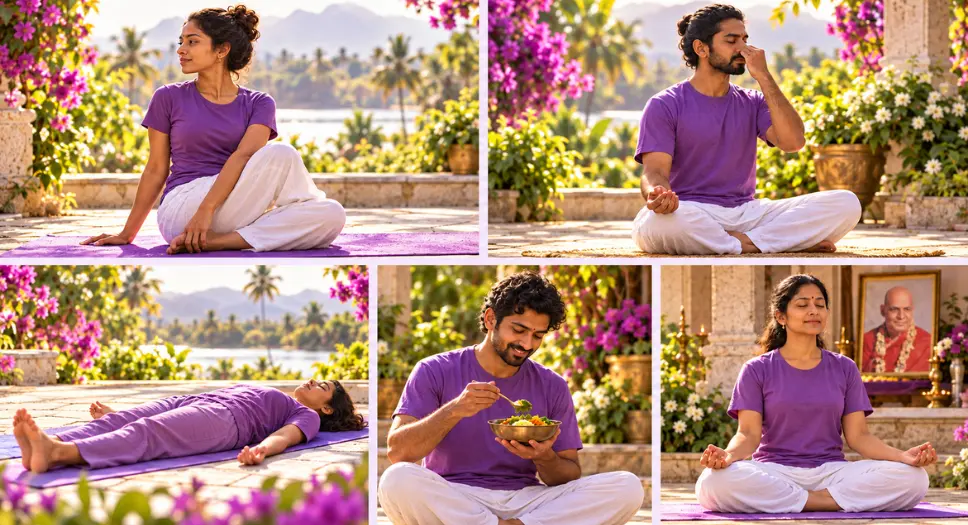
Sivananda Yoga is built on what practitioners often call the Five Points of Yoga:
- Proper Exercise (Asanas): A structured sequence of postures designed to keep the body flexible and strong.
- Proper Breathing (Pranayama): Breathing techniques intended to increase vital energy and calm the nervous system.
- Proper Relaxation (Savasana): Deliberate rest to release physical and mental tension.
- Proper Diet (Vegetarianism): A natural, plant based diet believed to support both physical and mental clarity.
- Positive Thinking and Meditation: Training the mind toward peace, focus, and self realization.
This structured approach made Sivananda Saraswati yoga especially appealing to Western students, who found it accessible, logical, and deeply transformative. Today, Sivananda Yoga Vedanta Centres exist across North America, Europe, and Asia, continuing to teach this same five point framework to new generations of students.
Why His Legacy Still Matters Today
More than sixty years after his passing on 14 July 1963, the influence of Swami Sivananda Saraswati can be felt in yoga studios, ashrams, and wellness centers around the world. Many of the most respected yoga teachers of the twentieth century were his direct disciples, including:
- Swami Chidananda Saraswati, who succeeded him as president of the Divine Life Society.
- Swami Vishnudevananda, founder of the Sivananda Yoga Vedanta Centres.
- Swami Satyananda Saraswati, founder of the Bihar School of Yoga.
- Swami Satchidananda, who introduced yoga to a wide American audience.
Each of these teachers carried forward a unique thread of his teaching, which is part of why his influence is so widespread today. Few spiritual figures of the modern era can claim to have shaped so many independent yoga lineages from a single source.
His enduring appeal comes from a few consistent qualities:
- A teaching style rooted in simplicity rather than complexity.
- An emphasis on service to humanity as a spiritual practice in itself.
- A scientific, health conscious approach to yoga that appealed to both Eastern and Western audiences.
- A genuinely inclusive philosophy that welcomed people of every religion and background.
Bringing These Teachings Into Your Own Practice
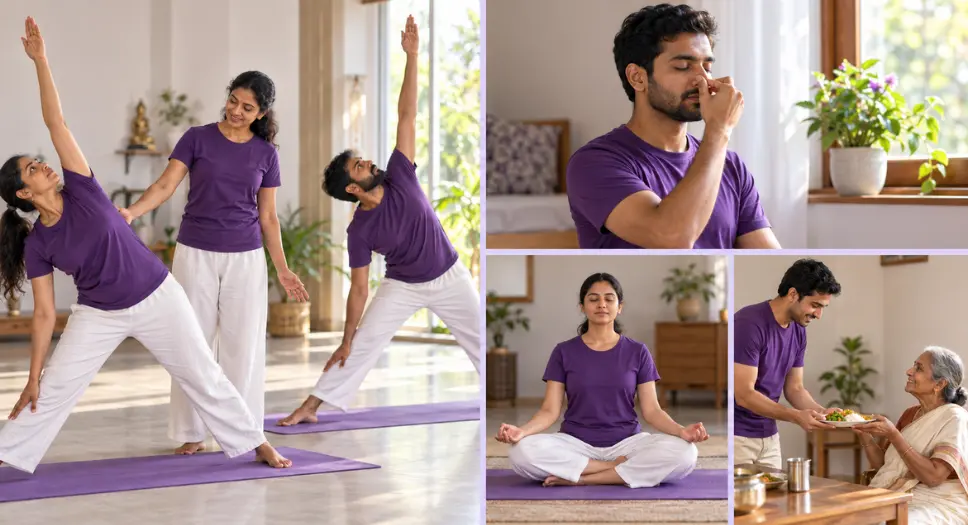
Understanding the life and philosophy of Sivananda Saraswati is one thing, but experiencing the benefits of his teachings firsthand is another. Whether it is through the Five Points of Yoga, the practice of Karma Yoga through small acts of service, or simply adopting a calmer and more disciplined daily routine, his teachings remain remarkably practical for modern life.
If you are looking to deepen your own yoga journey in this tradition, the Hatha Yoga Institute offers structured training that draws on many of these same time tested principles of breath, posture, diet, and meditation. Their programs are designed for students at every level, from complete beginners exploring their first asana class to dedicated practitioners preparing for teacher certification. It is a thoughtful way to connect classical yogic wisdom with a modern, supportive learning environment.
His Writings and Literary Contribution
One of the most remarkable aspects of Swami Sivananda Saraswati‘s life was his sheer output as an author. He is credited with writing more than 200 books, and some accounts place the number closer to 300, covering topics that ranged from yoga philosophy and Vedanta to practical health guides and moral instruction. He believed that the written word could reach seekers who might never have the chance to sit with a teacher in person, so he treated his writing as another form of service.
Some notable characteristics of his literary work include:
- A style that favored short, memorable phrases over dense academic language, making complex philosophy accessible to ordinary readers.
- Frequent use of practical instructions alongside spiritual concepts, so readers could immediately apply what they learned.
- Coverage of subjects far beyond yoga alone, including ethics, psychology, comparative religion, and everyday health.
- Publications distributed freely or at minimal cost through the Divine Life Society, reflecting his belief that spiritual knowledge should never be a luxury reserved for the wealthy.
Many of these texts remain in print today and continue to be studied by yoga teachers, monks, and casual readers who want a grounded introduction to Vedantic thought.
A Typical Day in His Ashram Life
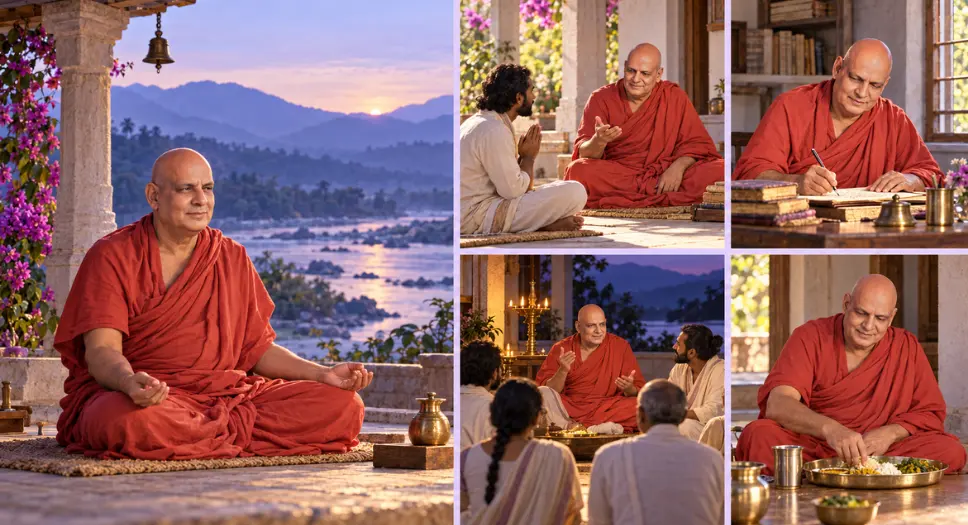
To understand how Sivananda Saraswati lived his philosophy rather than simply preaching it, it helps to look at the daily rhythm he maintained at his ashram near Rishikesh. His schedule reflected the same discipline he asked of his students, built around a few consistent habits:
- Waking well before sunrise for meditation and prayer.
- Personally attending to visitors, patients, and students, often offering both medical and spiritual guidance in the same conversation.
- Dedicating specific hours to writing, since he viewed authorship as a form of Karma Yoga.
- Leading group chanting and satsang sessions in the evening, open to people of any background or belief.
- Maintaining a simple vegetarian diet in line with the same principles later formalized within Sivananda Yoga.
This lived example is part of why his students found his teaching so credible. He never asked anyone to follow a discipline he had not already tested on himself for decades.
How Sivananda Yoga Differs From Other Styles
With so many yoga styles available today, it is worth understanding what sets Sivananda Saraswati yoga apart from more modern, fitness oriented approaches. While many contemporary classes focus almost entirely on physical postures, Sivananda Yoga was designed as a complete lifestyle system rather than an exercise routine.
A few distinguishing features include:
- A fixed sequence of twelve foundational postures, compiled by Swami Vishnudevananda as the core of every Sivananda class, rather than constantly varying routines, which allows practitioners to deepen their practice over time instead of learning new sequences every class.
- Equal emphasis placed on breathing, relaxation, and meditation alongside the physical postures themselves.
- A philosophical foundation rooted directly in the teachings of Swami Sivananda Saraswati, including the Four Paths of Yoga described earlier.
- A strong community and service oriented culture, echoing the original spirit of the Divine Life Society.
This structure is one reason the system has remained largely unchanged since its founding in 1959, even as the broader yoga industry has diversified into dozens of competing styles.
Common Questions About Swami Sivananda Saraswati

Readers exploring his life for the first time often have a few recurring questions, so it helps to address them directly.
1. When was Swami Sivananda Saraswati born, and where?
He was born on 8 September 1887 in Pattamadai, in what is now Tamil Nadu, India.
2. What did he do before becoming a monk?
He trained and worked as a medical doctor, practicing for over a decade in Malaya before renouncing worldly life in 1923.
3. What organization is he best known for founding?
He founded the Divine Life Society in 1936, which remains active today near Rishikesh.
4. Is Sivananda Yoga the same as what he personally taught?
Sivananda Yoga, as it is practiced in studios today, was formalized by his disciple Swami Vishnudevananda in 1959, drawing directly from the principles his guru taught, including the Five Points of Yoga.
Final Thoughts
The story of Swami Sivananda Saraswati is ultimately a story about transformation. A doctor who healed bodies became a sage who healed souls, and in doing so, he built a spiritual and physical practice that continues to touch millions of lives. From the founding of the Divine Life Society to the worldwide spread of Sivananda Saraswati yoga, his legacy stands as proof that ancient wisdom, when taught with clarity and compassion, can remain relevant for generations to come.
Whether you come to his teachings through the physical discipline of yoga postures, the devotional practice of service, or simply his famous instruction to serve, love, give, purify, meditate, and realize, there is something in his philosophy for every seeker on the path.