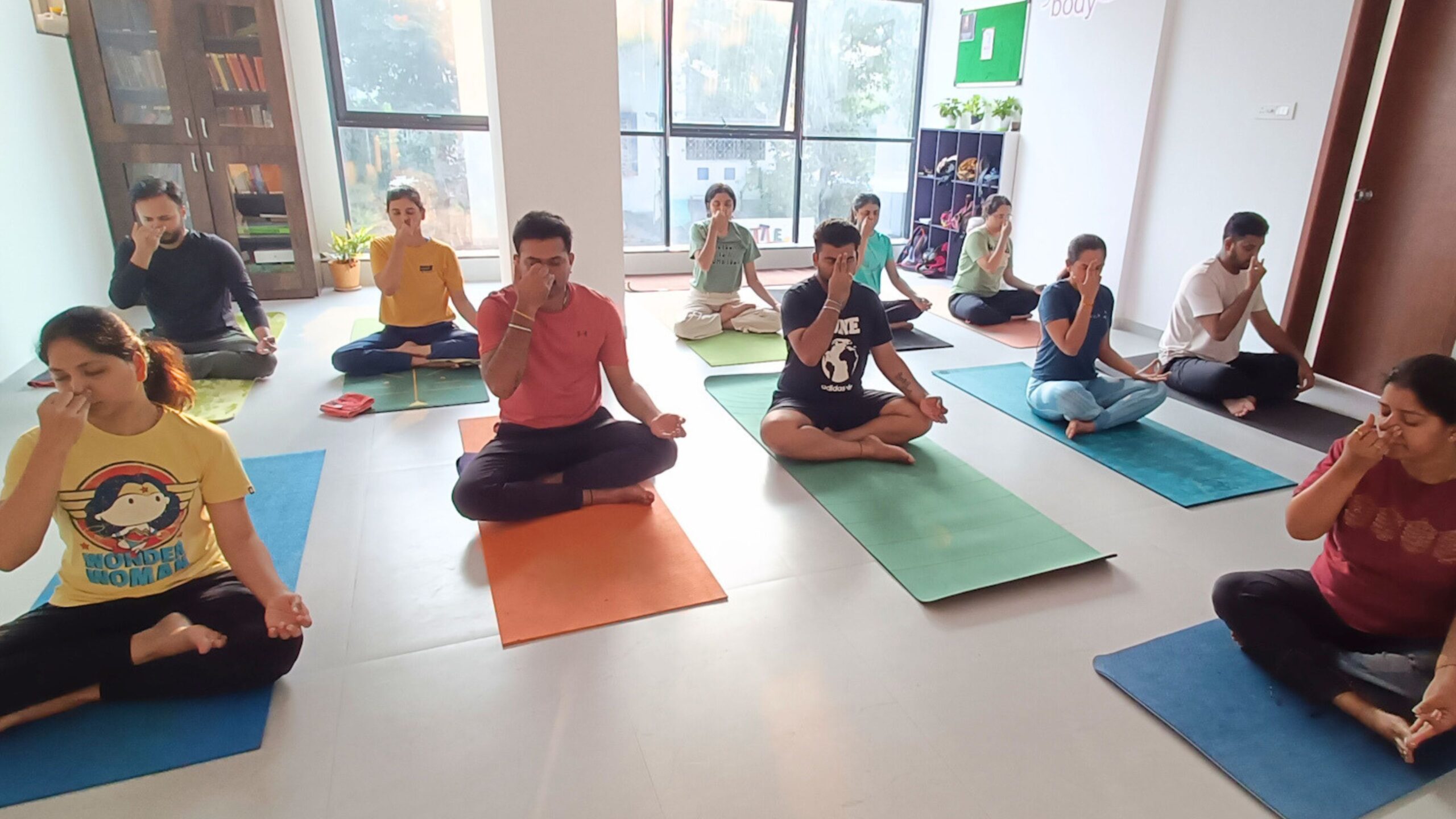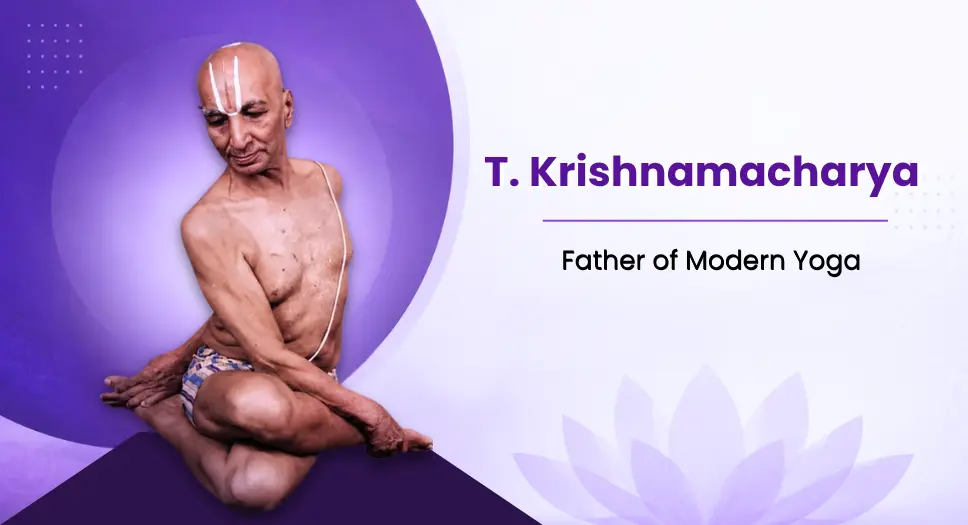
Yoga, as it is practiced across studios, wellness centers, and living rooms today, owes much of its shape to one extraordinary teacher from South India. T. Krishnamacharya transformed yoga into a living, adaptable system that could serve householders, students, and people with different physical and health needs. This is precisely why he is often remembered as the Father of Modern Yoga, a description that reflects his enormous influence on the development and transmission of modern yoga.
In this article, we will explore the life, philosophy, and lasting influence of this remarkable figure, understanding how one man’s vision helped reshape yoga practice for the modern era.
Who Was T. Krishnamacharya?
Born on November 18, 1888, in Muchukundapura in present-day Karnataka, India, Krishnamacharya was raised in a family with deep roots in Vedic scholarship. His family traced its lineage to the ninth-century teacher and sage Nathamuni, a connection that shaped his commitment to preserving and transmitting traditional knowledge.
From an early age, he displayed an unusual hunger for learning. He studied Sanskrit, logic, philosophy, Ayurveda, and yoga under a number of teachers and became highly accomplished in the Indian philosophical traditions.
Some key facts about his early life include:
- He was born into a Brahmin family with a strong tradition of Vedic study.
- He began studying philosophy, Sanskrit, and yoga with his father at a young age and later continued his education in Mysore and Banaras.
- Around 1916, according to accounts preserved in the Krishnamacharya tradition, he traveled to the Himalayas and spent approximately seven years studying under Sri Ramamohan Brahmachari.
- His education included Sanskrit, logic, grammar, philosophy, Ayurveda, and yoga.
- His family tradition traced its heritage to Nathamuni, an important figure in the Sri Vaishnava tradition.
This rigorous and wide-ranging education gave him a foundation unlike almost any other yoga teacher of his era, blending textual scholarship with practical experience.
A Brief Timeline of His Life and Work
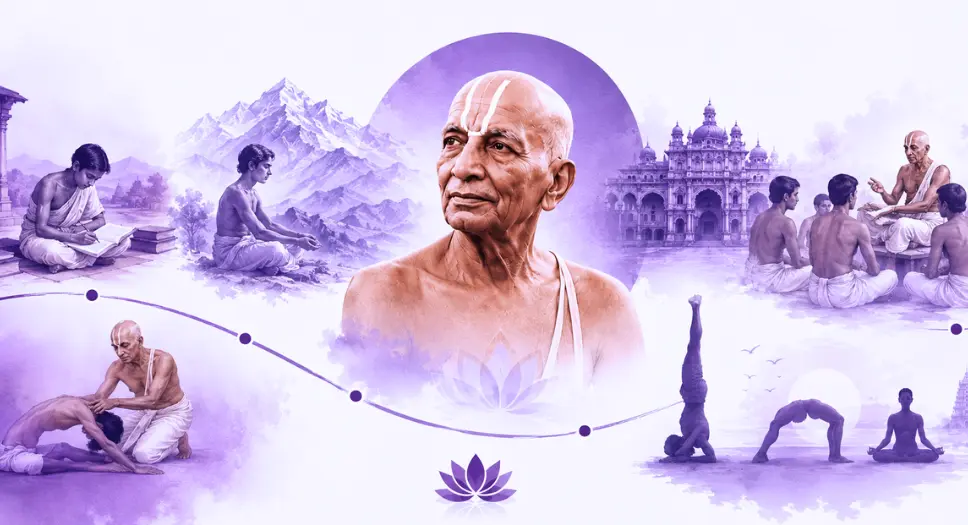
Understanding his journey chronologically helps illustrate just how much ground he covered across his long lifetime, which spanned nearly a century.
- 1888: Born in Muchukundapura, Karnataka, into a family devoted to Vedic scholarship and philosophy.
- Early 1900s: Pursued education in Sanskrit, logic, grammar, philosophy, and traditional Indian knowledge in Mysore and elsewhere.
- 1906: Studied Sanskrit, logic, and grammar in Banaras.
- 1916–1924: According to traditional biographical accounts, spent approximately seven years in the Himalayas studying under Sri Ramamohan Brahmachari.
- 1924: Returned to Mysore, married, and followed his teacher’s instruction to become a householder and teach yoga.
- 1931: Was invited to teach at the Sanskrit College in Mysore with the support of the Maharaja of Mysore.
- 1933: Established a yoga school, or Yogashala, in a wing of Jaganmohan Palace in Mysore, where he taught until the school eventually closed after the changing political circumstances surrounding Indian independence.
- 1930s–1940s: Trained students who would later become internationally recognized teachers, spreading different aspects of his teachings far beyond Mysore.
- 1950s onward: After moving to Madras (now Chennai), increasingly focused on individualized teaching and therapeutic applications of yoga.
- 1976: T.K.V. Desikachar, with support from colleagues including A.G. Mohan, established the Krishnamacharya Yoga Mandiram in Chennai, continuing and developing the therapeutic and individualized tradition associated with Krishnamacharya.
- 1989: Passed away at the age of 100, leaving behind a body of work and a teaching lineage that continues to influence yoga worldwide.
This timeline shows a life defined not by a single achievement but by decades of sustained study, teaching, and refinement, which is part of why his impact has proven so durable.
The Sage Behind the Title: Sri Tirumalai Krishnamacharya
Often addressed with reverence as Sri Tirumalai Krishnamacharya, he was not merely a yoga instructor in the modern sense. He was a scholar, Ayurvedic practitioner, and spiritual teacher who approached yoga as a broad discipline involving body, breath, mind, philosophy, and spiritual practice.
Tirumalai Krishnamacharya returned from his years of study determined to fulfill the instruction traditionally attributed to his teacher: to marry, raise a family, and teach yoga as a householder rather than retreating permanently into an ascetic life. This decision helped shape the way he taught yoga to people living ordinary household lives.
Building a Yoga Revolution at the Mysore Palace
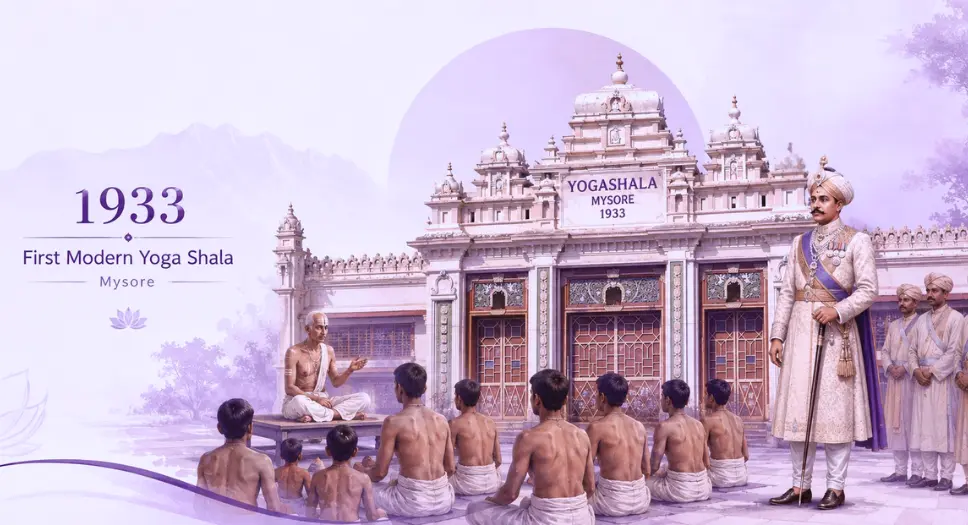
In the early 1930s, the Maharaja of Mysore, Krishna Raja Wadiyar IV, supported Krishnamacharya’s teaching work. In 1933, Krishnamacharya established a Yogashala in a wing of Jaganmohan Palace in Mysore. This became one of the most important periods in the development of his teaching and had a lasting impact on modern postural yoga.
At the Mysore school, several important developments took place:
- He taught sequences in which postures could be linked with movement and breathing, contributing significantly to the development of dynamic forms of modern yoga.
- His teaching incorporated elements of physical culture and traditional Indian practices, including approaches to strength, flexibility, and movement.
- He adapted practices according to the needs and abilities of individual students rather than treating one sequence as appropriate for everyone.
- Accounts of his demonstrations describe extraordinary control over his body, including demonstrations said to involve control of his heartbeat. These reports are part of his historical biography, although such demonstrations should not be presented as established medical facts.
The Mysore period produced some of the most influential yoga teachers of the twentieth century, several of whom later carried different interpretations of his teachings far beyond India.
The Students Who Carried His Legacy Worldwide
Perhaps the clearest evidence supporting his reputation as the Father of Modern Yoga lies in the extraordinary list of students he taught, many of whom became influential teachers in their own right.
Some of his most notable students include:
- K. Pattabhi Jois, who developed and popularized Ashtanga Vinyasa Yoga, a system that became highly influential in modern dynamic yoga.
- B.K.S. Iyengar, who developed Iyengar Yoga, known for its emphasis on precision, alignment, sequencing, and the use of props.
- Indra Devi, an important early female student who later helped introduce yoga to Western audiences, including through her work with Hollywood figures.
- T.K.V. Desikachar, his son, who continued and developed his father’s later individualized and therapeutic approach.
Each of these students absorbed different aspects of his vast teaching, and each went on to build distinct approaches to yoga. Despite their differences in style and emphasis, their connection to Krishnamacharya represents one of the most important teacher-student lineages in twentieth-century yoga.
A Philosophy Centered on the Individual
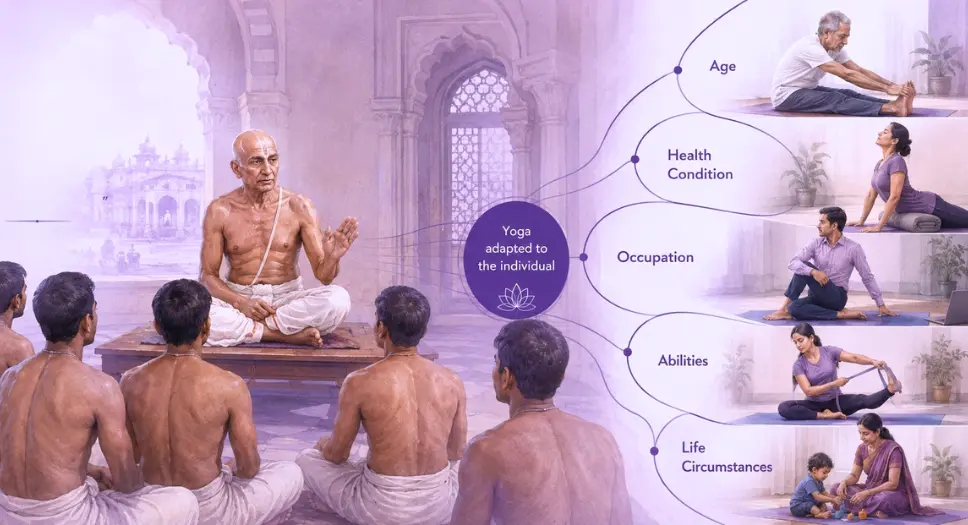
One of the most important aspects of his teaching philosophy was the belief that yoga should be adapted to the individual, not the other way around. Rather than insisting that every student conform to a rigid set of postures, he tailored practices based on a person’s age, health condition, occupation, abilities, and life circumstances.
This individualized approach included several core principles:
- Yoga should evolve according to a student’s changing needs across different stages of life.
- Breath, known as pranayama, plays an important role in coordinating movement and practice.
- Postures, or asanas, can be used as part of a broader approach to physical, mental, and therapeutic wellbeing rather than being treated simply as exercises.
- Teaching should take the individual student’s circumstances into account rather than assuming that one method is suitable for everyone.
This therapeutic orientation became especially prominent in Krishnamacharya’s later teaching and was further developed by students such as T.K.V. Desikachar. Modern yoga therapy has subsequently developed into a broader field, although its relationship with contemporary medical treatment should not be confused with medical care itself.
Why He Is Called the Father of Modern Yoga
The title Father of Modern Yoga is not an official historical title, but it is widely used to describe Krishnamacharya’s enormous influence on modern yoga. Academic scholarship specifically examines his role as a major figure in the development of modern, transnational yoga.
Here are the primary reasons he is so often associated with this title:
- He developed highly structured approaches to asana and movement in which postures could be linked with breath and movement, influencing later dynamic yoga traditions.
- He expanded the kinds of people who could receive yoga instruction, teaching householders, students, and people with different physical abilities rather than limiting yoga teaching to a narrow ascetic setting.
- He placed strong emphasis on individualized and therapeutic applications of yoga, particularly in his later teaching.
- He taught several influential twentieth-century yoga teachers, including B.K.S. Iyengar, K. Pattabhi Jois, Indra Devi, and T.K.V. Desikachar, whose subsequent work helped spread different forms of yoga internationally.
- He combined traditional textual knowledge with adaptation and experimentation, creating teaching methods that responded to the needs of his students and the changing cultural environment.
- He emphasized the relationship between asana, breath, concentration, and broader yogic practice, rather than treating yoga solely as physical exercise.
Taken together, these contributions explain why practitioners, historians, and yoga scholars continue to regard him as one of the central figures in the development of modern yoga.
The Global Ripple Effect
It is difficult to overstate how far his influence has traveled. Several major yoga traditions practiced today, including Ashtanga Vinyasa Yoga, Iyengar Yoga, and the individualized approach associated with Desikachar, have important connections to his teaching. His influence is particularly significant in the development of modern postural yoga.
Consider the following points that illustrate his lasting global impact:
- Modern yoga traditions continue to reflect the importance he placed on sequencing, breath, movement, and individual adaptation.
- Yoga therapy traditions associated with his later teaching emphasize adapting practices to individual needs.
- Breath-synchronized movement became an important feature of several modern yoga traditions influenced by his teaching.
- Scholars continue to study his writings, teaching methods, students, and historical context to better understand the development of contemporary yoga.
His work therefore represents an important bridge between traditional Indian yoga knowledge and several forms of modern yoga practice.
Lessons from His Life for Modern Practitioners
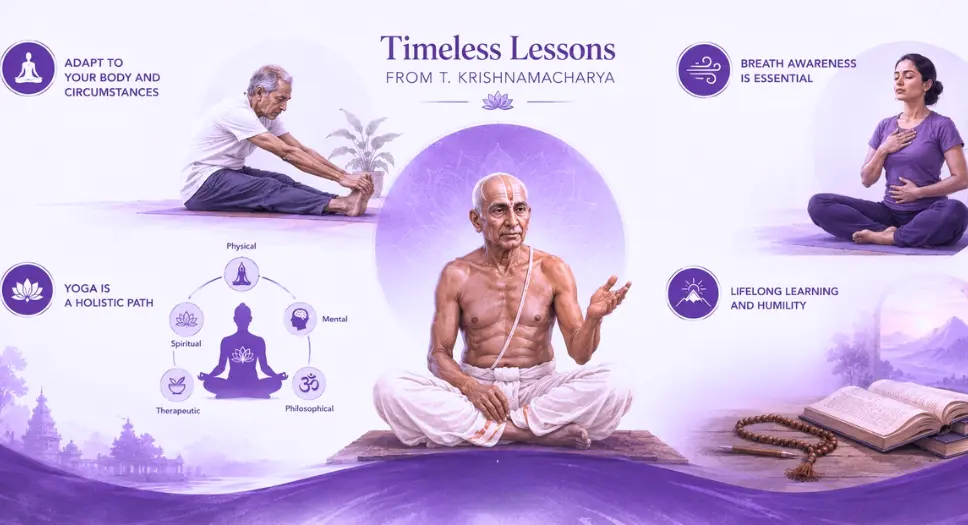
Beyond the historical facts, there is much that today’s yoga students and teachers can learn from his approach to practice and teaching.
A few enduring lessons stand out:
- Practice should be adapted to your body and circumstances rather than forced into a one-size-fits-all mold.
- Breath awareness is an important part of yoga practice, not merely an addition to physical postures.
- Yoga can be explored as a holistic discipline involving physical, mental, philosophical, and therapeutic dimensions.
- True mastery involves lifelong learning, humility, and a willingness to keep refining one’s understanding.
These principles remain relevant now as they were nearly a century ago, which is part of why his teachings continue to resonate so strongly.
Continuing the Tradition Through Structured Learning
Understanding the depth of this lineage naturally raises an important question for modern practitioners: how can one learn yoga in a way that honors this same spirit of individualized, therapeutic, and disciplined practice? This is where structured, traditional training becomes valuable.
At Hatha Yoga Institute, students are introduced to foundational practices rooted in principles such as breath-centered movement, therapeutic alignment, and a gradual, personalized progression through postures. Rather than treating yoga as a quick fitness trend, the institute encourages a deeper, more sustainable relationship with practice, one built on proper technique, patience, and long-term wellbeing. For anyone inspired by this history and eager to begin or deepen their own practice, exploring a course with a dedicated, tradition-informed institute like Hatha Yoga Institute can offer that kind of grounded foundation.
Frequently Asked Questions
1. Who was T. Krishnamacharya?
He was an Indian yoga teacher, scholar, and Ayurvedic practitioner who became one of the most influential figures in the development of modern yoga. His teaching in Mysore and later in Madras influenced several major teachers and traditions practiced around the world today.
2. Why is he called the Father of Modern Yoga?
He is often given this description because of his enormous influence on modern postural yoga, his individualized teaching approach, his development of breath-linked movement practices, his therapeutic work, and his role as teacher to figures such as B.K.S. Iyengar, K. Pattabhi Jois, Indra Devi, and T.K.V. Desikachar.
3. Who were his most famous students?
His best-known students include K. Pattabhi Jois, B.K.S. Iyengar, Indra Devi, and his son T.K.V. Desikachar. Each developed and popularized different approaches influenced by their studies with Krishnamacharya.
4. What made his teaching style unique?
Rather than teaching a single fixed method for everyone, he adapted practice according to the individual student’s circumstances and needs. He also emphasized the relationship between breath, movement, concentration, and broader yogic practice.
5. How can someone learn yoga in this tradition today?
Structured programs at dedicated yoga schools can provide a way to learn foundational, breath-centered, and therapeutically informed practices while developing an understanding of yoga’s broader philosophical and traditional context.
Conclusion
The story of this remarkable teacher is, in many ways, the story of an important chapter in yoga’s journey into the modern world. Through rigorous scholarship, experimentation, and a strong commitment to teaching, T. Krishnamacharya developed approaches that influenced generations of yoga teachers.
From the dynamic practices associated with Ashtanga Vinyasa Yoga to the precise approach developed by B.K.S. Iyengar, and from the individualized teachings of T.K.V. Desikachar to the wider international transmission of yoga, his influence is significant, even when his name goes unspoken.
This is why, when people ask who played a major role in shaping the yoga practiced around the world today, Krishnamacharya is one of the names that consistently emerges. His life’s work demonstrates how traditional knowledge can be interpreted, adapted, and transmitted across generations while remaining connected to its roots.
His legacy does not mean that every modern form of yoga comes directly from him. Rather, his importance lies in the extraordinary influence he had on several major branches of modern yoga and on teachers who helped carry those traditions across India and the world.