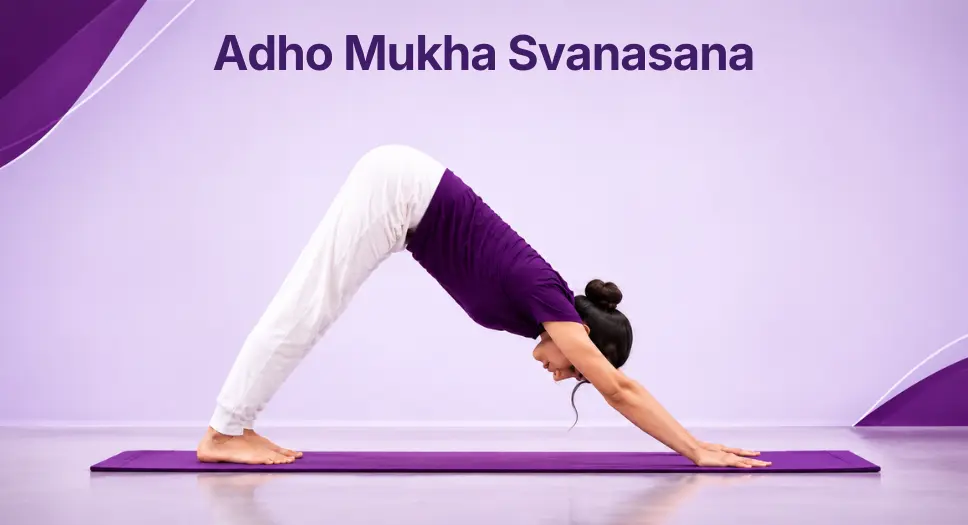
If you have ever stepped into a yoga class, you have almost certainly been guided into an inverted V shape, with your hips lifted high, your heels reaching toward the floor and your head hanging freely between your arms. That shape is adho mukha svanasana, known in English as the downward facing dog pose. It appears in nearly every modern style of yoga, from gentle Hatha classes to energetic Vinyasa flows, and it is often described as both a resting pose and a strengthening pose at the same time.
Despite how common it is, this posture is also one of the most misunderstood. Beginners often feel their wrists burning, their hamstrings complaining and their shoulders collapsing, and they wonder why teachers call it a “rest”. The truth is that the pose is simple in shape but rich in detail. Once you understand the alignment, the breath and the purpose behind it, it becomes one of the most useful postures in your practice.
In this guide, we will walk through the meaning of the pose, its surprisingly modern history, what research and tradition say about its benefits, a detailed step by step method, common mistakes, variations, safety tips and how it connects with its famous backbend counterpart, urdhva mukha svanasana. A list of sources is included at the end so you can verify the key points yourself.
What Is Adho Mukha Svanasana?
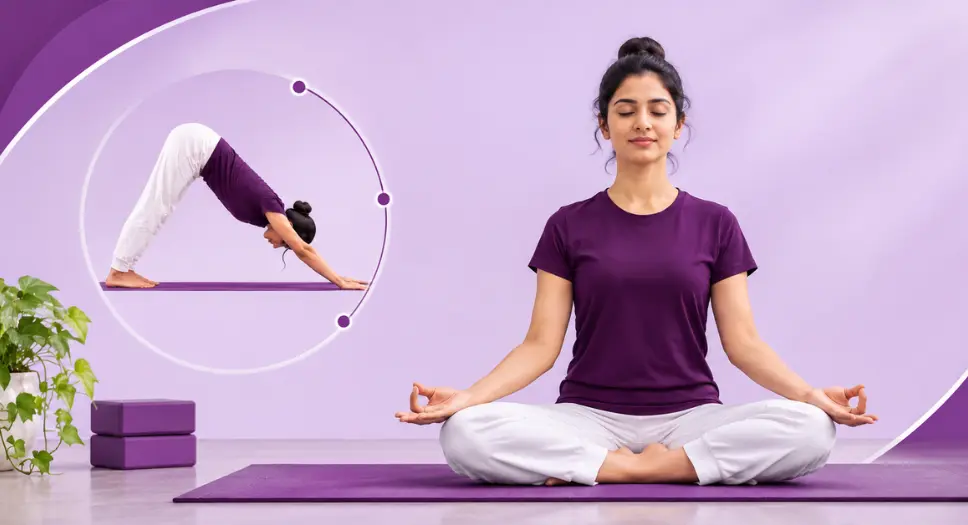
Adho mukha svanasana is a foundational yoga asana in which the body forms an upside down V. The hands and feet stay grounded, the hips rise toward the ceiling, and the spine lengthens from the tailbone to the crown of the head. It is usually classed as a mild inversion, because the head is lower than the hips and heart, but it is far gentler than a headstand or shoulder stand since the feet stay on the floor.
Many teachers call it simply downward dog pose in everyday conversation, and students often shorten it to “down dog”. Some people also search for it as adho mukha asana, but the complete traditional name includes the word svana (dog), so the full Sanskrit name is the form to use in writing and teaching. In the Bihar School of Yoga tradition, the same shape is called Parvatasana, or Mountain Pose, with the hands and feet placed slightly closer together.
The pose is both active and restorative. It is active because it asks your arms, shoulders, core and legs to work together. It is restorative for many experienced practitioners because, when practiced with care, it lets the spine lengthen and the breath slow down. For beginners, it can honestly feel like hard work, and that is completely normal.
Key Characteristics of the Pose
- The body forms an inverted V with a long spine
- The hands press firmly into the mat with spread fingers
- The hips lift up and back, away from the wrists
- The heels reach toward the floor, though they do not need to touch it
- The head hangs relaxed between the upper arms
- The breath stays steady and smooth through the nose
The Meaning Behind the Sanskrit Name
Sanskrit names in yoga usually describe the shape or feeling of a posture. Breaking the name into parts makes it much easier to remember.
- Adho (adhas) means down or downward
- Mukha means face
- Svana (shvana) means dog
- Asana means posture or seat
Put together, the name translates to “downward facing dog”. The name comes from the pose’s similarity to the way a dog stretches when getting up. Watch any dog after a nap and you will see it press its front paws forward, lift its hips and lengthen its back.
A Brief and Honest History of the Pose
Many people assume this posture is thousands of years old, but yoga scholarship paints a more interesting picture.
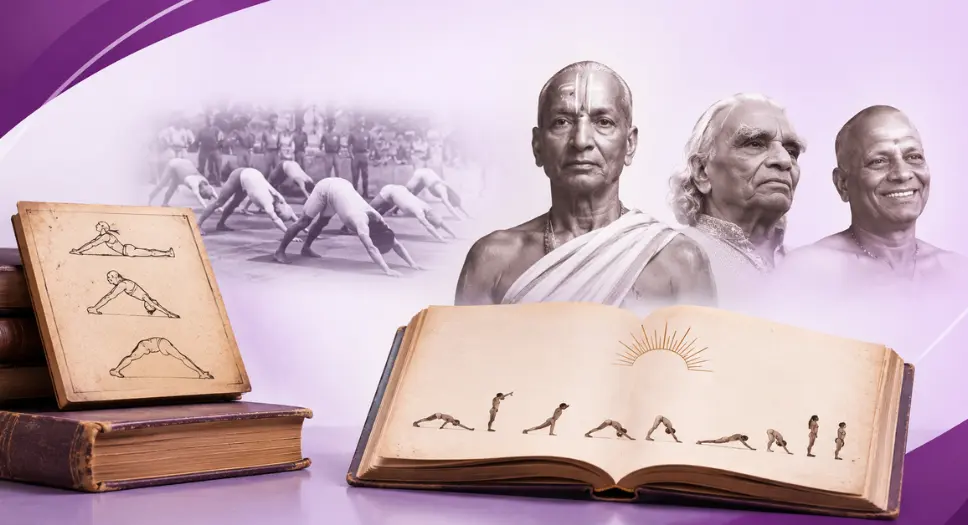
- Not in the medieval texts: The name does not appear in the medieval Hatha yoga texts. A similar movement, Gajasana (Elephant Pose), is described in the 18th century text Hathabhyasapaddhati, where it is repeated from a prone position.
- Gymnastics influence: Scholars such as Mark Singleton have pointed out that a similar pose and a system of jumping between poses appeared in the early 20th century Danish text Primary Gymnastics by Niels Bukh, which came from a 19th century Scandinavian gymnastics tradition that had reached India by the 1920s.
- Indian physical culture: Indian gymnastics also had a system of postures called dands, linked by jumps, and one of these is close to the pose we know today.
- Sun Salutation: In 1928, the Rajah of Aundh, Bhawanrao Pant Pratinidhi, popularized and described Surya Namaskar in his book The Ten-Point Way to Health. The pose appears twice in its sequence of twelve postures.
- Entering yoga: Swami Kuvalayananda included the pose in his system of exercises in the early 1930s, and his pupil Tirumalai Krishnamacharya took it up. Krishnamacharya in turn taught B.K.S. Iyengar and K. Pattabhi Jois, the founders of Iyengar Yoga and Ashtanga Yoga.
In other words, the posture is best understood as a modern yoga pose with roots in several older traditions of physical training, rather than a pose described in ancient scriptures. This does not make it less valuable. It simply reminds us that yoga has always evolved. As yoga spread worldwide, the downward facing dog pose became one of its most recognizable images, and Yoga Journal has described it as one of the most widely recognized poses in yoga.
What Are the Benefits of the Pose?
It is important to separate what is well supported from what is traditional or popular belief. Let us look at both.
Physical Benefits (Well Supported by Basic Anatomy)
- Stretches the back of the legs: The hamstrings and calf muscles lengthen as the heels reach down
- Builds shoulder strength: The shoulders, arms and upper back work to support your body weight
- Lengthens the spine: The hips lift away from the hands, creating a sense of traction along the back
- Stretches the shoulders and chest area: The overhead arm position opens the front of the shoulders and lengthens the lats
- Engages the core: Drawing the navel gently toward the spine helps stabilize the trunk
- Counters sitting: The posture is a useful reset after long hours at a desk
Mental Wellbeing (Supported by Research on Yoga in General)
The US National Center for Complementary and Integrative Health (NCCIH) reports that yoga as a whole may help with stress management and general wellness. It is important to note that these studies look at full yoga practices, not at this single pose alone. Still, a few slow breaths in this shape can feel calming and refreshing for many people.
Back Pain: What the Evidence Says
NCCIH summarizes that yoga may offer a small benefit for low back pain. A 2022 review of 21 studies found that yoga was slightly better than no exercise, although the difference may be small. The American College of Physicians has listed yoga among the non drug options for chronic low back pain. This does not mean the pose cures back pain, but it can be part of a sensible, gentle routine, ideally with guidance from a qualified teacher.
Traditional Claims to Treat with Care
You will find many websites claiming the pose treats high blood pressure, sinusitis, asthma, insomnia or osteoporosis, or that it increases circulation to the brain. Many of these claims trace back to twentieth century yoga teachers, including B.K.S. Iyengar, who described effects on specific organs without presenting scientific evidence. Treat such claims as traditional teaching, not medical fact, and never use a yoga pose in place of medical treatment.
Muscles Worked and Stretched
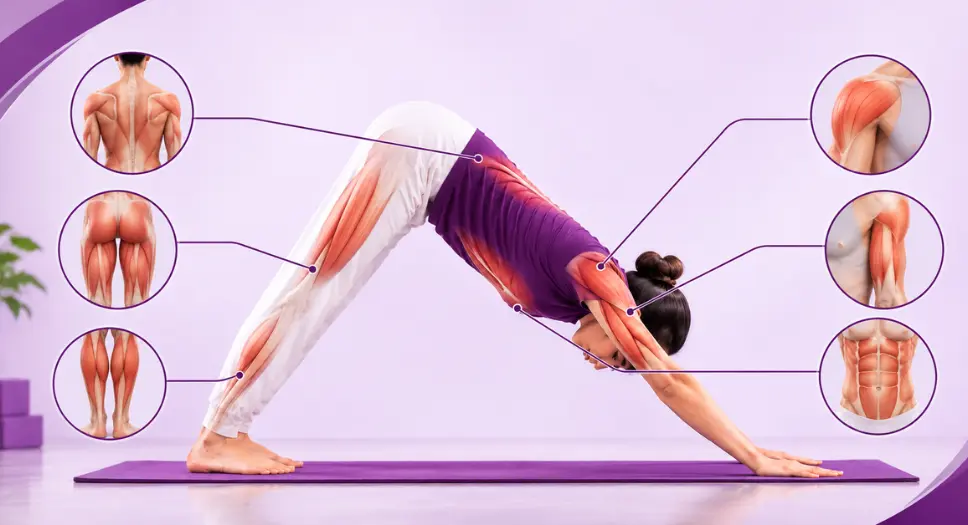
Understanding which muscles are involved helps you feel the pose more intelligently.
Muscles Commonly Described as Stretching
- Hamstrings
- Calves and Achilles tendon
- Latissimus dorsi
- Muscles along the spine
- Soles and arches of the feet
Muscles Commonly Described as Working
- Deltoids and rotator cuff muscles
- Triceps
- Serratus anterior and lower trapezius
- Quadriceps
- Abdominal muscles
How to Practice Adho Mukha Svanasana Step by Step
Learning the pose in clear stages helps you build good habits from the beginning. Move slowly and breathe naturally.
- Begin on all fours. Place your hands under your shoulders and your knees under your hips. Spread your fingers wide, with the index fingers pointing forward.
- Set your hands. Press firmly through the whole palm, especially the base of the index finger and thumb, to share the weight across the hand.
- Tuck your toes. Curl your toes under so the balls of your feet are on the mat.
- Exhale and lift. Press into your hands and raise your knees off the floor. Keep them softly bent at first.
- Send your hips up and back. Imagine your tailbone drawing toward the ceiling while your spine lengthens.
- Lengthen your arms. Straighten your elbows without locking them, and keep the shoulders moving away from the ears.
- Reach your heels down. Move them toward the mat, but do not worry if they stay lifted. Bend your knees if your hamstrings feel tight.
- Relax your neck. Let your head hang between your upper arms with your gaze toward your navel or thighs.
- Breathe. Stay for five breaths or longer, lengthening the spine a little more with each inhale.
- Release. Exhale, bend your knees and lower to all fours, or rest in Child’s Pose.
Alignment Cues That Make a Difference
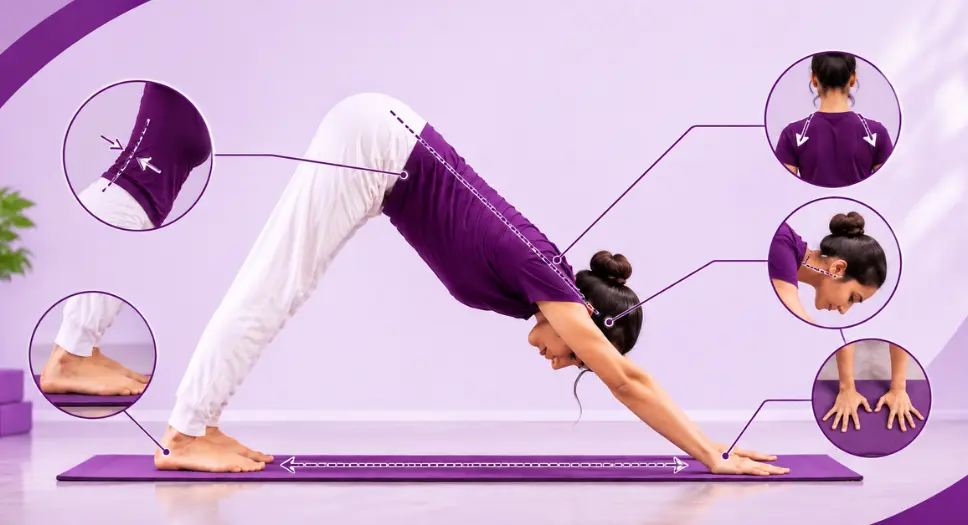
Small adjustments can transform the pose from uncomfortable to satisfying.
- Hands: Roughly shoulder width apart, fingers spread, weight pressed evenly into the palms
- Feet: About hip width apart and parallel
- Spine: Long and straight, not rounded, even if that means bending the knees
- Shoulders: Moving away from the ears with the upper arms rotating slightly outward
- Ribs: Drawn gently in so the lower back does not sag
- Neck: Neutral and relaxed
- Distance: Many teachers suggest a hand to foot distance similar to that of a plank pose
A useful mental picture is a long diagonal line running from your wrists through your arms and spine to your hips.
Common Mistakes and How to Fix Them
- Rounding the back: Usually caused by tight hamstrings. Bend your knees generously and prioritize a long spine.
- Collapsing into the shoulders: Press the floor away and widen across the shoulder blades.
- Too much weight on the hands: Shift weight back toward the legs and press through the whole hand.
- Locking the knees and elbows: Keep a micro bend to protect the joints.
- Letting the head dangle heavily: Relax the neck without dropping weight into it.
- Forcing the heels down: Flexibility varies, so allow the heels to float if needed.
- Holding the breath: Keep a smooth inhale and a slightly longer exhale.
Modifications and Props for Every Body
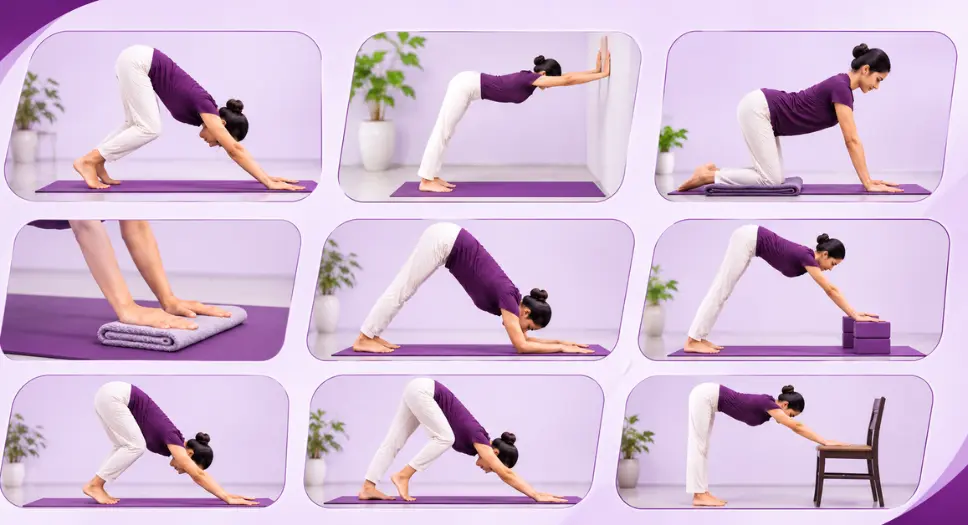
Yoga adapts to you, not the other way around.
For Beginners
- Keep the knees bent and the heels lifted
- Try a wall version with the hands on the wall and the torso parallel to the floor
- Use a folded blanket under the knees when coming up from all fours
For Tight Wrists
- Place a folded towel or wedge under the heels of the hands, or hold a rolled towel beneath the palms
- Practice Dolphin Pose with the forearms on the floor
- Use yoga blocks under the hands
For Tight Hamstrings
- Bend the knees as much as needed
- Pedal the feet by bending one knee at a time
- Practice with the hands on a chair seat, with the back horizontal
Other Supports
- A rolled mat under the heels can support the feet
- A bolster or block under the forehead can support the head
- A strap around the hips anchored to a wall can reduce effort in the shoulders
Popular Variations to Explore
The pose has no formally named variations in classical texts, but teachers use many helpful ones.
- Single leg version: One leg lifts toward the ceiling, often called Eka Pada Adho Mukha Svanasana
- Dolphin Pose: The forearms replace the hands, shifting focus to the shoulders
- Twisting version: One hand reaches back toward the opposite ankle
- Pedaling: Bending one knee and then the other to warm up the calves and hamstrings
- Wall version: Hands on a wall, ideal for desk workers and for easing pressure on the wrists
Understanding the Counterpart: Urdhva Mukha Svanasana
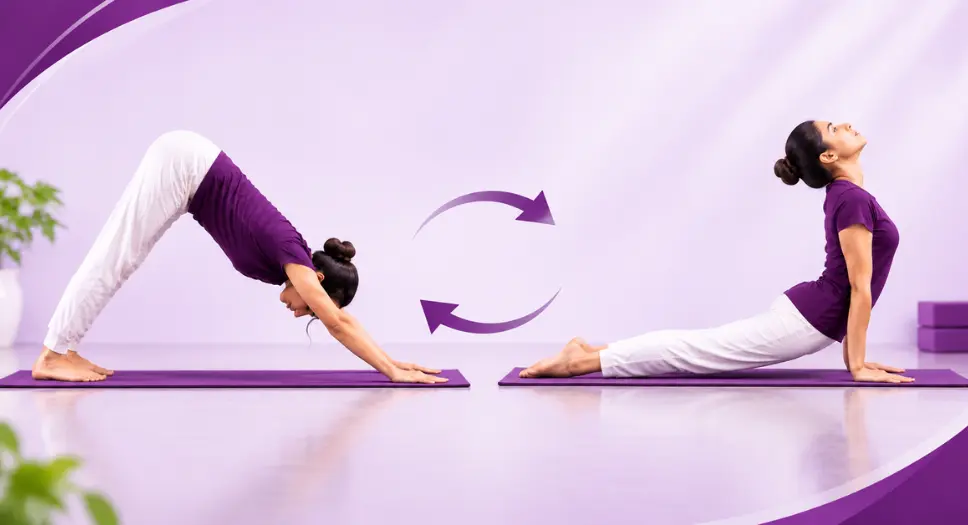
No discussion of this posture is complete without its partner, urdhva mukha svanasana, known as Upward Facing Dog. The two are often paired in Sun Salutations. Like the downward version, this pose is credited to the modern era, having entered the yoga world from Surya Namaskar through Krishnamacharya and his students.
Where adho mukha svanasana is a mild inversion that lengthens the back of the body, urdhva mukha svanasana is a backbend that opens the front body. The legs are stretched out straight, the tops of the feet press into the floor rather than the toes being tucked, and the body is supported on the hands and feet, so that the hips, thighs and knees lift off the ground. The gaze is directed upward and the neck and back are arched.
Key Differences at a Glance
- Shape: One is an inverted V, the other is a backbend with the chest lifted
- Spinal action: The first lengthens the spine, the second extends it
- Feet: Toes tucked in the downward version, tops of the feet down in the upward version
- Primary stretch: Back of the body versus front of the body
- Sequence order: In Ashtanga Sun Salutation A, the upward pose comes before the downward pose, while in the Iyengar sequence the downward pose comes first. Order varies by tradition.
A Gentler Alternative
If your wrists or lower back feel strained in the upward version, Cobra Pose (Bhujangasana) is a common substitute. In Cobra, the legs remain on the ground, whereas in urdhva mukha svanasana the hips, thighs and knees are lifted. Many teachers suggest building comfort in Cobra first.
Breathing and Gaze in the Pose
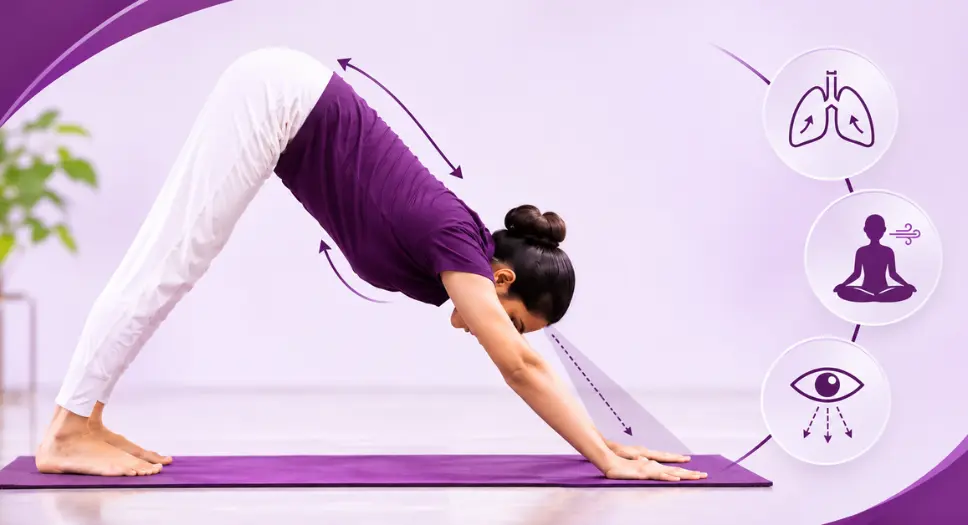
Many classes pair this posture with Ujjayi breathing, a gentle narrowing at the back of the throat that makes an ocean like sound. It is optional, so use whatever steady nasal breath keeps you calm.
- Inhale: Lengthen through the spine
- Exhale: Draw the navel gently in and press the floor away
- Pace: Slow and even
- Gaze (drishti): Toward the navel or thighs, which keeps the neck relaxed
If your breath becomes short or strained, soften the pose by bending your knees or stepping out of it for a moment.
Safety: Who Should Be Careful
The posture is accessible to many people, but a few conditions call for care. Always consult a healthcare provider if you are unsure.
- Wrist problems: Carpal tunnel syndrome and wrist injuries are commonly listed cautions. Use props or choose Dolphin Pose.
- Glaucoma and eye conditions: A 2015 pilot study in PLOS ONE measured eye pressure in 10 people with glaucoma and 10 without. Eye pressure rose in both groups during four head down poses, and the largest increase happened in this pose. The researchers said the long term importance is unknown, and one author noted there is no indication that holding the pose for two minutes a day would cause glaucoma in healthy people. People with glaucoma should speak with their eye doctor before practicing.
- High blood pressure: Sources differ. Some modern guides advise avoiding the pose if blood pressure is uncontrolled, while some traditional sources suggest supporting the head on a block or bolster. Check with your doctor.
- Headaches or migraines: Many teachers recommend a supported version or skipping the pose on days when you have a headache.
- Shoulder, neck or ankle injuries: Modify or avoid the pose until cleared by a professional.
- Pregnancy: Popular sources have sometimes advised against it, but a 2015 study of healthy women between 35 and 37 weeks pregnant found no acute adverse effects from 26 yoga poses, including this one. This was a small study, so every pregnancy should be discussed with a doctor, and a prenatal yoga teacher can suggest suitable modifications.
Preparatory Poses and Counter Poses
Good Preparation
- Cat and Cow Pose for spinal mobility
- Table Top with gentle wrist circles
- Standing forward fold with bent knees
- Plank Pose for shoulder strength
Good Follow Up Poses
- Child’s Pose to rest
- Standing forward fold to release the legs
- Cobra or urdhva mukha svanasana to open the chest
- Low lunge to stretch the hips
A Simple Sequence to Practice
Hold each posture for three to five breaths unless noted otherwise.
- Mountain Pose to center yourself
- Standing forward fold with soft knees
- Step back to Plank Pose
- Lower to the floor and lift into Cobra
- Press back to the downward dog pose and hold for five breaths
- Pedal the feet by bending each knee in turn
- Step forward to a forward fold
- Rise slowly to Mountain Pose
Repeat three to five times, noticing how the pose feels a little more open with every round.
How Long and How Often?
There is no single official prescription. Many instructional sources suggest holding the pose for about 30 to 60 seconds as a beginner and for one to three minutes as an experienced practitioner, but five breaths is a perfectly good starting point. Consistent short practice is generally more helpful than occasional long holds. Always warm up first and never force the stretch.
Frequently Asked Questions

1. Is the pose good for beginners?
Yes, with modifications. Bent knees and lifted heels make it accessible, and a long spine matters more than straight legs.
2. Why do my wrists hurt?
Wrist discomfort often comes from uneven weight distribution or limited wrist mobility. Spread your fingers, press through the whole hand and try a wedge, a folded towel or Dolphin Pose.
3. Should my heels touch the floor?
No. Heels reaching toward the floor is a direction, not a requirement.
4. Can this pose help with back pain?
Yoga in general may give a small benefit for low back pain, but persistent or severe pain should be evaluated by a medical professional.
5. Is it the same as the other dog pose?
No. The upward version is a backbend, while the downward version is a mild inversion. They complement each other.
6. Is this an ancient pose?
Not in this exact form. It is best described as a modern yoga pose with roots in several traditions of physical training, as explained in the history section above.
Learn and Practice with Hatha Yoga Institute
Reading about yoga is a good start, but nothing replaces the guidance of an experienced teacher who can see your alignment and offer personal adjustments. If you would like to learn postures, breathing and relaxation in a structured setting, consider exploring Hatha Yoga Institute, based in Baner, Pune. Founded in 2019 by Himanshu Raj and Aanchal Raj, the institute offers online and offline programs rooted in traditional Hatha yoga.
According to its website, you can choose from:
- Hatha Vinyasa yoga classes that include asanas, pranayama, mudras and bandhas
- Yoga teacher training courses, including 200 hour and 300 hour programs, a diploma course and a residential option
- Specialized certificate courses such as Pregnancy Yoga Teacher Training, Mudra Yoga and Pranayama and Meditation
- Workshops and a holistic yoga retreat
The institute states that it is a registered 200 hour and 300 hour yoga school with Yoga Alliance, USA. If you are curious, visit https://hathayogainstitute.com/ to explore the programs and request details, and ask a teacher there to help you adapt this pose to your own body.
Final Thoughts
Adho mukha svanasana may look simple, but it combines stretch, strength and breath awareness in a single shape. Whether you are lifting into it for the first time or returning after years of practice, the downward facing dog pose meets you where you are. Bend your knees, breathe deeply, and let go of the idea that it must look a certain way. Pair it with its energizing partner, urdhva mukha svanasana, and you have a balanced foundation for countless sequences.
So roll out your mat, press into your hands, lift your hips and take a long, slow breath. Your downward dog pose is waiting.
Sources and Further Reading
- Mallinson, J. and Singleton, M. (2017), Roots of Yoga, Penguin Books, and Singleton, M. (2010), Yoga Body: The Origins of Modern Posture Practice, Oxford University Press
- Polis, R.L., Gussman, D. and Kuo, Y.H. (2015), “Yoga in Pregnancy”, Obstetrics & Gynecology, 126(6): 1237 to 1241. PubMed ID 26551176
- Jasien, J.V., Jonas, J.B., De Moraes, C.G. and Ritch, R. (2015), “Intraocular Pressure Rise in Subjects with and without Glaucoma during Four Common Yoga Positions”, PLOS ONE. See also coverage in EyeWorld, September 2016: https://digital.eyeworld.org/i/722331/99
- National Center for Complementary and Integrative Health (NCCIH), “Yoga: Effectiveness and Safety”: https://www.nccih.nih.gov/health/yoga-effectiveness-and-safety