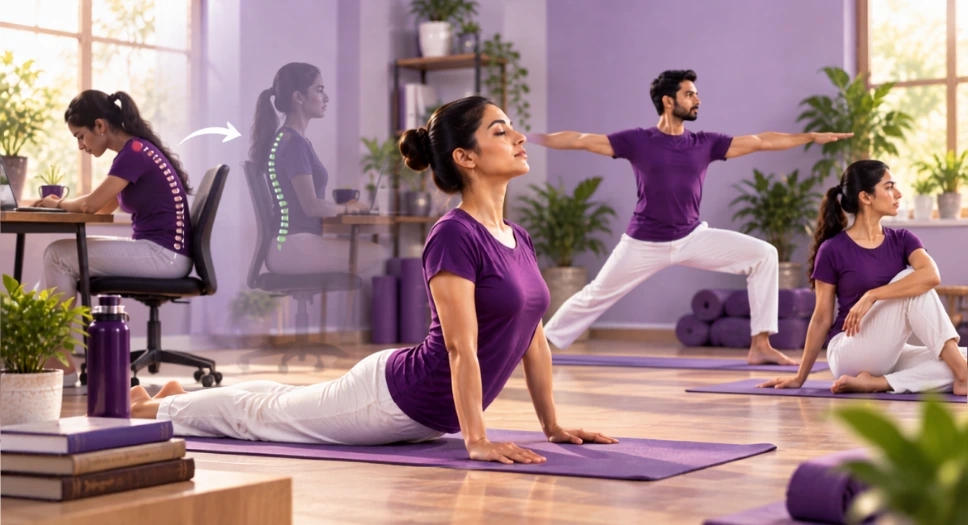
If your day looks like waking up, sitting at a desk for eight-plus hours, driving or commuting while seated, and then collapsing onto the couch in the evening, your body is sending you signals you may be ignoring. Rounded shoulders, a stiff neck, a dull ache in the lower back, and that “text neck” forward head tilt are not just cosmetic issues. They are the direct result of prolonged sitting, and over time they reshape the way your spine holds itself, even when you are standing up.
The good news is that you do not need hours of practice or advanced flexibility to reverse this pattern. A short, consistent yoga routine using a handful of basic yoga poses can retrain your muscles, open up compressed areas, and gradually restore a more natural alignment. This guide walks through practical, easy-to-follow yoga poses for posture, including options you can do right at your desk, poses that specifically target a stiff low back, and stretches for the neck and shoulders that carry so much of our daily tension.
Why Sitting All Day Wrecks Your Posture
Before jumping into the poses, it helps to understand what actually happens to your body when you sit for extended periods.
- Hip flexors shorten and tighten, which tilts the pelvis forward and increases the curve in the lower back.
- Hamstrings stiffen, limiting your ability to hinge properly at the hips when standing or bending.
- Chest and shoulder muscles shorten, pulling the shoulders forward and rounding the upper back.
- Upper back and neck muscles weaken and overstretch, straining to hold the head up against gravity, especially when looking down at screens.
- Core muscles disengage, since a chair with back support does the stabilizing work your abdominal and back muscles should be doing.
The result is a slouched, forward-leaning posture that becomes the body’s new “normal” resting position. This is exactly why practicing yoga for posture works so well. Yoga does not just stretch tight areas, it also strengthens the weak, underused muscles that are supposed to hold you upright. That combination of releasing tension and building strength is what makes lasting postural change possible.
Getting Started: A Few Ground Rules
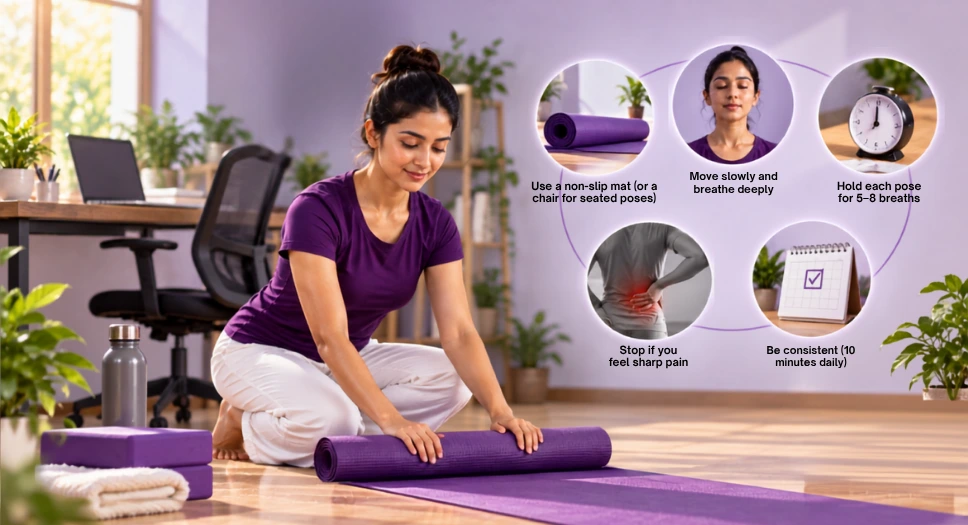
You do not need a yoga studio, special equipment, or years of practice to benefit from this routine. A few simple guidelines will help you get the most out of it:
- Practice on a non-slip mat or a carpeted floor if you are working on the ground, or simply use your office chair for the seated variations.
- Move slowly and breathe deeply through your nose during each pose. Breath is what separates yoga stretching from ordinary stretching.
- Hold each pose for at least five to eight slow breaths unless otherwise noted.
- Stop if you feel sharp pain. Mild stretching sensation is normal; sharp or shooting pain is not.
- Consistency matters more than intensity. Ten minutes daily will do more for your posture than an occasional one-hour session.
With that foundation, let’s get into the actual poses.
Basic Yoga Poses to Build a Postural Foundation
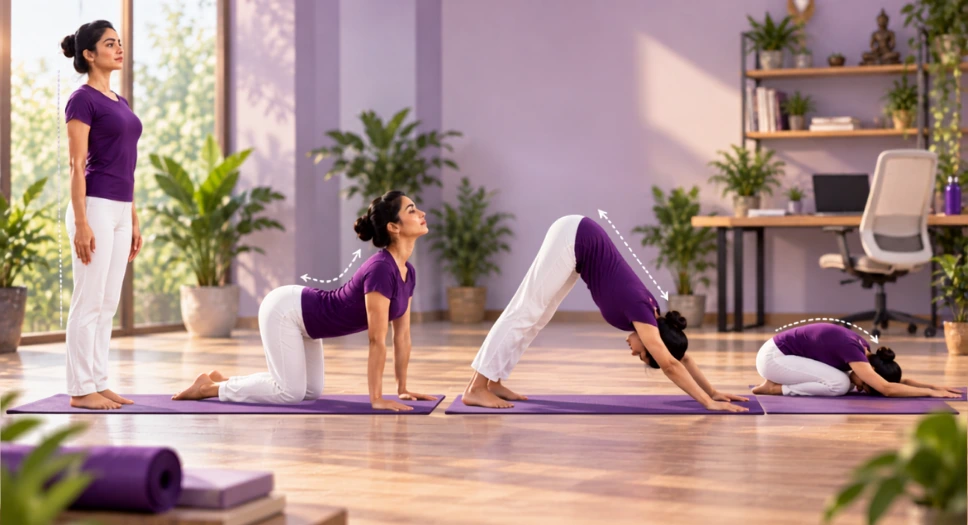
These basic yoga poses form the backbone of any posture-focused practice. They are beginner-friendly, require no prior yoga experience, and directly target the muscle groups affected by prolonged sitting.
1. Mountain Pose (Tadasana)
This may look like simply standing still, but Mountain Pose is where postural awareness begins. Stand with feet hip-width apart, weight evenly distributed across both feet, knees soft, and spine tall. Draw your shoulder blades gently down and back, lengthen the crown of your head toward the ceiling, and let your arms rest naturally at your sides.
- Practice this pose for one to two minutes daily to build body awareness.
- Use it as a “reset” pose whenever you catch yourself slouching during the day.
2. Cat-Cow Stretch (Marjaryasana-Bitilasana)
This gentle, flowing movement mobilizes the entire spine and is one of the most effective basic yoga poses for people who spend hours in a fixed seated position.
- Start on hands and knees, wrists under shoulders and knees under hips.
- Inhale, drop the belly, lift the chest and tailbone (Cow Pose).
- Exhale, round the spine, tuck the chin and tailbone (Cat Pose).
- Repeat for 8 to 10 slow rounds, moving with your breath.
3. Downward-Facing Dog (Adho Mukha Svanasana)
This full-body stretch lengthens the hamstrings, decompresses the spine, and strengthens the shoulders and arms, counteracting the rounded, compressed posture caused by sitting.
- From hands and knees, tuck your toes and lift your hips up and back, forming an inverted V-shape.
- Keep a slight bend in the knees if your hamstrings are tight.
- Press firmly through your hands, and let your head hang relaxed between your arms.
4. Child’s Pose (Balasana)
A restful, grounding pose that gently stretches the lower back and hips while calming the nervous system after a long day of sitting tension.
- Kneel on the mat, sit back onto your heels, and fold forward, extending your arms in front of you or resting them alongside your body.
- Hold for one to two minutes, breathing deeply into your back body.
Tirumalai Krishnamacharya returned from his years of study determined to fulfill the instruction traditionally attributed to his teacher: to marry, raise a family, and teach yoga as a householder rather than retreating permanently into an ascetic life. This decision helped shape the way he taught yoga to people living ordinary household lives.
Yoga Poses for Posture: Targeting the Upper Body
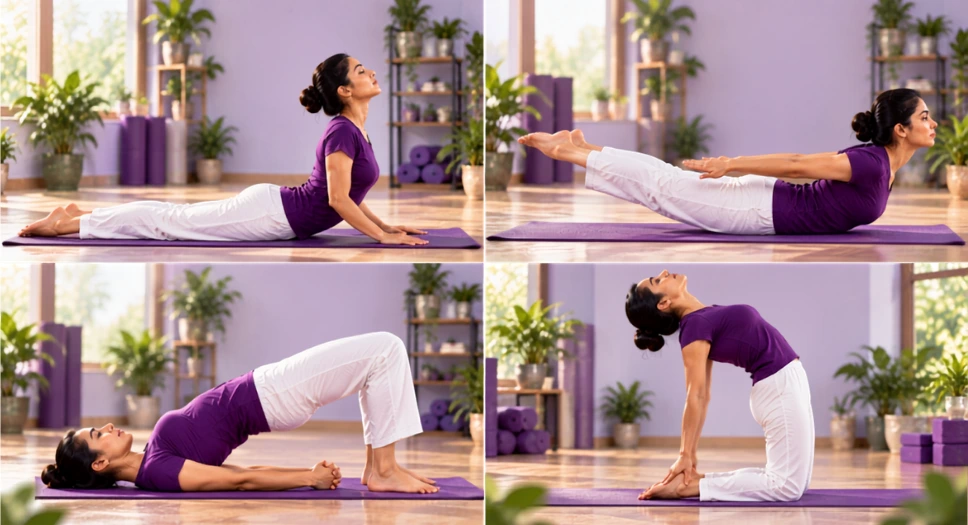
While the basic poses above build a strong foundation, these next poses focus more specifically on improving posture with yoga by opening the chest and strengthening the upper back muscles that keep the shoulders in proper alignment.
1. Cobra Pose (Bhujangasana)
Cobra Pose strengthens the muscles along the spine and opens the chest, directly counteracting the forward-rounded posture common among desk workers.
- Lie on your stomach, hands placed under your shoulders.
- Press through your palms to lift your chest, keeping elbows slightly bent and shoulders away from your ears.
- Engage your lower back and glutes gently, hold for five breaths, then release.
2. Locust Pose (Salabhasana)
This pose strengthens the entire posterior chain, including the muscles between the shoulder blades that are often weak and overstretched from sitting.
- Lie face down, arms alongside your body, palms facing down.
- Simultaneously lift your chest, arms, and legs off the floor.
- Squeeze your shoulder blades together and hold for a few breaths before lowering down.
3. Bridge Pose (Setu Bandhasana)
Bridge Pose stretches the hip flexors, which tighten from sitting, while also strengthening the glutes and lower back muscles that support upright posture.
- Lie on your back, knees bent, feet flat on the floor hip-width apart.
- Press into your feet and lift your hips toward the ceiling.
- Interlace your fingers beneath your hips for a deeper chest opening, or keep arms flat on the floor.
4. Camel Pose (Ustrasana)
For those with particularly tight, rounded shoulders, Camel Pose provides one of the deepest chest and shoulder openers available in a basic yoga sequence.
- Kneel with knees hip-width apart, tuck your toes under for support if needed.
- Place your hands on your lower back, fingers pointing down, and gently arch backward, opening the chest toward the ceiling.
- Only reach for your heels if it feels comfortable; otherwise, staying upright with hands on the back is enough.
Chair Yoga Poses: Posture Support Right at Your Desk
Not everyone has time to unroll a mat during the workday, which is why chair yoga poses are such a valuable tool for anyone stuck at a desk for long stretches. These can be done in work clothes, in a regular office chair, and often without anyone even noticing.
- Seated Spinal Twist: Sit tall, place one hand on the opposite knee and the other hand behind you on the chair, and gently twist your torso, looking over your shoulder. Hold for five breaths, then switch sides. This relieves stiffness that builds up from sitting still for hours.
- Seated Cat-Cow: Place your hands on your knees, inhale to arch your back and lift your chest, exhale to round your spine and tuck your chin. This mobilizes the spine without needing to get on the floor.
- Seated Forward Fold: Sitting at the edge of your chair, fold forward over your knees, letting your arms and head hang loose. This releases tension in the lower back and gives your spine a brief break from holding you upright.
- Eagle Arms: Cross one arm over the other in front of you, bending at the elbows and bringing palms together if possible. This stretches the upper back and shoulder area, an area that becomes chronically tight from rounded, forward-hunched sitting.
- Seated Chest Opener: Interlace your hands behind the back of your chair, gently press your chest forward and open your shoulders. This directly counters the forward-rolled shoulder posture caused by typing and screen use.
Doing even two or three of these chair yoga poses every hour can significantly reduce the cumulative postural strain of an eight-hour workday.
Yoga Poses for Lower Back Pain
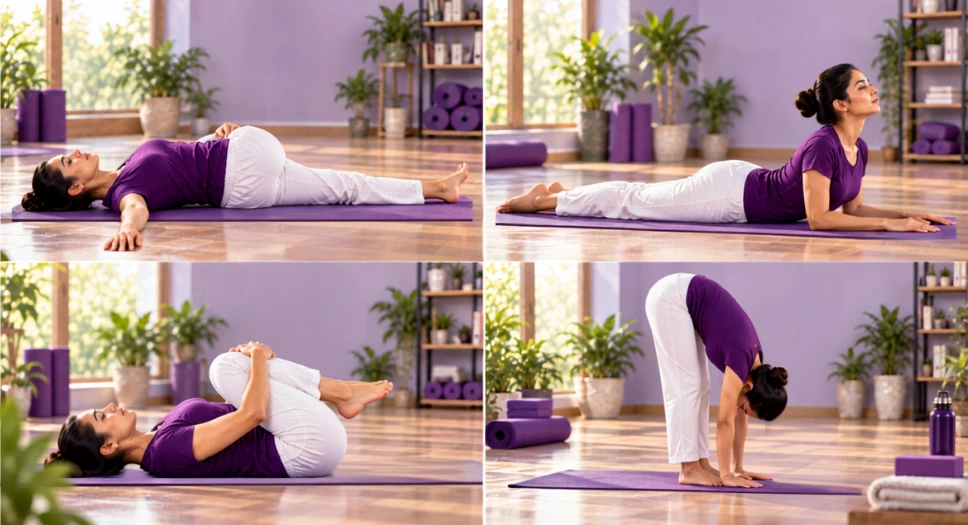
Lower back pain is one of the most common complaints among people with sedentary jobs, largely because sitting compresses the lumbar spine and weakens the muscles meant to support it. These yoga poses for lower back pain are gentle enough for daily practice while still being effective.
1. Reclined Twist (Supta Matsyendrasana)
- Lie on your back, hug one knee into your chest, then guide it across your body to the opposite side while keeping shoulders flat on the floor.
- This decompresses the lower spine and releases the tightness that builds up along the sides of the lower back.
2. Sphinx Pose
- Lie on your stomach and prop yourself up on your forearms, elbows under shoulders.
- This is a gentler alternative to Cobra Pose and is excellent for those with more sensitive lower backs, as it builds strength without excessive compression.
3. Knees-to-Chest Pose (Apanasana)
- Lie on your back and hug both knees into your chest, rocking gently side to side if it feels good.
- This is one of the simplest and most immediately relieving yoga poses for lower back pain, releasing tension along the entire lumbar region.
4. Standing Forward Fold (Uttanasana)
- Stand with feet hip-width apart, hinge forward from the hips, letting your head and arms hang.
- Bend your knees generously if your hamstrings are tight, since tight hamstrings often contribute to lower back strain.
Yoga for Neck Pain and Yoga for Neck and Shoulder Pain
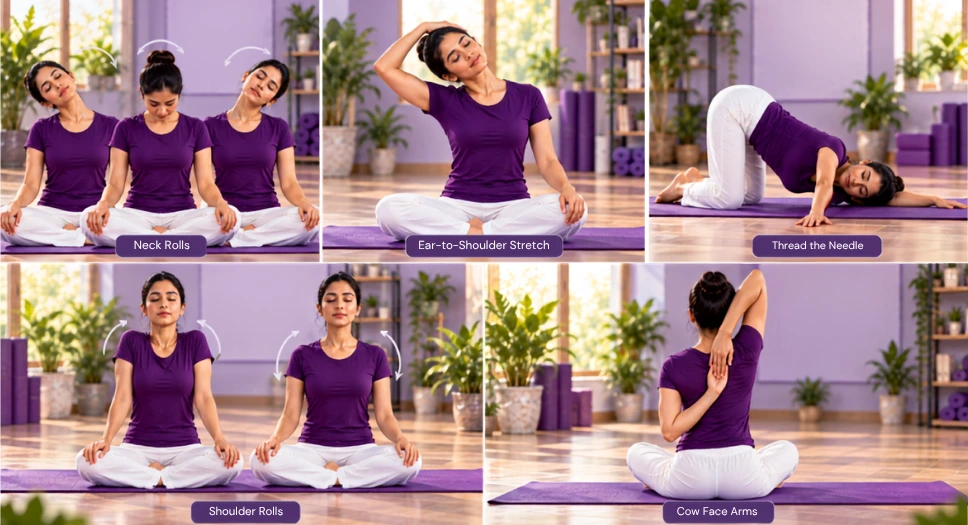
Few areas suffer more from desk work than the neck and shoulders. Hours of looking at a screen, especially with a forward head position, place enormous strain on the cervical spine. These poses target yoga for neck pain and yoga for neck and shoulder pain specifically.
- Neck Rolls: Slowly drop your ear toward one shoulder, roll your chin down toward your chest, then continue to the other shoulder. Move slowly and avoid rolling the neck all the way back, which can strain the cervical spine.
- Ear-to-Shoulder Stretch: Sit tall, drop your right ear toward your right shoulder, and gently place your right hand over your head for added stretch. Hold for five breaths, then switch sides.
- Thread the Needle: From hands and knees, slide one arm underneath your body, resting your shoulder and head on the mat. This deeply stretches the upper back and shoulder area where tension often accumulates.
- Shoulder Rolls: Roll your shoulders up, back, and down in a slow, deliberate circle. This is a simple but effective way to release built-up tension during work breaks.
- Cow Face Arms (Gomukhasana Arms): Reach one arm up and bend it behind your head, and reach the other arm behind your back to try to clasp hands, or use a strap or towel if your hands do not meet. This is one of the most effective yoga for neck and shoulder pain stretches for people who spend long hours typing or looking down at a phone.
Practicing these stretches two to three times throughout the workday, even for just a couple of minutes each session, can meaningfully reduce the tension headaches and stiffness that come from sedentary screen time.
Building a Simple Daily Routine
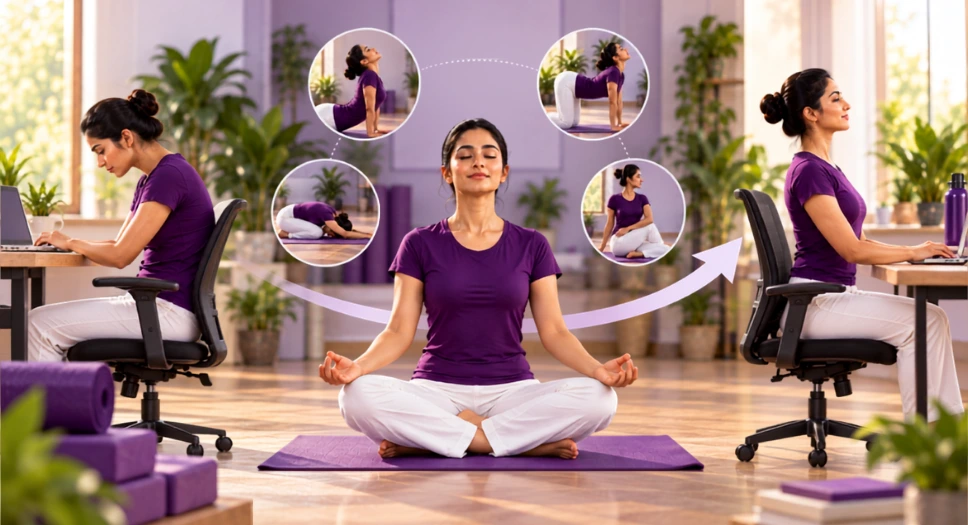
To bring all of this together, here is a sample 15-minute posture-focused sequence you can do first thing in the morning or in the evening after work:
- Mountain Pose (1 minute) to reset your standing alignment.
- Cat-Cow Stretch (10 rounds) to mobilize the spine.
- Downward-Facing Dog (1 minute) to lengthen the hamstrings and decompress the spine.
- Cobra Pose or Sphinx Pose (5 breaths, repeat twice) to strengthen the back and open the chest.
- Bridge Pose (5 breaths, repeat twice) to stretch the hip flexors and strengthen the glutes.
- Reclined Twist on each side (5 breaths per side) to release the lower back.
- Child’s Pose (1 to 2 minutes) to close the practice and calm the nervous system.
On busy workdays, supplement this routine with a few chair yoga poses every hour or two to prevent tension from building up in the first place.
A Note on Consistency Over Perfection
Improving posture through yoga is not about achieving a perfect-looking pose. It is about consistently reminding your body of a better alignment until that alignment starts to feel normal, even natural. Some days your hamstrings will feel tighter, your shoulders more rounded, or your lower back more sensitive, and that is completely normal. What matters most is showing up regularly, even if only for ten minutes, and listening to what your body needs on any given day.
Over weeks and months, these small, consistent efforts compound. You will likely notice you stand a little taller, your shoulders sit further back, and the persistent ache between your shoulder blades starts to fade. Photos, mirrors, and even how your clothes fit can become subtle indicators of the postural changes taking place.
Learn More With Guided Support
While self-practice with these poses can bring real, noticeable change, learning proper alignment from an experienced teacher accelerates progress and helps you avoid common mistakes, especially with poses like Camel Pose or Cow Face Arms that require careful attention to form.
The Hatha Yoga Institute offers structured classes designed specifically around posture correction, back care, and gentle strengthening for people who spend most of their day sitting. Whether you are completely new to yoga or looking to deepen an existing home practice, their instructors can guide you through personalized adjustments that are difficult to achieve through video tutorials or self-guided practice alone. If you are serious about correcting years of desk-related postural habits, working with a qualified teacher through an institute like this can make a meaningful difference in both the speed and safety of your progress.
Final Thoughts
Sitting all day does not have to permanently reshape your posture. With a consistent practice built around these yoga poses for posture, including a foundation of basic yoga poses, quick chair yoga poses for the office, targeted yoga poses for lower back pain, and dedicated stretches for yoga for neck pain and yoga for neck and shoulder pain, you can gradually undo the physical toll of a sedentary lifestyle. Start small, stay consistent, and give your body the daily attention it needs to stand tall again.