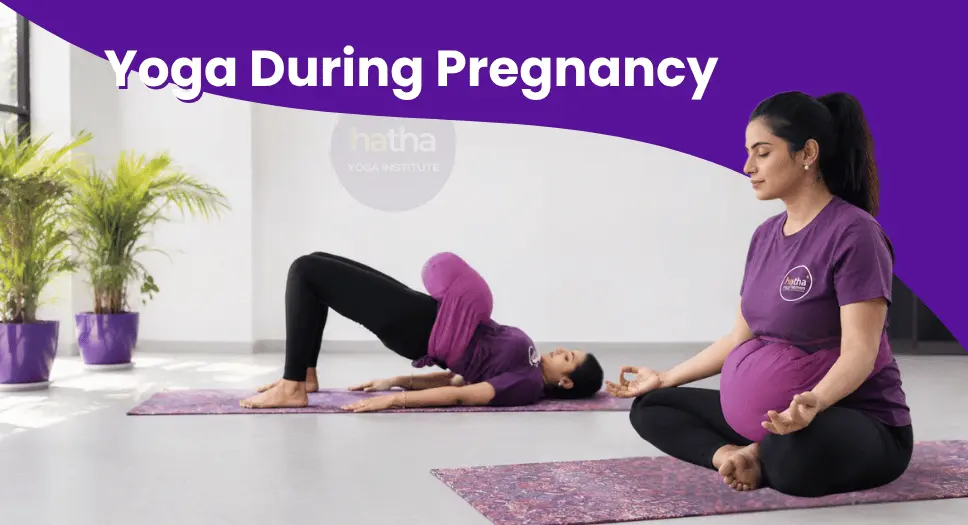
Motherhood is said to be the purest form of human existence as it involves nurturing and loving one’s child deeply without any expectations. Motherhood creates many responsibilities and often changes a woman as a person. Being a mother comes with a lot of responsibilities, struggles, difficulties and compromises, but it is also all about new experiences and learning new things every day. As Gurudev Sri Sri Ravi Shankar beautifully noted: “Motherhood is wanting the best of others and not expecting anything in return. There is motherhood in each and every one of us.”
Pregnancy is a very precious and important event in a woman’s life where the complete care of both mother and the baby is of the utmost importance. From the moment of conception, the mother’s body begins to transform in many ways to accommodate the new life nurturing within her. As the baby grows and develops, mothers need to adjust both physically and emotionally. Pregnancy-related discomforts due to anatomical and physiological changes can be very stressful to women. This is exactly where yoga for pregnancy plays a vital role.
Incorporating dedicated maternity yoga practices can help managing these shifts smoothly. By seeking qualified instruction through formal prenatal yoga classes, expectant mothers can learn how to protect their bodies while creating an optimal, calm environment for their developing child.
The Objective and Need of Yoga During Pregnancy
Objectives of Yoga for Pregnancy
The core objectives of executing a specialized yoga routine during this sacred time include:
- To make awareness about certain Yogic practices during pregnancy.
- To overcome the complications occurring in pregnancy.
- To disseminate the knowledge and understanding of Yogic diet and lifestyle in pregnancy.
Why Expectant Mothers Need Yoga
During the pregnancy period, the body undergoes various changes, which create stress on mental as well as physical levels. Implementing regular yoga for pregnant women helps maintain a healthy mind and body in pregnancy. Specialized maternity yoga classes provide foundational techniques to increase the strength, flexibility, and endurance of pelvic floor muscles needed for childbirth. Furthermore, it assists significantly in developing proper breathing and promoting a more comfortable labor process.
Specifically, structured yogic practices help to:
- Reduces stress level
- Improves the quality of sleep
- Increases the strength, flexibility and endurance of muscles around the pelvic region
- Decreases lower back pain
- Decreases nausea
- Decreases carpal tunnel syndrome
- Decreases headaches
- Reduces risk of preterm labour
- Lower risk of intrauterine growth restriction (a condition that slows the baby’s growth)
General Safety Guidelines for Pregnant Ladies
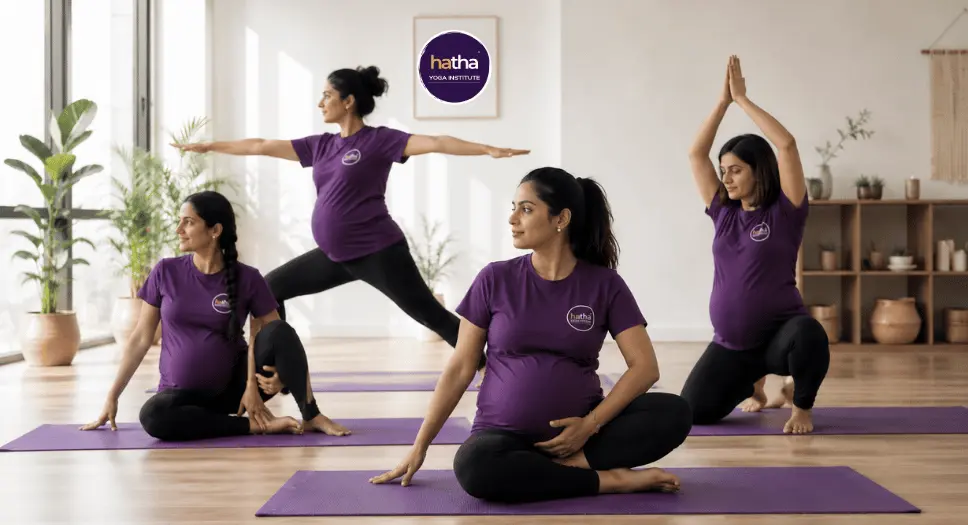
When participating in pregnant yoga classes, safety must remain the absolute priority. Every pregnancy is different, even for the same woman. It is always best to listen to the body and do only what feels right each day. Practices must be modified according to the practitioner’s condition, especially when trying new pregnancy yoga postures.
Essential Safety Practices:
- Supervision: Asanas should be practiced with proper guidance or under proper supervision.
- Make Space: As a general rule, modify poses to make space for the growing belly and find poses that are similar but less demanding to the body.
- Nutrition/Energy: Blood sugar levels can dip more frequently in pregnancy. Although one is advised not to eat before doing Yoga, pregnant women may need to have a light snack or juices before class.
- Pelvic Floor Awareness: More attention should be paid to pelvic floor awareness in all asanas and pranayama practice.
- Rhythm and Connection: Tune the body with the growing baby with slow rhythmic breathing and relaxation poses during the Yoga practice. Focus on stability and strength, rather than flexibility and endurance.
What to Avoid:
- Uterine Compression & Abdominal Strains: Avoid asanas compressing the uterus (e.g., forward bends or closed twists) or asanas overstretching the abdominal muscles (e.g., backbends).
- Inverted and Core Poses: Avoid inverted asanas, like shoulder/hand/head stand; compressing the abdomen in twisted standing poses like Parivritta Trikonasana and abdominal poses like Navasana and Naukasana.
- Prone Postures: Absolutely no lying on your stomach asanas like Bhujangasana, Shalabhasana, and Dhanurasana, etc.
- Supine Positions: Avoid lying flat on your back if you feel dizzy, sweaty, nauseous, or short of breath. Additionally, avoid raising the hands above your head if dizzy when standing.
- Aggressive Breathing Techniques: Avoid Kapalabhati kriya or any such straining cleansing practices. In pranayama, avoid Bhastrika and Kumbhaka (retention of breath).
Instead, practitioners should favor slow breathing techniques, such as the Yogic deep breathing, Anuloma Viloma, Ujjayi, and Bhramari to bring focus, reduce stress, anxiety, and prepare for childbirth.
Classification of Practitioners
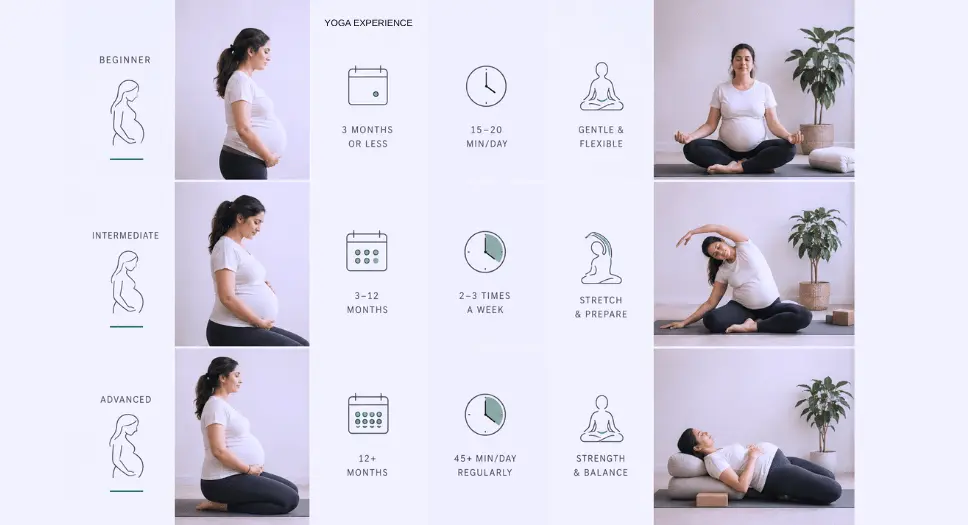
| Level | Span of Yoga Practice | Frequency of Practice | State of the Body | Type of Practice Encouraged |
| Beginner Level | Practicing for about 3 months or less or having high risk pregnancy | Once in a while or doing short practices for 15-20 minutes a day | Body is not very flexible | Gentle Practice, More Rest and Relaxation |
| Intermediate Level | Practicing for more than 3 months but less than 1 year | Practicing 2-3 times a week | Body is ready for stretches | Gentle Practice with Asana and Relaxation |
| Advanced Level | Practicing yoga for more than a year | Practicing for at least 45 minutes a day, practicing advanced postures regularly | Body is flexible | Safe variations can be done of Pre Natal asanas only |
Sukshma Vyayamas (Gentle Stretches) for Pregnancy
Before stepping into complex pregnancy yoga postures, gentle joint-mobilization movements (Sukshma Vyayamas) should be performed to ease tension and safely warm up the body.
Head Region Stretches
- Massage top – Temporal Tapping
- Forehead Massage and Tapping
- Temple, Ear, Eyes, and Eyebrows massage
- Nasal Line, Jaw, Mouth movements
- Opening and moving jaw left and right
- Tongue stretches (take tongue out, then move left and right)
- Filling the mouth with Air
Wrist and Forearm Mobilization
- Wrist Flexion and Extension – with fingers open and then with a fist
- Arm straight, pulling the fingers towards you with the help of the other hand, then fingers turned downwards and pulling towards the body
- Fist rotation
- Fist open and close, Palms up and down
- Phalanges stretch and Web-space stretching of fingers
Upper Back and Chest Stretches
- Side Bending (only a little)
- YLWT Stretch for upper and middle back
- Big Thoracic Circle
- Big Circles with one hand (other hand placed on the floor) – Pectoral Stretch
- Parvatasana
- Paschim Namaskar
- Modified Gomukhasana with simple Sukhasana or sitting on a block
Lower Body Mobilization
- Hip: Ardha badhakonasana – Shroni Chakra
- Lower Limbs (Can be practiced sitting): Knee movement with one leg bent, toe movements, and ankle cranking, rotation, flexion, and extension.
- Standing Stretches: Hip movement (forward and backward) and gentle knee bending.
Safe Prenatal Sequences and Postures Across Trimesters
The concept behind executing safe pregnancy yoga postures is to keep it simple and not push oneself too much. The entire practice must always align with the classical Yoga Sutra “Sthira Sukham Asanam”—meaning the practice needs to remain entirely comfortable and stable.
The primary focus of a safe sequence during pregnancy includes preparation of the right internal environment, pelvic floor stretching/strengthening, thoracic opening for improved breathing, and back strengthening to carry the shifting center of gravity safely.
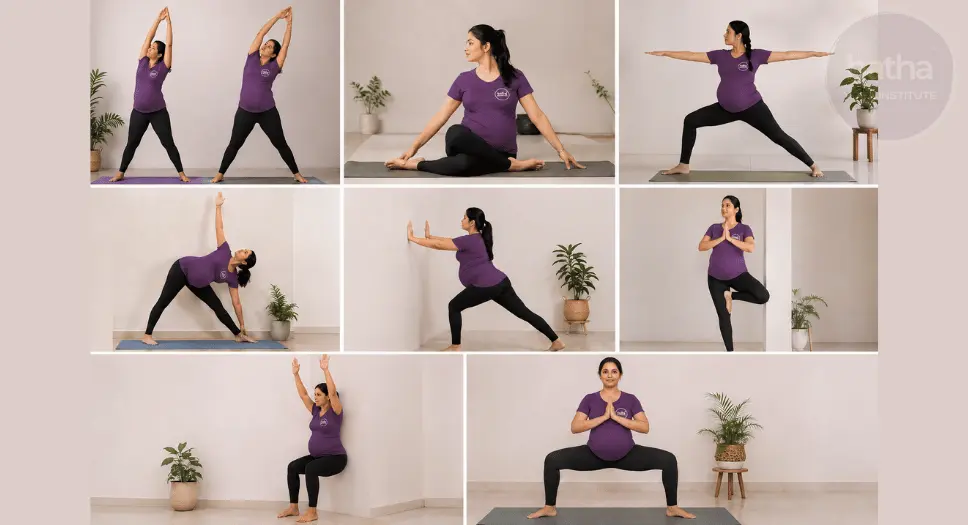
Safe Standing Postures
- Urdhva Tadasana & Konasana 1: Excellent for lengthening the spine and opening up the sides of the torso without straining the abdominal wall.
- Kati Chakrasana (Modified): Provides gentle rotational mobilization for the spine. Ensure the movement stays from the head to the waist only, acting as a safe open twist.
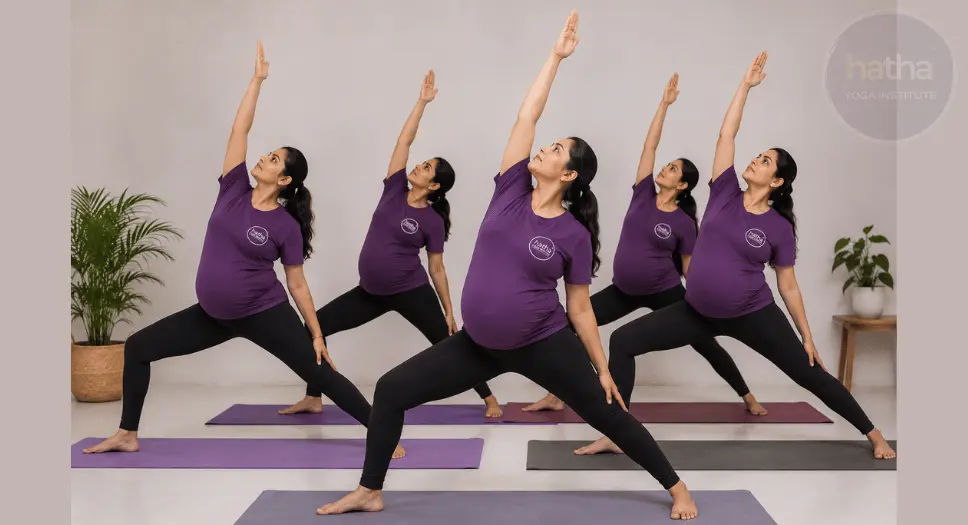
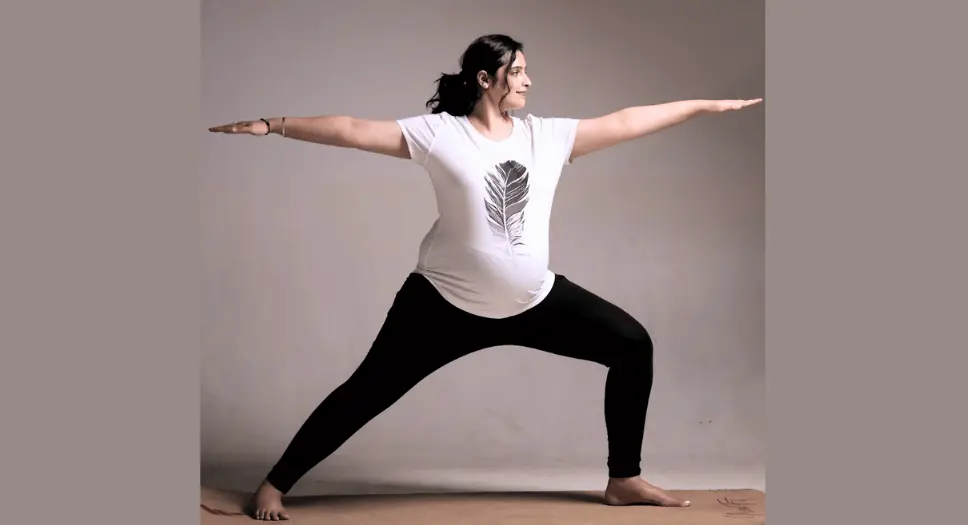
- Veerbhadrasana 2 (Warrior II): Excellent for establishing stability and building leg endurance while keeping the belly safe and unobstructed.
- Gentle Trikonasana: Gently stretches the hips and sides. Can be practiced with a wall for balance support.
- Push the Wall: A safe variation to engage the upper body and back muscles without overstretching or losing balance.
- Vrikshasana (Tree Pose): Cultivates deep focus and balance. Best practiced near a wall for safety.
- Utkatasana (Chair Pose) & Goddess Pose: Modified with a wider leg stance or practiced against a wall to expand space in the pelvic inlet and outlet safely.
Safe Seated Postures
Seated positions in maternity yoga classes help open up the hips and reinforce pelvic floor health. Below are standard safe selections along with modifications by proficiency level:
1. Marjariasana (Cat-Cow Pose)
- Beginners: Do not bend the lower back too much. Keep it neutral. Place a blanket under the knees for comfort.
- Intermediate & Advanced: Proceed with a normal but gentle practice. Can include gentle hip movements (wagging or circular movements) or raising the leg back gently.
- Trimesters: Highly recommended throughout the 2nd and 3rd Trimesters.
2. Chakki Chalana (Churning the Mill)
- Beginners: Practice with hands resting on the thighs.
- Intermediate: The elbows can be bent with a narrower stance, or sitting safely on a small cushion.
- Advanced: Wider stance with straight elbows.
- Important Note: Do not bend backwards while doing this pose as it will put too much pressure on the core muscles. Keep your back neutral when you come back.
- Trimesters: Ideal for 2nd and 3rd Trimesters.
3. Gomukhasana (Cow Face Pose)
- All Levels: Sit safely on a block or a bolster placed between the legs, or do it normally if flexible. Combine with Paschim Namaste or general chest opening movements to build thoracic strength. Beginners may use yoga belts to bridge the gap between hands.
- Trimesters: Safe for 2nd and 3rd Trimesters.
4. Baddhakonasana (Bound Angle / Butterfly Pose)
- Beginners: Sit on a folded blanket or a block, keeping feet further away from the groin. A towel or block can be placed underneath the knees for joint safety.
- Intermediate & Advanced: Sit normally with feet as close as the body comfortably allows, focusing on thoracic breathing, keeping the back straight, and leaning slightly upward.
- Trimesters: Highly beneficial during 2nd and 3rd Trimesters to widen pelvic regions.
5. Vakrasana (Gentle Seated Twist)
- All Levels: Sit comfortably elevated on a bolster, cushion, or a block.
- Important Note: We twist only very gently across all three categories of practitioners to safeguard the uterine environment.
- Trimesters: Safe during 2nd and 3rd Trimesters.
Transitory and Restorative Postures
When shifting between floor exercises or moving into a resting phase, utilize these specialized transitions to maintain total body equilibrium:
- Transitory Movements: Gentle pendulum rocking, gentle side twists, Shishuasana (Child’s Pose), and a gentle Gorilla walk help transfer weight safely without jarring movements.
- Side-Lying Postures: Vishnu Asana and Gentle Raj Vishram Asana provide structural relaxation on the side of the body.
- Supine & Restorative Support: Avoid lying flat on your back unless using an inclined backrest. Shavasana with an inclined backrest or relaxing deeply in Parsva Shavasana (Side-Lying Corpse Pose) with a slight elevation towards the leg is ideal.
- Inversion Substitutes: Advanced inversions are dangerous, but Saral Viparitkarni (Legs-up-the-wall) can be safely practiced for short durations (maximum 1 to 2 minutes) with legs supported against the wall to relieve leg swelling and pressure.
Advanced Pelvic Floor Nuances: Bandhas in the Later Stages
Pelvic floor locks or Bandhas are neuromuscular locks that help guide the flow of Prana (energy) safely. Do not apply any bandha during the 1st trimester or at least till the 5th month of pregnancy. In the third trimester, a woman can carefully start integrating these under expert instruction to tone the birth canal muscles:
- Moolbandha: Involves pulling the perineum upwards consciously.
- Sahajoli Mudra: This is the contraction and lifting of the genital organs (resembling the physical action of holding the urination process midway).
- Ashwini Mudra: Rapid or sustained contraction of the anal sphincter muscle.
A simplified instruction for beginners who find it hard to separate these is to gently contract and pull up the entire pelvic floor region together.
Elevate Your Journey with Hatha Yoga Institute
Navigating the beautiful, transformative phase of pregnancy requires specialized care, authentic authentic knowledge, and structured guidance. At Hatha Yoga Institute, we specialize in empowering expectant mothers and wellness professionals alike through our dedicated, comprehensive training structures.
Whether you are looking to deepen your personal practice or seeking a professional path to guide others, our certified Pregnancy Yoga Teacher Training Course provides deep anatomical insights, trimester-specific modifications, and an authentic lineage of holistic health techniques. Discover how to create a harmonious environment for both mother and baby by joining a community that prioritizes safety, mindful alignment, and pure well-being.
Conclusion
Embracing yoga for pregnancy provides an exceptional framework for navigating the profound physical changes of motherhood. By regularly attending specialized prenatal yoga classes and incorporating targeted maternity yoga movements, mothers can safeguard their structural health, relieve common discomforts, and foster an early, deep emotional bond with their growing child. Always remember to let your practice be governed by personal comfort, treat your body with complete kindness, and consult your medical care team before initiating any new physical routine.