If you have spent any time exploring yoga, chances are you have already come across bhujangasana, one of the most recognisable and widely practised backbends in the entire yogic system. Commonly known as the bhujangasana cobra pose, this asana is loved by beginners and seasoned practitioners alike for the way it gently opens the chest, strengthens the spine, and leaves the body feeling energised rather than exhausted. Whether you are just stepping onto your mat for the first time or you are a regular practitioner looking to deepen your understanding of this pose, this guide walks you through everything you need to know, from its meaning and classification to the exact bhujangasana steps, bhujangasana procedure, and a detailed look at the advantages of bhujangasana for your physical and mental wellbeing.
What is Bhujangasana?
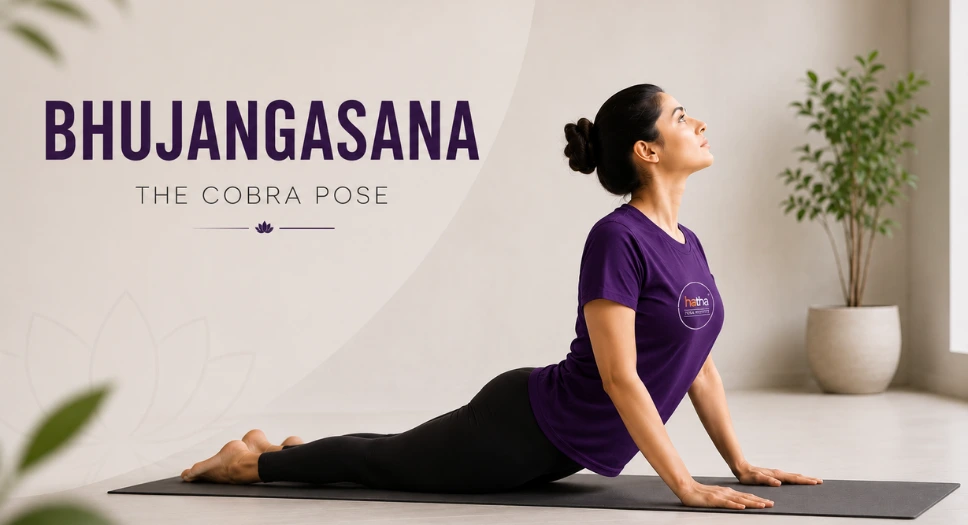
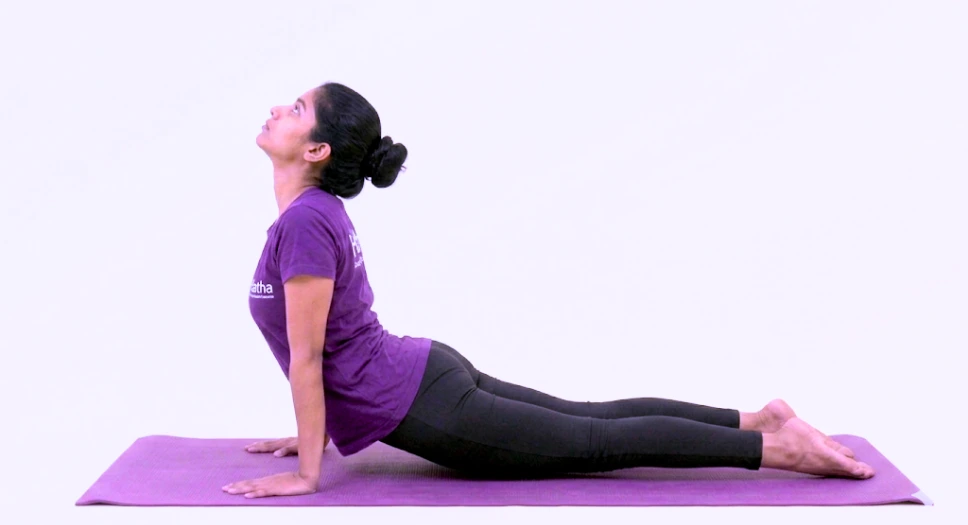
The word “Bhujanga” comes from Sanskrit and translates to “cobra” or “serpent.” The bhujangasana yoga pose gets its name because the final shape of the body closely resembles a snake with its hood raised, ready and alert. The chest lifts, the head tilts slightly upward, and the lower body stays grounded, mimicking the elegant, poised stance of a cobra about to strike.
In terms of classification, bhujangasana falls under the category of a prone position backward bending asana. This means the practice begins by lying flat on the stomach (a prone position) and then moves into a backward arch of the spine. This classification is important because it tells us how the pose works on the body: it is designed specifically to counteract the forward-hunching postures so many of us adopt during the day, whether from sitting at a desk, looking down at our phones, or driving for long hours.
Because of its accessibility and the way it can be modified for different ability levels, the bhujangasana pose is often one of the first backbends taught to new yoga students. It also forms a key part of the traditional Surya Namaskar (Sun Salutation) sequence, which is one more reason it has become such a staple in yoga classes around the world.
Bhujangasana Procedure: How to Practise the Pose Correctly
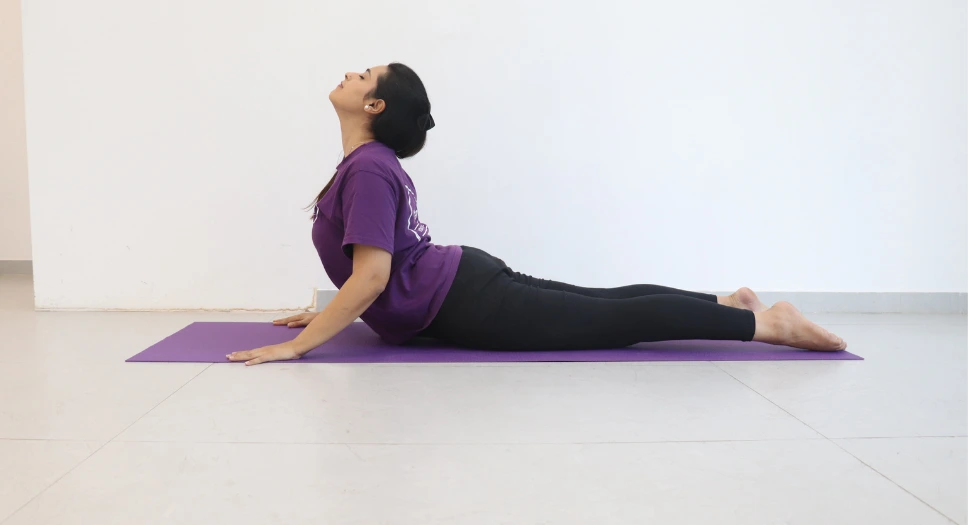
Before attempting any backbend, it is important to warm up the spine with some gentle stretches or a few rounds of cat-cow pose. Once your body feels ready, follow this step by step bhujangasana procedure to move into the posture safely and effectively.
Bhujangasana Steps
1. Lie flat on your stomach on a yoga mat, with your legs extended straight behind you and the tops of your feet resting on the floor. Keep your legs together or hip-width apart, whichever feels more comfortable.
2. Place your palms flat on the mat directly under your shoulders, with your elbows bent and tucked close to your body rather than flaring outward.
3. Rest your forehead gently on the mat and take a few deep, calming breaths to settle into the starting position.
4. As you inhale, begin to lift your head, chest, and shoulders off the floor. Use the strength of your back muscles to initiate the lift rather than pushing forcefully through your hands.
5. Continue to lift gradually until your chest is raised and your spine is curving backward in a smooth arch.
6. Keep your navel pressed gently into the floor throughout the lift. This is one of the most important cues in the entire pose, as it protects the lower back and ensures the stretch is distributed evenly along the spine.
7. Allow your elbows to stay slightly bent unless your flexibility allows you to straighten them comfortably. There is no need to force a full extension of the arms.
8. Tilt your head back gently and look upward, taking care not to strain or compress the back of your neck.
9. Hold the pose for fifteen to thirty seconds initially, breathing steadily, then slowly lower your chest and forehead back down to the mat as you exhale.
10. Rest in a relaxed prone position, perhaps with your cheek turned to one side, before repeating the pose for two or three rounds.
This sequence of bhujangasana steps can be practised on its own as part of a backbending routine, or it can be woven into a more comprehensive sequence such as the Sun Salutation. Many practitioners also use it as a counter-pose after seated forward bends or core-focused exercises, since it opens up the front body after a period of contraction.
Key Points to Remember While Practising Bhujangasana
The original guidance on this pose offers three essential cues that make a significant difference in how safely and effectively the posture is performed:
- Keep your navel on the floor. This single instruction is often the difference between a backbend that strengthens the spine and one that strains it. Lifting the navel off the mat shifts the work into the lower back rather than distributing it along the entire spine.
- Keep your shoulders relaxed, even if it means bending your elbows. It is tempting to push hard through the palms to gain height in the pose, but this often causes the shoulders to creep up toward the ears, creating tension in the neck and upper back. A bent elbow with relaxed shoulders is far more beneficial than a straight arm with hunched shoulders.
- If possible, straighten your arms by arching your back as much as possible, then tilt your head back and look up. This is meant for practitioners who have built sufficient flexibility and strength in the spine. It should never be forced, and beginners are encouraged to work toward this gradually rather than attempting it on day one.
Keeping these three points in mind while exploring the bhujangasana pose will help you build a sustainable practice that improves over time rather than one that leads to discomfort or injury.
Benefits of Bhujangasana
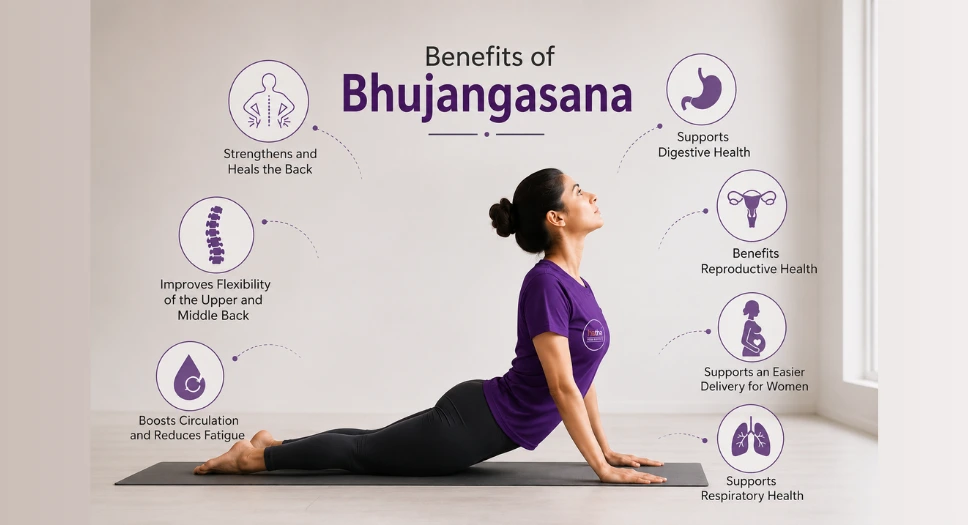
The benefits bhujangasana offers extend well beyond a simple stretch of the back. This pose touches on multiple systems of the body, from the musculoskeletal and digestive systems to the reproductive and respiratory systems, making it one of the more holistic postures in the yogic repertoire.
1. Strengthens and Heals the Back
One of the most celebrated advantages of bhujangasana is its impact on overall back health. The pose strengthens the entire back, helping to relieve conditions such as hunchback posture, general back pain, lumbago, and kyphosis, which refers to an exaggerated curvature of the thoracic spine. For individuals dealing with a slipped disc, this asana, when practised mindfully and ideally under guidance, can help support spinal health. Regular practice also plays a role in keeping the spine supple and resilient over the long term.
2. Improves Flexibility of the Upper and Middle Back
As the spine receives a powerful backward stretch during this pose, the flexibility of the upper and middle back improves significantly. This is particularly valuable for people who spend long hours sitting, since prolonged sitting tends to stiffen the thoracic spine and round the shoulders forward.
3. Boosts Circulation and Reduces Fatigue
This asana provides a rich blood supply to each vertebra along the spine. The improved circulation helps reduce fatigue and stress while rejuvenating the nerves and muscles that support the spinal column. Many practitioners report feeling more alert and refreshed after just a few rounds of this backbend.
4. Supports Digestive Health
The bhujangasana cobra pose tones the abdominal region, and the gentle pressure created on the abdomen during the pose helps combat constipation, indigestion, flatulence, and acidity. It is also said to improve appetite by stimulating what is traditionally referred to as the digestive fire.
5. Benefits Reproductive Health
This pose is traditionally associated with relief from amenorrhea, dysmenorrhea, leucorrhea, and various other utero-ovarian and reproductive concerns. Because of the way it stimulates the pelvic and abdominal region, it has long been recommended as part of a holistic approach to reproductive wellness.
6. Supports an Easier Delivery for Women
Women who practise yoga regularly before pregnancy may find that this preparation contributes to an easier and more normal delivery process. While yoga should always be practised in consultation with a qualified instructor and healthcare provider during the reproductive years, the foundational strength and flexibility built through consistent practice can be a valuable form of preparation.
7. Supports Respiratory Health
For individuals dealing with respiratory disorders such as asthma, this pose can be particularly useful. As the chest lifts and opens, the rib cage expands, which helps increase lung capacity over time. This makes it a valuable addition to breathing-focused yoga routines.
8. Regulates Thyroid Function
The gentle backward tilt of the head and the stretch through the throat region in this pose is believed to help regulate the secretion of the thyroid gland, supporting better hormonal balance.
9. Awakens Spiritual Energy
In the more subtle and energetic dimensions of yoga, this pose is said to awaken the Kundalini shakti, the dormant spiritual energy believed to reside in the Mooladhar chakra at the base of the spine. While this aspect of the practice is more rooted in yogic philosophy than physical science, many long-term practitioners describe a sense of heightened awareness and vitality after consistent practice.
Taken together, these benefits bhujangasana provides make it clear why this pose has remained a cornerstone of yoga practice across generations. It is rare to find a single posture that addresses the spine, digestion, reproductive health, respiratory function, and the subtle energy body all at once.
Who Should Avoid Bhujangasana: Contraindications
While the bhujangasana yoga pose is generally considered safe for most healthy individuals, there are specific situations in which it should be avoided or practised only under the close supervision of a qualified yoga teacher or medical professional. The contraindications include:
- Pregnancy. The abdominal pressure created in this pose is not suitable during pregnancy.
- Wrist injury. Since the hands bear some weight in this pose, an existing wrist injury can be aggravated.
- Recent abdominal surgery. The body needs time to heal before the abdomen is placed under any stretching or pressure.
- Hernia. The abdominal engagement involved in this pose can worsen a hernia.
- Peptic ulcers. The pressure on the abdominal region may aggravate symptoms.
- Intestinal TB. This condition requires avoiding postures that place pressure on the abdomen.
- Serious spinal disorders. Anyone with significant spinal conditions should consult a doctor or experienced yoga therapist before attempting this or any backbend.
If you fall into any of these categories, it is always best to speak with a healthcare provider or an experienced yoga teacher before incorporating this asana into your routine. There are often gentler alternatives or modifications that can offer similar benefits without the associated risks.
Tips for Beginners
If you are new to backbends, here are a few additional pointers that can help you ease into the bhujangasana pose with confidence and care:
- Always warm up your spine before attempting a deep backbend, since cold muscles are more prone to strain.
- Focus on length before height. It is far more beneficial to lengthen the spine evenly than to push for a dramatic lift that compresses the lower back.
- Engage your leg muscles and press the tops of your feet into the mat for additional stability and support.
- Breathe steadily throughout the hold. Holding your breath tends to create unnecessary tension in the body.
- Practice consistently rather than intensely. The cumulative benefits of this pose are best experienced through regular, gentle practice rather than occasional, forceful attempts.
- Listen to your body. A little sensation of stretch is normal, but sharp pain in the lower back or wrists is a sign to ease out of the pose immediately.
Frequently Asked Questions About Bhujangasana
How is Bhujangasana different from Urdhva Mukha Svanasana (Upward Facing Dog)?
While both poses involve a backward arch from a prone position, the bhujangasana yoga pose keeps the lower body, thighs, and pelvis grounded on the mat throughout, with the lift coming primarily from the upper back. Upward Facing Dog, on the other hand, lifts the thighs and hips off the floor entirely, creating a deeper and more intense backbend that requires greater strength and flexibility.
1. How long should I hold the pose?
Beginners can start by holding the pose for fifteen to twenty seconds, gradually building up to thirty seconds or longer as the back grows stronger and more flexible. It is generally more beneficial to repeat the pose for two or three rounds with shorter holds than to force a single long hold that compromises form.
2. Can Bhujangasana help with stress relief?
Yes. By improving circulation along the spine and gently opening the chest, this pose can have a calming effect on the nervous system. Many practitioners include it as part of a short daily routine specifically to release tension accumulated from sitting or stress throughout the day.
3. Is it normal to feel a slight compression in the lower back?
A mild sensation of engagement is normal, but sharp or pinching pain is not. If you feel discomfort in your lower back, check that your navel is staying grounded and that you are not lifting too high too quickly. Reducing the height of the backbend and focusing on length rather than lift usually resolves this issue.
4. Can this pose be modified for tight backs or limited flexibility?
Absolutely. A gentler variation, sometimes called Baby Cobra, involves lifting only a few inches off the mat while keeping the elbows bent close to the body. This modification still offers many of the same benefits while placing far less demand on the lower back, making it an excellent starting point for those new to backbends.
Bringing It All Together
The bhujangasana cobra pose is far more than a simple backbend. It is a complete posture that strengthens the spine, supports digestion, encourages healthy reproductive function, improves lung capacity, and even has a place in the subtler, energetic dimensions of yoga practice. With its accessible bhujangasana procedure and the option to modify the depth of the backbend based on your current flexibility, this pose offers something valuable for practitioners at every stage of their journey.
As with any yoga posture, the real benefits come from consistent, mindful practice rather than rushing toward an advanced expression of the pose. Pay close attention to the key points of keeping the navel grounded, the shoulders relaxed, and the breath steady, and you will find that this asana becomes a reliable, restorative part of your daily routine.
Learn Bhujangasana the Right Way with Hatha Yoga Institute
If you are looking to deepen your practice of bhujangasana and other foundational yoga postures under the guidance of experienced teachers, the Hatha Yoga Institute offers structured courses designed for practitioners at every level, from absolute beginners to those preparing for teacher certification. Our instructors place a strong emphasis on correct alignment, breath awareness, and the traditional philosophy behind each asana, ensuring that you not only learn the physical bhujangasana steps but also understand the deeper purpose behind the practice. Whether you are looking to join an in-person class or explore a more flexible online program, the Hatha Yoga Institute is committed to helping you build a safe, sustainable, and transformative yoga practice. Reach out to us today to learn more about our upcoming sessions and begin your journey toward better health, strength, and inner balance.