In the fast-paced landscape of the 21st century, stress has become a ubiquitous buzzword, often blamed for everything from minor headaches to major systemic collapses. To truly manage it, however, we must move beyond colloquial definitions and look at the foundational science and ancient wisdom that define our internal pressures. Hans Selye defined stress as a nonspecific and conventional response of the body to any demand made upon it. This definition was revolutionary because it suggested that the body has a unified biological “defense budget”—whether the demand is a promotion at work or a physical injury, the physiological machinery shifts into gear in a predictable pattern. Understanding this pattern is exactly why yoga for stress has moved from ancient practice to evidence-backed intervention — it works directly with this “defense budget” rather than against it.
At its core, the concept of stress is a survival mechanism. Primarily it prepares the body for physical activity. It is an ancestral gift that allowed our predecessors to survive in a world filled with tangible threats. It prepares us for two primary actions, fight or flight in response to the demanding situation. In the modern context, these impulses remain, but their outlets have vanished. Fight means dealing with the situation with more strength and energy. In a corporate setting, this might manifest as an argument or aggressive overworking. Flight means running away from the situation. This might look like procrastination, avoidance, or literal resignation. In both cases, we are trying to get stress relief that the situation has imposed on us.
However, modern science is now catching up to what Eastern philosophy has suggested for millennia. The mental aspect of this tension is often more destructive than the physical. From a Yogic perspective, the violent negative destructive functions of the Manomaya Kosha (the mental sheath) is what we call stress. When our thoughts become erratic, violent, or circular, they create a “vibration” that disturbs our entire being, leading to the chronic conditions we see today.
Identifying Your Stressors: The Triggers of Modern Life
Those situations where an individual finds himself unable to cope up and deal with are known as stressors. A stressor is essentially any stimulus that the brain perceives as a threat to its equilibrium. These are highly subjective; what one person finds a stimulating challenge, another might find a paralyzing burden. To better understand them, we categorize these triggers into four distinct realms:
- Environmental: pollution, crowds, noise. These are external sensory overloads that keep the nervous system in a state of high alert.
- Physiological: pain, fatigue, disease. These are internal demands where the body is struggling to maintain homeostasis.
- Mental: fear, anxiety, anger. These are cognitive patterns that create a perceived threat even when no physical danger is present.
- Spiritual: existential crisis. This is the deep-seated stress of feeling disconnected from one’s purpose or the universe.
Furthermore, we must recognize that stress can occur at two levels – Physical and Psychological. While they are often discussed separately, they are inextricably linked. Physical stress – accidents, burns, major surgeries, major infections etc. creates an immediate demand for repair and recovery. However, the mind rarely stays silent during these times. Psychological stress can occur independently or as a reaction to the physical stress – tension, worry, hatred, anger, jealousy, emotional conflict etc.
The timeline of these feelings is the difference between a healthy recovery and a chronic illness. It can be a short-term reaction or it may be a long standing one, leaving deep seated subconscious impressions leading to prolonged tension. When stress becomes “deep-seated,” it moves into the Samskaras (subconscious impressions), where it continues to influence our behavior and health even after the original stressor has disappeared.
The Dual Nature of Pressure: Eustress vs. Distress
One of the greatest misconceptions about stress is that it is inherently “bad.” Without stress, there would be no growth, no muscle building, and no learning. Scientists categorize this “good” pressure as Eustress. Eustress is any kind of challenging stimulus that stresses the individual but with the result that they feel energized, motivated or compelled to respond or make some kind of beneficial action for themselves.
Think of the “positive” nerves one feels before a wedding, a big game, or a job interview. For example – stress produced by extreme joy, any positive impulse, recreational activities, sports, hobbies etc. This type of stress is essential for a fulfilling life.
Eustress, or positive stress, has the following characteristics:
- Motivates, focuses energy. It acts as a fuel for the task at hand.
- Is short-term. It rises for the occasion and then dissipates.
- Is perceived as within our coping abilities. We feel “up to the challenge.”
- Feels exciting. It is characterized by adrenaline rather than cortisol-driven dread.
- Improves performance. It keeps us sharp and attentive.
However, even “good” things can be overdone. Although it is considered good, high and prolonged eustress can be harmful for our system. An athlete who never rests or a CEO who loves the “high” of the deal but never sleeps will eventually crash. When the system is pushed beyond its elastic limit, it breaks.
When Pressure Turns Into Pain: Distress
If the subject is unable to relieve the cause of stress leading to morbidity it is termed distress. This stress has to be controlled in all respects. This is the type of stress that leads to burnout, heart disease, and mental health crises. For example – continuous mental and physical strain, any kind of anger, frustration, states of tension etc.
In contrast to eustress, distress, or negative stress, has the following characteristics:
- Causes anxiety or concern. It feels like a weight rather than a spark.
- Can be short or long-term. It often lingers, becoming a background “hum” in our lives.
- Is perceived as outside of our coping abilities. We feel overwhelmed and helpless.
- Feels unpleasant. It manifests as dread, fatigue, or irritability.
- Decreases performance. The brain “fogs” and productivity plummets.
Can lead to mental and physical problems. It is the root of psychosomatic illnesses.
The Anatomy of a Crisis: Why We Get Stressed and How the Body Reacts
Why do some people seem unshakeable while others are constantly on the edge? The Main Reasons for stress are often found in our habits, social structures, and thought patterns:
- Number of Obligations – A person is asked to address problems beyond its capability. It can be at his home or job. We live in a culture of “more,” where saying “no” is viewed as a weakness.
- When the enemy is himself/herself – When a person deliberately does wrong things to himself out of impatience or frustration. For example, smoking. We often use self-destructive coping mechanisms that create a secondary layer of physiological stress.
- Negative thoughts – Whenever there is a lack of positive thoughts or good company, a person is totally surrounded by haunting thoughts. The mind is like a garden; if we do not plant flowers (positive thoughts), weeds (negative thoughts) will grow automatically.
- Poor skills to deal with conflicts – We must know how to deal with conflicts, we should be smart enough to decide whether we have to take action or not. Often, stress comes from indecision or inappropriate reactions to social friction.
- Overburdened with commitments – Sometimes we promise more than what we can fulfil. This brings burden and stress to us.
The Biological Storm
When the brain sounds the alarm, the body doesn’t just feel “nervous”—it undergoes a massive physiological transformation. The Body Reactions under stress are designed for survival, not for longevity:
- Stored sugar and fats poured into blood to provide fuel for quick energy. This is great for sprinting away from a lion, but bad for someone sitting in a car in traffic, leading to metabolic issues.
- The breath rate shoots up. Rapid, shallow breathing ensures oxygen reaches the muscles, but it also signals the brain to stay in a state of panic.
- Heart speeds up and blood pressure soars, ensuring sufficient blood supply to needed areas. Over time, this constant “soaring” wears down the cardiovascular system.
- Digestion ceases, so that blood may be deviated to the muscles and the brain. This is why chronic stress leads to IBS, ulcers, and indigestion.
- Perspiration and saliva increase. This is the body cooling itself down for the physical “fight.”
- Bowel and bladder muscles loosen. A primal response to lighten the body’s load for faster flight.
- All senses are heightened. We become hyper-vigilant, making us jumpy and unable to focus on complex, creative tasks.
The Wisdom of Yoga: A Holistic View of Balance
According to Yoga, stress is an imbalance. It is a deviation from our natural state of equilibrium (Samatvam). This imbalance isn’t just in the muscles or the nerves; it is multi-dimensional. Imbalance at any level can cause stress. At an emotional level imbalance causes strong likes and dislikes. We become slaves to our preferences, being happy only when things go “our way.”
At a psychological level imbalance leads to narrow ego-centric behaviour. We lose our connection to others and see every interaction as a threat to our status or self-image. At a physical level imbalance can cause any of the body disturbances mentioned above. Ultimately, according to yoga, mental imbalance, wrong thought patterns, over sensitivity etc. is stress!
Yoga offers a unique “Pancha Kosha” (Five Sheaths) model to understand this. In Yoga, while understanding stress we consider the holistic concept of a man’s existence, not just the physical or emotional aspect. Taittiriya Upanishad has described the holistic existence of a man in its pancha kosha theory.
- Annamaya (Food/Physical)
- Pranamaya (Energy/Breath)
- Manomaya (Mind/Emotion)
- Vijnanamaya (Wisdom/Intellect)
- Anandamaya (Bliss)
Every kosha suffers and gets disturbed as stress enters into it. A disturbance in the mind (Manomaya) will eventually leak into the physical body (Annamaya) as disease.
Returning to the Self
The ultimate goal of stress management in Yoga is not just “relaxation,” but a return to our true nature. In our original state we are totally stress-free. We are blissful, devoid of any tension or any kind of pressure. Sage Patanjali calls this state as svarupa or the self. We are not “creating” peace; we are removing the agitation that obscures the peace already within us. As Gurudev Sri Sri Ravi Shankar says, stress is when you have too much to do and too little time or energy. Yoga helps us expand our energy and manage our time by sharpening our focus.
Practical Life Management through Yogic Principles
To manage life is to manage the mind. As per Bhagavadgītā, our constant thinking about sensory objects is the main cause of emotional instability. When we obsess over what we want or what we fear losing, we create a chain reaction of suffering. This gives rise to kāma (desires), krodha (anger), lobha (greed), and moha (attachment) with worldly things. These four “enemies” are the internal stressors that no amount of money or external success can cure.
The Five Pillars of a Stress-Free Life
Yoga provides a practical blueprint for daily living through these principles: ahara (food), vihara (relaxation and recreation) achara (conduct and attitudes), and vichara (thinking) and vyavahara (actions). When these are aligned, they enable us to deal with stress on a daily basis.
To implement these, we follow The 5 Points of Yoga, which are intended to address each of these principles through:
1. Proper Exercise (asana): Using the body to move stagnant energy.
2. Proper Breathing (pranayama): Directly hacking the nervous system to switch from “Fight/Flight” to “Rest/Digest.”
3. Proper Relaxation (savasana): Teaching the body to let go of muscular tension.
4. Proper Diet (sattvic vegetarian): Eating foods that promote a calm, clear mind rather than agitation.
5. Positive Thinking and Meditation (Vedanta and dhyana): Training the intellect to observe thoughts rather than be swept away by them.
Yoga for Stress: Asanas and Pranayamas
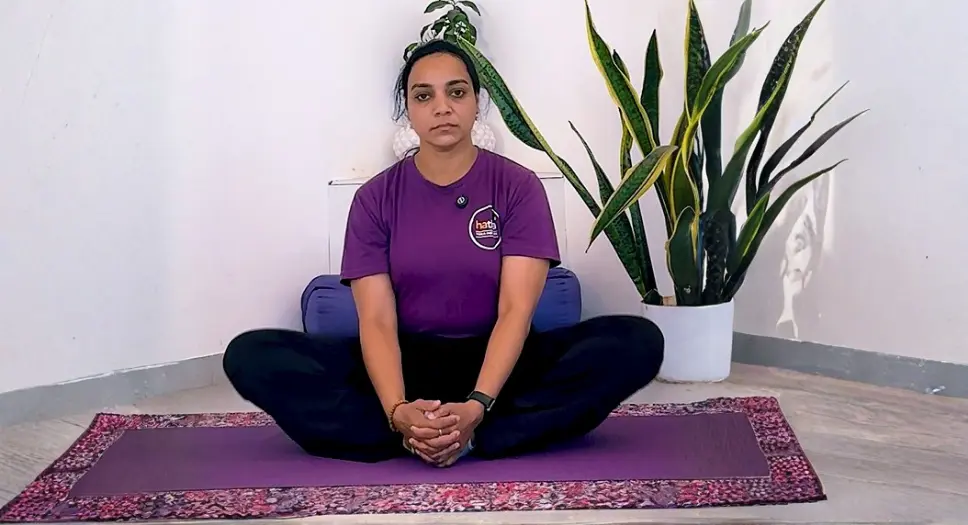
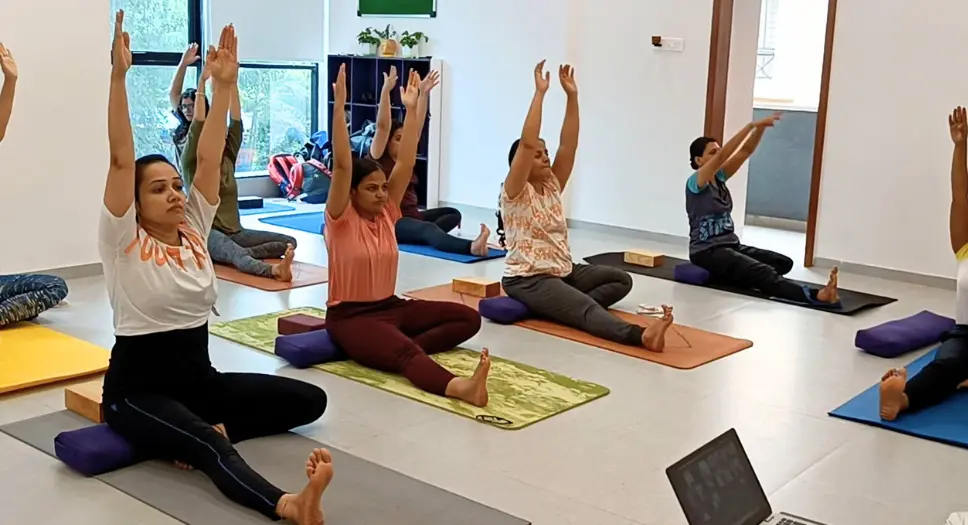
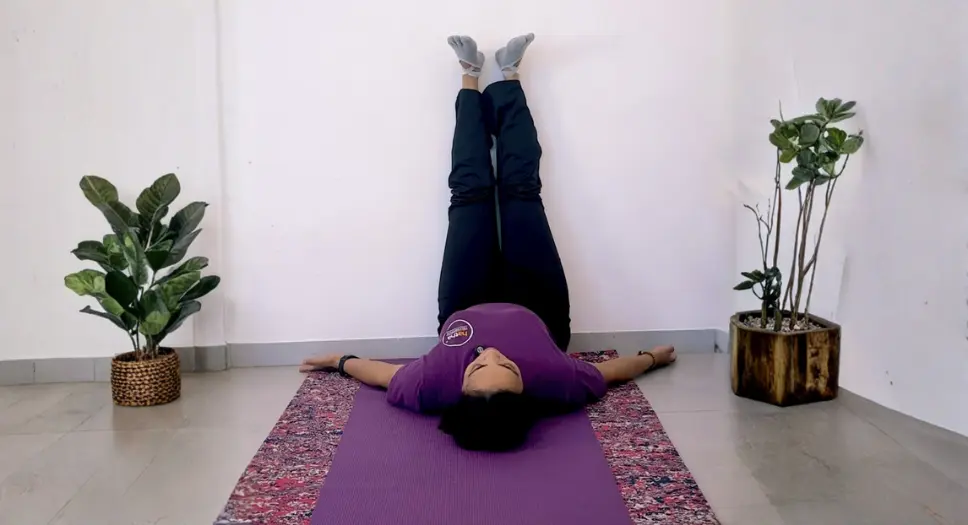
If you are currently feeling the weight of distress, Yoga offers specific, immediate tools. Asanas that are beneficial in managing stress are Paschimottanasana (Seated Forward Bend), Setubandhasana (Bridge Pose), Shavasana (Corpse Pose) etc. These poses help lower the heart rate and stretch the areas where we hold tension, such as the spine and hips.
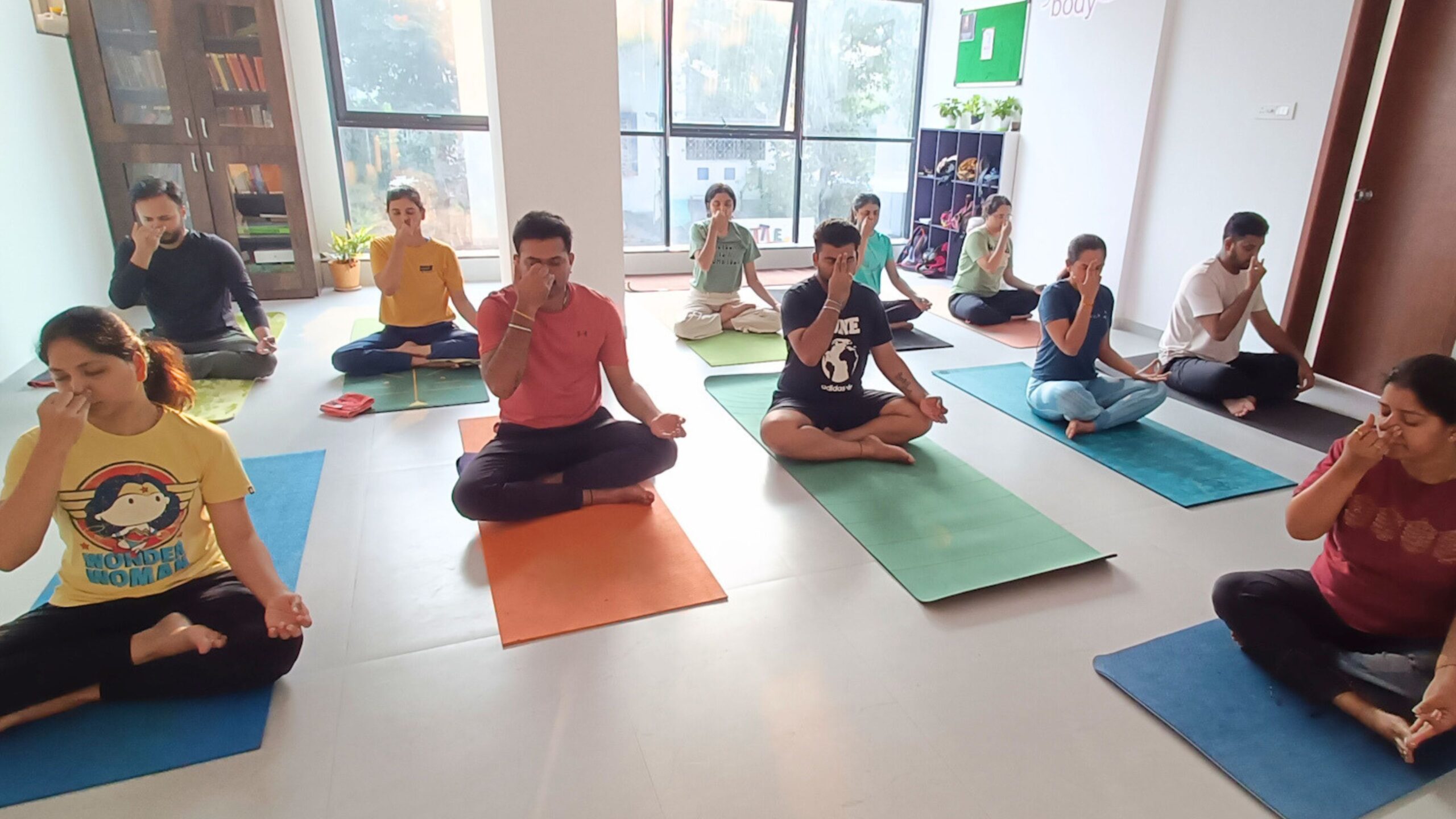
To quiet the mental chatter, breathwork is unparalleled. Pranayamas that can reduce stress are Nadi shodhan pranayama (Alternate Nostril Breathing), Brahmari (Bee Breath), Ujjayi (Victorious Breath) etc.
By understanding the modern view of stress as a holistic imbalance, and using these ancient tools to restore harmony, we can move from a state of survival (Distress) to a state of thriving (Eustress), and finally, to the state of Svarupa—total, blissful peace.
Begin Your Journey with Hathayoga Institute
Understanding stress is the first step, but experiencing relief requires guidance and consistent practice. At the Hatha Yoga Institute, we specialize in translating these profound ancient teachings into practical, modern lifestyles. Our curriculum is designed to help you navigate the complexities of modern “Distress” and transform it into a life of “Svarupa”—your natural state of bliss.
Whether you are looking to master Proper Breathing (pranayama) to calm your nervous system or seeking to understand the deeper Pancha Kosha theory to heal from within, our expert instructors provide a supportive environment for your growth. Join us at the Hatha Yoga Institute to rediscover your stress-free self and build the resilience needed for a vibrant, balanced life.
Visit us at www.hathayogainstitute.com to explore our courses, workshops, and resources dedicated to your holistic well-being. Your path to a peaceful mind and a healthy body begins here.