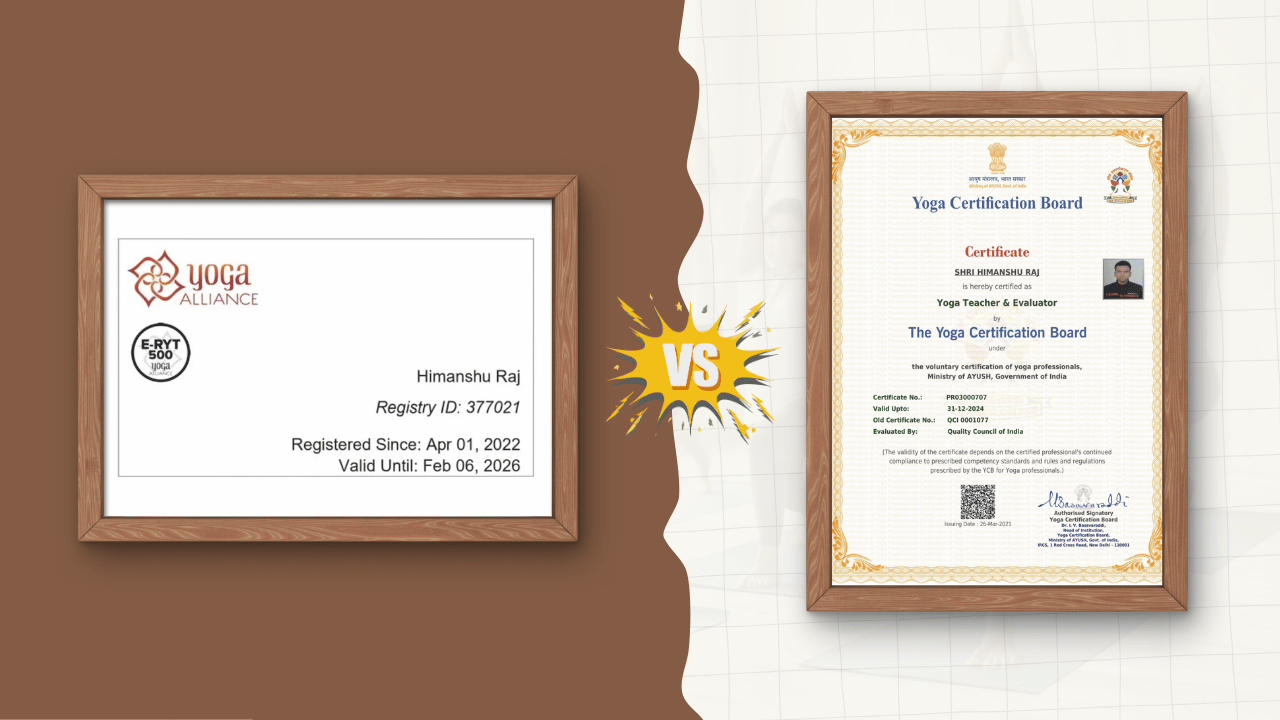
Yoga has gained immense popularity worldwide, leading to the need for standardized certification for yoga teachers and practitioners. Two prominent certification bodies that regulate yoga education and accreditation are the Yoga Certification Board (YCB), under the Ministry of AYUSH, Government of India, and Yoga Alliance, US. While both organizations aim to promote quality yoga education, their approaches, recognition, and standards differ significantly.
Therefore, it is essential to thoroughly research both options to find the best fit for their professional aspirations.
Understanding the Key Differences Between YCB and Yoga Alliance
Yoga Certification Board (YCB)
The Yoga Certification Board (YCB) was established by the Ministry of AYUSH, Government of India, in 2018 to standardize and promote authentic yoga practices based on traditional Indian knowledge. It ensures quality education in yoga and provides internationally recognized certifications. The YCB certification is based on guidelines derived from ancient Indian scriptures, scientific research in yoga, and yogic traditions originating from authentic yoga gurus of the country.
Official Website: Yoga Certification Board

Key Features of YCB Certification
1. Government-Backed Accreditation
YCB operates under the Ministry of AYUSH, making it an authoritative certification in yoga education, especially in India. One such certificate appears in the eligibility criteria of most yoga jobs published in India.
2. Certification Levels for Yoga Teachers
Yoga Protocol Instructor (YPI)
Yoga Wellness Instructor (YWI)
Yoga Teacher and Evaluator (YTE)
Yoga Master (YM)
Higher levels lead to broader opportunities, higher salaries, and greater recognition. However, the syllabus becomes more detailed, and assessments become more challenging. Commitment to time and effort is necessary at each level.
Additional certification levels are also available for Yoga therapists and Yoga school teachers.
3. Syllabus Rooted in Ancient Yogic Traditions
YCB follows the principles outlined in texts like the Patanjali Yoga Sutras, Bhagavad Gita, Hatha Yoga Pradipika, and Ayurveda, ensuring an authentic understanding of yoga.
Explore syllabi here: YCB Syllabus
4. Certification Validity & Renewal Process
The certification requires renewal every five years. The renewal process includes:
Attending an online workshop
Passing a small MCQ assessment
Paying a renewal fee (₹500 – ₹2000, depending on the level)
4. Certification Validity & Renewal Process
No age or education restrictions
Available worldwide
No mandatory sequential order for certification levels
5. Eligibility Criteria
No age or education restrictions
Available worldwide
No mandatory sequential order for certification levels
6. Rigorous Examination Process
Candidates must pass both theory (MCQ-based) and practical (demonstration and viva) assessments. A minimum score of 70% is required in both sections. Those who fail can reappear without limitations.
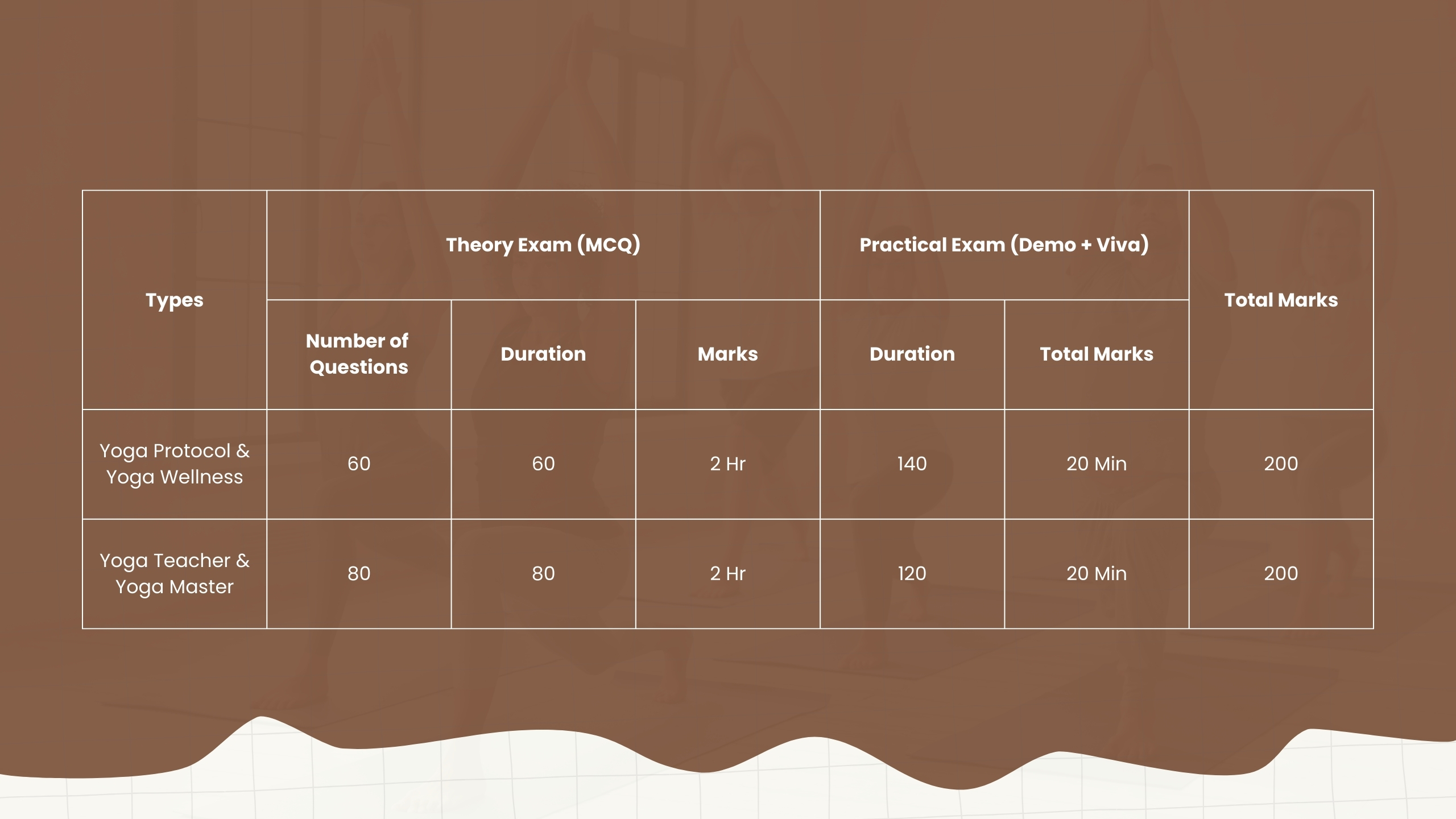
Only government-appointed examiners conduct the assessments. Private institutes may provide premises but are not authorized to conduct exams independently.
7. Career Opportunities
Recognized by the Government of India
Required for government and private sector yoga jobs in India
Eligible for Ministry of External Affairs-sponsored foreign yoga positions
Listed on the Yoga Certification Board website
Sponsored by the Indian Council for Cultural Relations (ICCR) for overseas opportunities
Yoga Alliance, US
Yoga Alliance (YA) is a non-profit organization based in the United States that provides accreditation for yoga schools and teachers globally. Founded in 1999, Yoga Alliance sets voluntary standards for yoga teacher training programs but does not conduct direct assessments or exams.
Official Website: Yoga Alliance

Key Features of Yoga Alliance Certification
1. Private, Non-Governmental Organization
Unlike YCB, Yoga Alliance is not regulated by any government body. It is a private non-profit organization headquartered in Arlington, Virginia, US.
2. Registration-Based Certification Model
Teachers can become Registered Yoga Teachers (RYTs) after completing training at a Registered Yoga School (RYS).
Yoga Alliance Certification Levels:
RYT 200 – Complete a 200-hour training program from an RYS
E-RYT 200 – RYT 200 + 2 years of teaching experience
RYT 500 – Complete a 500-hour training or a combination of 200-hour + 300-hour courses
E-RYT 500 – RYT 500 + 4 years of teaching experience
RCYT – Children’s Yoga Certification
RPYT – Prenatal Yoga Certification
3. Flexible Syllabus & Examination Approach
The syllabus and assessment process depend entirely on the yoga school. Yoga Alliance approves the curriculum at the time of school registration, but ongoing quality control depends on the school.
4. Renewal & Membership Fees
Annual renewal required
Approximate renewal fee: ₹5000
Continuing education requirements must be met
More details: Yoga Alliance Fee Structure
5. Global Recognition & Membership Benefits
Accepted worldwide, especially in North America, Europe, and Australia
Focuses on both traditional yoga and modern fitness trends
Membership includes access to yoga business resources, discounts on partner programs, and a wellness support program
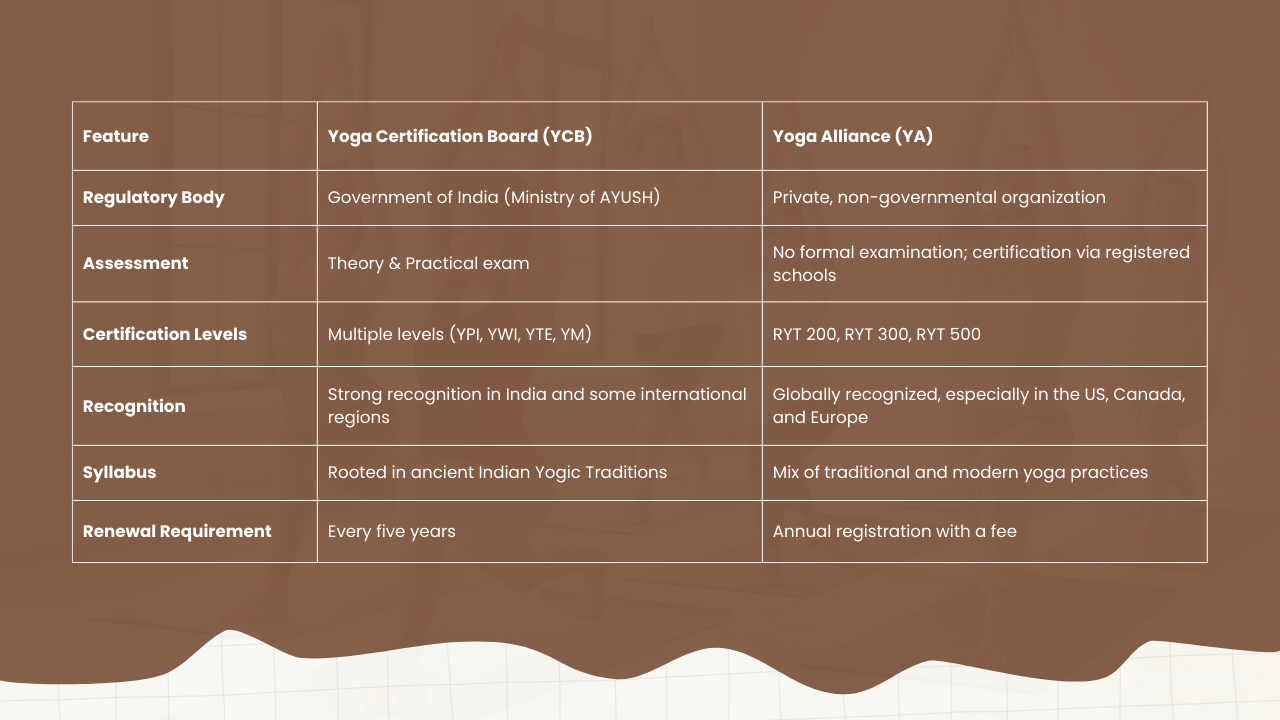
YCB vs. Yoga Alliance: A Quick Comparison
Which Certification Should You Choose?
For teaching in India & Government Institutions, YCB is the best option due to its official recognition.
For International Teaching Opportunities: Yoga Alliance is widely accepted in global markets.
For Authentic Yogic Knowledge: YCB is deeply rooted in traditional Indian yoga.
For Commercial Yoga Careers: Yoga Alliance offers flexibility for integrating modern fitness trends
Which Certification Should You Choose?
Both YCB and Yoga Alliance have unique strengths. YCB offers government-backed credibility and deep traditional knowledge, whereas Yoga Alliance provides global recognition and flexibility. Your choice should align with your career aspirations, teaching goals, and preferred style of yoga education. Regardless of certification, continuous learning and practice are key to becoming an exceptional yoga teacher.