Yoga is far more than a physical practice. For thousands of years, it has been a comprehensive science of living a method for achieving harmony between the body, mind, and soul. At the very heart of this ancient science lies Ashtanga Yoga, the foundational framework described by Maharishi Patanjali in his classical text, the Yoga Sutras.
The word “Ashtanga” is derived from two Sanskrit words: ashta (eight) and anga (limb or branch). Together, they form the concept of Ashtanga Yoga a systematic, eightfold path designed to guide a practitioner from the outermost layers of ethical living all the way to the innermost state of pure consciousness.
Ashtanga Yoga by Patanjali is not a style of fast-flowing postures, as many modern practitioners assume. It is a deeply philosophical and practical system that addresses how we relate to the world, to ourselves, to our bodies and breath, and ultimately to the infinite. These 8 limbs of Ashtanga Yoga are carefully sequenced each one building upon the last to create a complete path of transformation.
In this blog, we explore each of the eight limbs of yoga in depth, understand their purpose, and discover why they remain profoundly relevant in our modern lives.
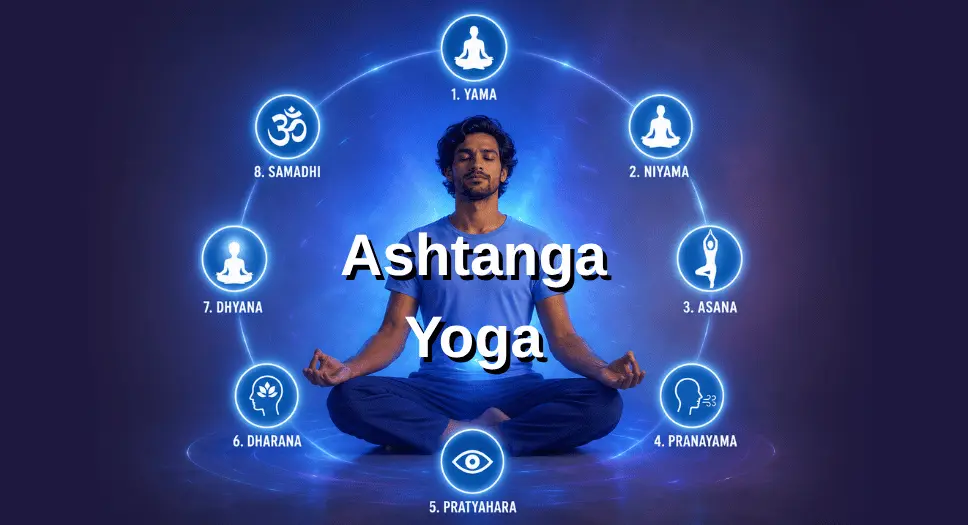
The 8 Limbs of Yoga at a Glance
Before we dive deep, here is a quick overview of all 8 limbs of Ashtanga Yoga:
- Yama – Social Ethics
- Niyama – Personal Ethics
- Asana – Posture
- Pranayama – Breath Control
- Pratyahara – Withdrawal of the Senses
- Dharana – Concentration
- Dhyana – Meditation
- Samadhi – Union / Absorption
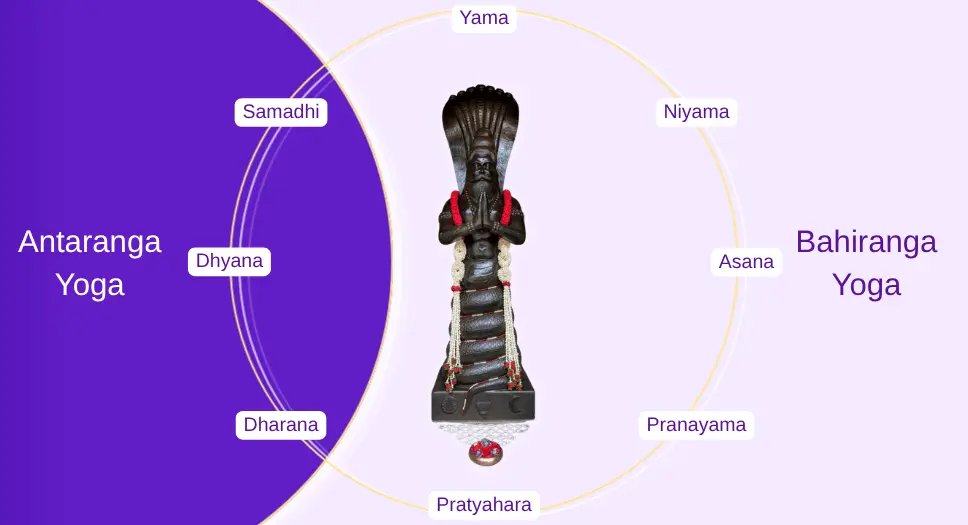
These are not eight separate practices to be chosen from a menu. They are eight interconnected dimensions of yogic living, meant to be cultivated together as one holistic path. The first five limbs Yama, Niyama, Asana, Pranayama, and Pratyahara are collectively known as Bahiranga Yoga (external yoga), because they use indirect techniques to bring the mind under control. The last three Dharana, Dhyana, and Samadhi are known as Antaranga Yoga (internal yoga), as they directly engage and transform the mind from within.
Now, let us understand each limb in its full depth.
Limb 1: Yama – Social Ethics
The first of the eight limbs of yoga is Yama, which translates as restraints or ethical disciplines. Yamas are not imposed restrictions but natural expressions of a life lived with wisdom and compassion. They govern how we interact with the world around us other people, living beings, and nature.
अहिंसासत्यास्तेयब्रह्मचर्यापरिग्रहा यमाः || २.३० ||
There are five Yamas in Ashtanga Yoga by Patanjali:
- Ahimsa (Non-violence): Ahimsa asks us to practice non-violence in thoughts, words, and deeds. It is the most fundamental of all ethical principles. It means refraining from harming others and equally important, refraining from harming ourselves through harsh self-criticism, destructive habits, or violent thinking.
- Satya (Truthfulness): Satya means truthfulness in words, thoughts, and action. Living in alignment with truth creates trust in our relationships, in ourselves, and in our spiritual journey. When our inner and outer lives are consistent, there is no internal conflict.
- Asteya (Non-stealing): Asteya refers to non-stealing of material as well as non-material things. This extends beyond physical theft it includes not stealing someone’s time, ideas, credit, energy, or peace of mind.
- Brahmacharya (Right use of energy): Brahmacharya is generally understood as celibacy or sexual abstinence, but a more complete and nuanced explanation would be the evolution of pleasure. Etymologically, it means the path of Brahma or the path of Truth. It is about directing one’s vital energies toward higher purposes rather than dissipating them.
- Aparigraha (Non-accumulation): Aparigraha means non-accumulation or non-holding of any material wealth. One must understand one’s genuine requirements and must not accumulate more than that. This principle liberates us from the anxiety of possession and teaches contentment.
Practicing the Yamas is the foundation of mental hygiene. When we bring ethical clarity to our external world, the mind naturally becomes less agitated and more available for deeper practice.
Limb 2: Niyama – Personal Ethics
If Yamas govern our relationship with the outer world, Niyamas govern our relationship with ourselves. These are the five personal observances that cultivate self-discipline, inner cleanliness, and devotion.
शौचसन्तोषतपःस्वाध्यायेश्वरप्रणिधानानि नियमाः || २.३२ ||
The five Niyamas in Ashtanga Yoga are:
- Saucha (Purity): Saucha refers to purity in mind and body. This includes cleanliness of the physical body, the environment, the thoughts we entertain, and the words we speak. Inner purity is just as essential as outer hygiene.
- Santosha (Contentment): Santosha is the practice of contentment accepting what is, with gratitude. It doesn’t mean complacency; it means finding peace in the present moment rather than constantly seeking fulfillment in what is absent.
- Tapas (Discipline / Austerity): Tapas refers to penances or disciplined effort. It is the inner fire of self-discipline that burns through laziness, resistance, and distraction. Tapas is what gets us to the mat when we’d rather sleep in.
- Swadhyaya (Self-Introspection): Swadhyaya means self-introspection the study of oneself through reflection, journaling, reading sacred texts, and honest self-observation. It is the practice of turning the lens of awareness inward.
- Ishwara Pranidhana (Surrender to the Divine): Ishwara Pranidhana means complete surrender to Ishwara the divine or universal intelligence. It is the act of releasing the ego’s grip on outcomes and trusting the larger flow of life.
Mental hygiene can be brought about by consistently practicing both Yamas and Niyamas. Together, these two limbs form the ethical and psychological foundation upon which all other aspects of the yogic path are built.
Limb 3: Asana – The Posture
The third of the 8 limbs of yoga is Asana, the limb that most modern practitioners are most familiar with. Yet Patanjali’s vision of Asana is very different from the dynamic, gymnastic sequences we often see today.
स्थिरसुखमासनम् || २.४६ ||
Maharishi Patanjali devotes only three sutras to Asana one for its definition, one for its methodology, and one for its effects on the mind.
- Definition: Asana is a posture that is steady and comfortable. Patanjali’s focus was on meditative asanas postures that should be steady and stable enough to hold for a long period of time. The purpose of Asana in Ashtanga Yoga by Patanjali is to prepare the body to sit still, so the mind can go inward.
- Methodology: When the effort ceases on its own and the practice becomes effortless, it means that purification in Asana is attained. This moves the mind toward the infinite core of one’s being. An effortless alertness is achieved in which the body is steady yet perfectly relaxed. This is the hallmark of true Asana not strain, but ease within stillness.
- Benefit: Then, any conflict can be resolved. A body freed from restlessness and pain no longer pulls the mind into distraction. The practitioner becomes available for the deeper limbs of practice.
In the context of the eight limbs of yoga, Asana is not an end in itself it is a tool for creating the physical stability needed to journey inward.
Limb 4: Pranayama – Breath Regulation
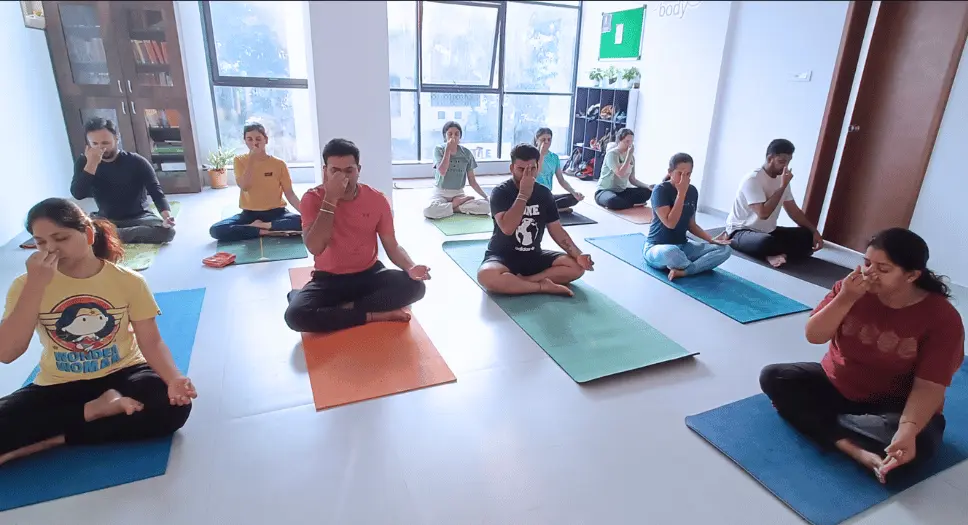
Pranayama is the fourth limb and bridges the external practices with the internal ones. Prana means life force or vital energy; ayama means extension or regulation. Together, Pranayama is the art of consciously working with the breath to influence the state of the mind and the flow of energy in the body.
तस्मिन् सति श्वासप्रश्वासयोर्गतिविच्छेदः प्राणायामः || २.४९ ||
Patanjali explains four types of Pranayama:
- Modification of inhalation (puraka)
- Modification of exhalation (rechaka)
- Stoppage of breath (kumbhaka)
- The fourth, which transcends the subject matter of inhalation and exhalation entirely pointing toward the subtlest dimensions of breath awareness
It is noteworthy that Patanjali’s attention was more toward inhalation and exhalation as compared to Hatha Yoga, in which more focus is on retention of breath. Patanjali says Pranayama happens when there is a break in the ordinary pace or flow of our breath when breathing becomes conscious, intentional, and refined.
Why does breath matter so much in Ashtanga Yoga? Because the breath and the mind are intimately linked. When the breath is agitated, the mind is restless. When the breath becomes smooth and regulated, the mind follows. Pranayama is thus one of the most direct tools available to influence mental states.
Limb 5: Pratyahara – Withdrawal of the Senses
Pratyahara is a pivotal limb the bridge that connects the outer world of the first four limbs with the inner world of the final three. The word means withdrawal or drawing inward.
Our mind clings to the objects of the senses sights, sounds, tastes, smells, and textures constantly pulling our attention outward. Pratyahara means withdrawing the senses inwards, like a tortoise withdraws its limbs into its protective shell. The senses don’t cease to function; they simply stop being pulled away by every external stimulus.
स्वविषयासम्प्रयोगे चित्तस्य स्वरूपानुकार इवेन्द्रियाणां प्रत्याहारः || २.५४ ||
- Pratyahara forms the bridge between the first four limbs and the last three limbs of Ashtanga Yoga.
- In other words, it is during this stage that we start turning our mind inwards with genuine intention.
- Pratyahara is prescribed as the first step to self-control in the Bhagavad Gita, underscoring its universal importance across traditions.
The above five limbs of yoga Yama, Niyama, Asana, Pranayama, and Pratyahara help us gain mastery over our mind by using indirect techniques to handle it. Together, they are known as Bahiranga Yoga (external yoga).
Limb 6: Dharana – Concentration
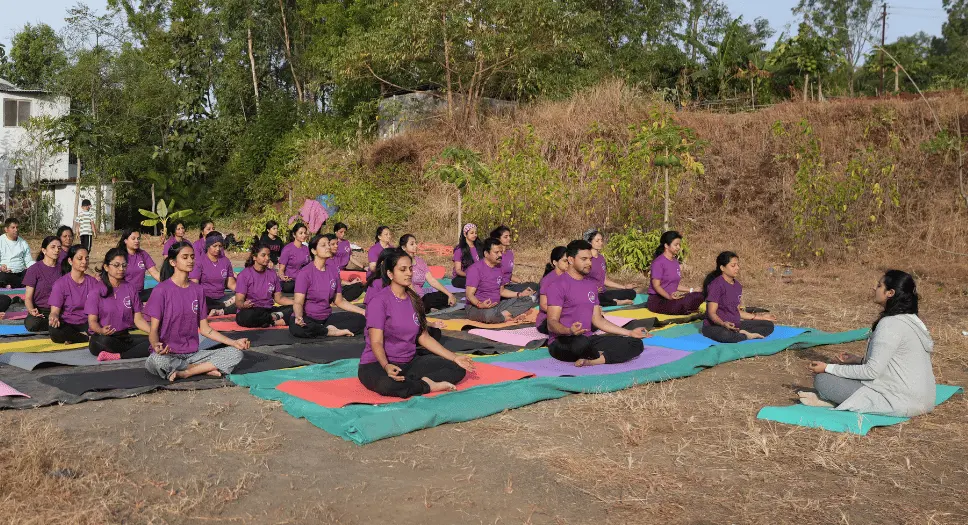
With Pratyahara having drawn the senses inward, Dharana takes the practice a step further. Dharana is fixing the mind or concentration onto a particular object either within the body or outside it making a deliberate effort to destroy all distractions.
This is the first stage of formal meditation according to Patanjali. It is active and effortful the meditator is consciously choosing to hold the mind on a single point and gently returning each time it wanders.
देशबन्धश्चित्तस्य धारणा || ३.१ ||
In Dharana, there are three elements:
1. The meditator the one who is concentrating
2. The object being meditated upon a candle flame, a mantra, a chakra, the breath, etc.
3. The process of meditation the ongoing act of directing and redirecting attention
Dharana is the training ground. It is where the practitioner learns that the mind can be directed that attention is a trainable faculty, not a helpless leaf blown about by the winds of thought.
Limb 7: Dhyana – Meditation
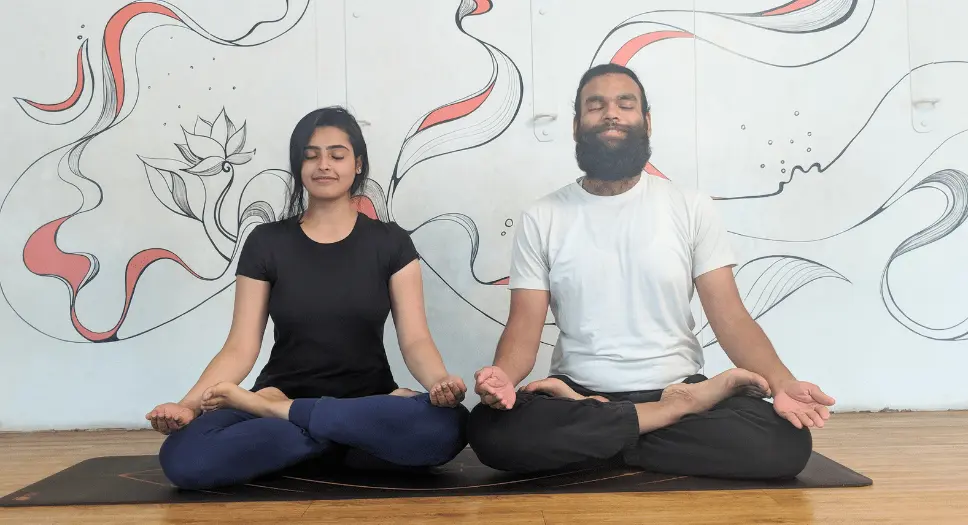
Where Dharana is concentration, Dhyana is meditation in its truest form. When there are no distractions left in the mind when one can concentrate effortlessly, without struggle it is called Dhyana.
In Dhyana, the meditation process becomes seamless. There is no longer a gap between the meditator and the object. There is no longer a constant effort to return the mind. The mind rests naturally in the object of focus, like a river flowing unobstructed to the sea.
तत्र प्रत्ययैकतानता ध्यानम् || ३.२ ||
In Dharana, three elements are present. In Dhyana, only two remain:
- The meditator
- The object being meditated upon
The process of meditation the conscious effort has dissolved. If Dharana is concentration, Dhyana is deconcentrating. There is no force. There is only presence.
This is the quality of consciousness that long-term practice and deep inner work are building toward an effortless, luminous awareness.
Limb 8: Samadhi – Union and Absorption
Samadhi is the pinnacle of Ashtanga Yoga by Patanjali the final limb and the ultimate fruit of the entire journey. It represents the culmination of everything that has come before.
In Dharana and Dhyana, there are three elements the meditator, the meditation process, and the object meditated upon. In Samadhi, the meditator and the meditation process disappear, and only the object meditated upon shines forth. You finally drop your sense of separate existence and become one with the object of meditation. That state of complete dissolution of self into the infinite is called Samadhi.
It is Samadhi which leads one toward the experience of Kaivalya the state of absolute liberation, freedom, and aloneness (in the deepest philosophical sense pure consciousness without the veil of the ego).
तदेवार्थमात्रनिर्भासं स्वरूपशून्यमिव समाधिः || ३.३ ||
Patanjali describes three types of Samadhi:
1. Sabija Samadhi – “With seed” a state of deep absorption that still carries the seeds of karma and individuality
2. Nirbija Samadhi – “Without seed” a state where all karmic seeds are dissolved
3. Dharma Megha Samadhi – The highest state, described as a “cloud of virtue,” the ultimate flowering of consciousness
The last three limbs Dharana, Dhyana, and Samadhi are together known as Antaranga Yoga, the internal yoga, involving direct techniques for handling the mind and gaining complete mastery over it. These three, when practiced together in a single session of focused inner work, are collectively referred to as Samyama, the combined thread of concentration, meditation, and absorption.
The Significance of Ashtanga Yoga in Modern Life
Many people wonder whether an ancient system like Ashtanga Yoga the 8 limbs of yoga described by Patanjali centuries ago has any relevance in today’s fast-paced, distraction-saturated world. The answer is: more than ever.
Consider what modern life demands of us:
- We are constantly bombarded by sensory stimulation → Pratyahara teaches us to turn inward
- We struggle with chronic stress and shallow breathing → Pranayama restores balance
- We are physically sedentary yet energetically depleted → Asana renews vitality
- We act impulsively, often harming ourselves and others → Yama and Niyama restore ethical clarity
- We are mentally scattered and unable to focus → Dharana trains sustained attention
- We rarely experience silence or stillness → Dhyana offers a gateway to peace
- We live entirely at the surface of life → Samadhi reveals the depths
The eight limbs of yoga are not a rigid prescription. They are an intelligent, deeply human map for navigating the complexity of consciousness. Each limb complements the others. Each one deepens your experience of all the rest.
Bahiranga and Antaranga – The Inner and Outer Yoga
To summarize this elegant structure:
Bahiranga Yoga (External / Indirect Path):
- Yama
- Niyama
- Asana
- Pranayama
- Pratyahara
These five limbs work on the outer layers the body, breath, ethical behavior, and senses and indirectly bring the mind toward stillness. They purify the ground so that deeper work can happen.
Antaranga Yoga (Internal / Direct Path):
- Dharana
- Dhyana
- Samadhi
These three limbs work directly on the mind concentrating it, refining it, and ultimately transcending the separate sense of self. Together with Samyama, they represent the apex of yogic science.
Final Thoughts: Walking the Eightfold Path
Understanding the eight limbs of yoga is not merely an intellectual exercise. It is an invitation to examine how you live, how you breathe, how you hold your body, how you focus your mind, and ultimately, how you understand the nature of your own consciousness.
Ashtanga Yoga by Patanjali offers us not a religion, not a belief system, but a methodology a time-tested, experiential path that has guided seekers across millennia toward greater health, clarity, peace, and ultimately, liberation.
Whether you are new to yoga or a seasoned practitioner, returning to the 8 limbs of Ashtanga Yoga can transform your practice from the inside out. It reminds us that yoga is not something we do for an hour on a mat it is something we live, breath by breath, choice by choice, moment by moment.
Deepen Your Practice at the Hatha Yoga Institute
If this exploration of Ashtanga Yoga and the eight limbs of yoga has sparked something in you a curiosity, a yearning to go deeper we warmly invite you to continue your journey with us at the Hatha Yoga Institute.
At the Hatha Yoga Institute, we honour the classical roots of yoga while making its wisdom accessible to modern practitioners. Our programs are rooted in the teachings of Ashtanga Yoga by Patanjali, integrating all 8 limbs of Ashtanga Yoga into a holistic curriculum that nurtures body, mind, and spirit.
What we offer:
- Foundational and advanced Ashtanga Yoga and Hatha Yoga courses
- In-depth study of Patanjali’s Yoga Sutras
- Pranayama and meditation immersions
- Yoga Teacher Training Programs (TTCs) rooted in classical philosophy
- Weekend workshops and residential retreats
Whether you are beginning your yogic journey or seeking to deepen an existing practice, the Hatha Yoga Institute provides a space for authentic learning, genuine transformation, and community. Our experienced teachers bring the eight limbs of yoga alive not as theory, but as lived experience.