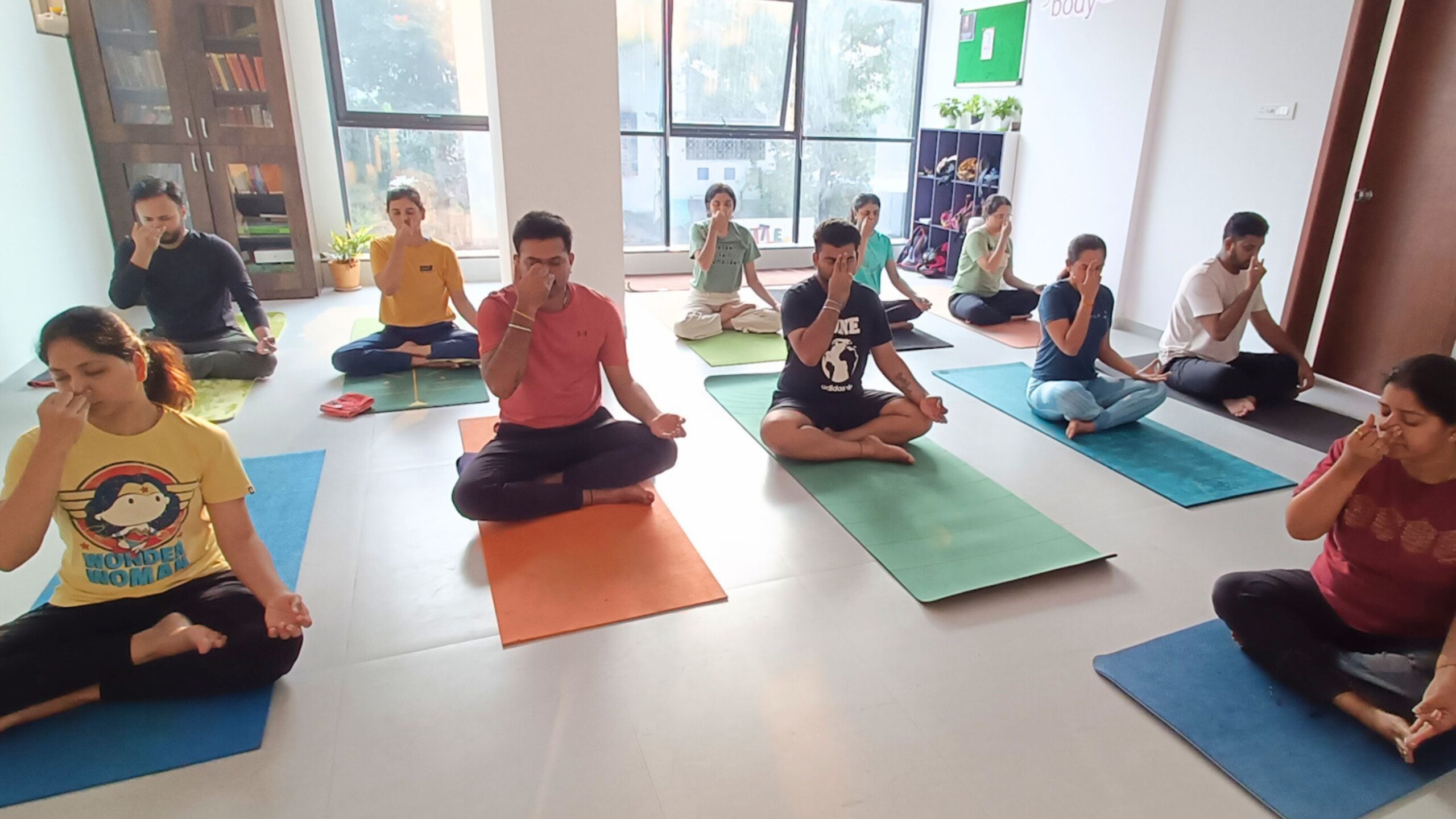
Most people step onto a yoga mat to stretch, sweat or relax. Far fewer realise that the classical texts place posture quite low on the list of priorities. Before asana and breathwork, the sage Patanjali described a set of ethical and personal guidelines that shape how a student lives. These are the yamas and niyamas, and they form the moral and inner base of the entire system.
If you have ever wondered why a calm mind is so hard to find even after years of practice, the answer often lies here. Without a stable foundation of conduct, advanced techniques give shaky results. This guide explains each principle in plain language, shows where it fits within the eight limbs of yoga, and offers practical ways to bring it into ordinary days. If you want a structured path alongside your reading, Hatha Yoga Institute teaches these ideas as part of its traditional courses.
In this article you will learn:
- What the ten guidelines mean and where they come from
- How each restraint and observance works in real life
- Common mistakes students make when they begin
- Simple daily habits that build the foundation step by step
What Are Yamas and Niyamas?
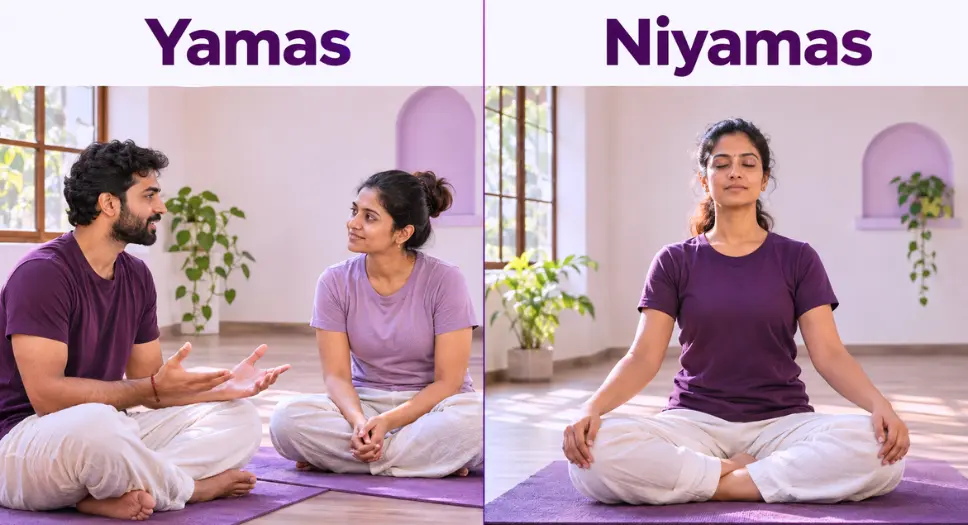
The Sanskrit word yama means restraint, and niyama means observance. Put simply, the yamas are the things we choose to hold back from, while the niyamas are the habits we choose to build. One group mainly shapes how we treat the world around us. The other mainly shapes how we treat ourselves.
Think of a tree. The roots stay hidden underground, yet everything visible depends on them. In the same way, the postures and breathing techniques people see in a class rest on a hidden root system of character. A student who can touch their toes but speaks harshly, hoards possessions or neglects their own health has built only the branches.
Both groups are listed in the second chapter of the Yoga Sutras, the Sadhana Pada, which deals with practice. There are five principles in each group, giving a clear set of ten. Together, the yamas and niyamas work as a practical code that any person can follow, whatever their background or belief.
Quick overview:
- Five restraints (yama): Ahimsa, Satya, Asteya, Brahmacharya, Aparigraha
- Five observances (niyama): Saucha, Santosha, Tapas, Svadhyaya, Ishvara Pranidhana
- Purpose: to purify conduct, steady the mind and prepare the student for meditation
Who Was Patanjali, and Why Do These Principles Matter?
Patanjali is the compiler of the Yoga Sutras, a collection of short verses that organise the science of yoga into a clear path. Historians place the text roughly between 200 BCE and 400 CE, although the traditions it draws on are far older. The sutras are brief on purpose. Each line is meant to be studied with a teacher, who unpacks it with examples and personal guidance.
Patanjali begins by defining yoga as the stilling of the fluctuations of the mind. The rest of the text explains how to reach that stillness. He does not start with difficult poses. He starts with how a person behaves, because a restless life produces a restless mind. If your day is full of lies, resentment and clutter, sitting quietly will only show you the noise.
One verse in the second chapter says the restraints are a great vow that holds true regardless of birth, place, time or circumstance. That is a bold claim. It suggests that these principles are not cultural rules for one group, but universal supports for anyone who wants clarity.
Where They Fit in the Eight Limbs of Yoga

Patanjali’s path is called Ashtanga, which means eight limbs. Each limb builds on the one before it, moving from outer conduct toward inner stillness.
- Yama: ethical restraints toward others and the world
- Niyama: personal observances toward oneself
- Asana: steady, comfortable posture
- Pranayama: conscious regulation of breath
- Pratyahara: withdrawal of the senses from distraction
- Dharana: focused concentration
- Dhyana: sustained meditation
- Samadhi: complete absorption and freedom
Notice that the yamas and niyamas take the first two places. Posture comes third. This order is a quiet reminder that the mat is only one small room in a much larger house. Modern studios often start at limb three and skip the first two, which explains why many students feel something is missing even when their flexibility improves.
The Five Yamas: Ethical Restraints

The five yamas train us to act with care toward others. Each one is simple to state and surprisingly deep to practise.
1. Ahimsa: Non-Violence
Ahimsa is usually listed first because the other restraints grow from it. It means avoiding harm in thought, word and action. That includes obvious violence, but also sharp speech, silent resentment and the way we speak about ourselves when we make a mistake.
How to practise ahimsa:
- Pause for one breath before replying to an irritating message
- Notice self-critical thoughts and answer them as you would answer a friend
- Practise postures within your own range instead of forcing a deeper shape
- Choose kindness in small choices, including food, shopping and daily speech
2. Satya: Truthfulness
Satya asks us to live in line with what is real. This goes beyond avoiding lies. It means speaking clearly, keeping promises and not pretending to be someone you are not. Classical teachers add one condition: truth should be spoken with care, so that it does not become a weapon.
How to practise satya:
- Say “I do not know” when you do not know
- Avoid exaggeration, flattery and small convenient excuses
- Match your actions to your stated values
- Be honest with yourself about your limits on the mat
3. Asteya: Non-Stealing
At the simplest level, asteya means not taking what is not freely given. At a deeper level, it includes stealing time, credit, attention and energy. Being late again and again, taking credit for a colleague’s idea, or draining a friend with endless complaints are all quiet forms of taking.
How to practise asteya:
- Arrive on time and respect other people’s schedules
- Give credit openly and generously
- Release envy by appreciating what others have achieved
- Use shared resources, such as a studio or a classroom, with care
4. Brahmacharya: Wise Use of Energy
Brahmacharya is often translated as celibacy, and in monastic settings that meaning is kept. For householders, teachers increasingly explain it as moderation and the wise use of vital energy. The question it raises is simple: where is your energy going, and does it serve your growth?
How to practise brahmacharya:
- Keep a sensible daily routine with regular sleep and meals
- Limit habits that drain focus, such as endless scrolling
- Practise moderation instead of extremes in food, work and pleasure
- Protect your mornings for practice, reading or quiet
5. Aparigraha: Non-Possessiveness
Aparigraha means not grasping. It is the habit of holding things lightly, whether they are possessions, opinions, relationships or results. Much of modern stress comes from clinging to how things should be. Letting go does not mean owning nothing. It means not being owned by what you have.
How to practise aparigraha:
- Clear one drawer or shelf each week and donate what you do not use
- Do your work well without gripping the outcome
- Allow other people to change and grow
- Treat achievements in your practice as passing, not as identity
Teacher’s note: The five restraints are not meant to be mastered in a month. Choose one, observe it for a week, and notice where it is hardest. That honest observation is already the practice.
The Five Niyamas: Personal Observances
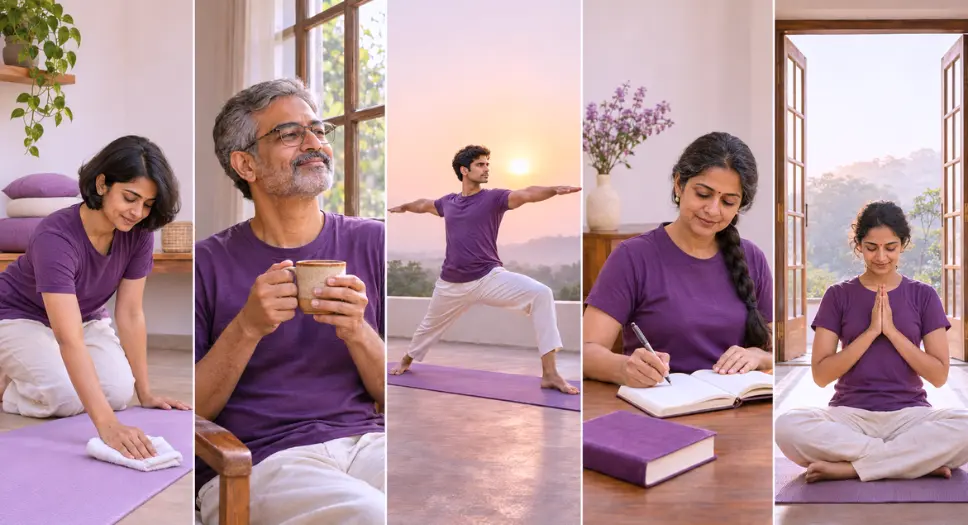
If the first group looks outward, the niyamas look inward. They describe the daily habits that keep a practitioner clean, content, disciplined, curious and humble.
1. Saucha: Purity and Cleanliness
Saucha covers cleanliness of body, surroundings and mind. In the Hatha tradition it is closely linked with the cleansing techniques known as shatkarma. On an everyday level, it includes tidy spaces, wholesome food, regular bathing and a mind that is not crowded with unnecessary noise.
How to practise saucha:
- Begin the morning with a clean practice space
- Choose fresh, simple meals more often than heavy processed ones
- Reduce mental clutter by limiting constant news and notifications
- Wash the mind with a few minutes of quiet breathing
2. Santosha: Contentment
Santosha is the ability to feel settled with what is present. It is not laziness, and it does not mean giving up on growth. It means that your peace is not postponed until the next promotion, the next purchase or the next perfect posture.
How to practise santosha:
- End each day by noting three things that went well
- Notice the urge to compare yourself with others, then let it pass
- Accept the body you have today, including stiffness and tiredness
- Work with full effort, while accepting that results are not entirely in your hands
3. Tapas: Disciplined Effort
The word tapas literally means heat. It is the steady fire of self-discipline that burns away laziness and habit. Tapas shows up as waking early to practise, staying with a difficult posture a little longer, or choosing a healthier habit when a harmful one is easier.
How to practise tapas:
- Set a small daily commitment, such as ten minutes of practice, and keep it
- Stay with discomfort that is useful, never with pain that is harmful
- Follow a routine even when motivation is low
- Review your habits once a month and adjust with honesty
4. Svadhyaya: Self-Study
Svadhyaya has two layers. The first is the study of inspiring texts, such as the Yoga Sutras, the Bhagavad Gita and the Hatha Yoga Pradipika. The second is the study of the self through reflection and observation. Both work together: the text offers a mirror, and your own life supplies the evidence.
How to practise svadhyaya:
- Read a few lines of a yoga text each day and reflect on them
- Keep a short journal of thoughts, moods and reactions
- Notice patterns in your own behaviour without judgement
- Learn from a teacher who can guide your questions
5. Ishvara Pranidhana: Surrender
Ishvara pranidhana means offering your actions to something larger than the personal ego. For some people this is a personal form of the divine. For others it is nature, humanity or simply the order of life. Either way, the attitude is the same: do your best, then release the need to control everything.
How to practise ishvara pranidhana:
- Begin practice with a moment of silence or gratitude
- Act with sincerity and let go of the need for applause
- Trust the slow process of growth
- Dedicate the benefit of your effort to something beyond yourself
How the Two Groups Work Together
It is tempting to treat the ten principles as a checklist, but they function more like a conversation. Non-violence supports self-acceptance. Truthfulness supports self-study. Non-possessiveness supports contentment. When one improves, the others tend to follow.
They also protect each other from excess. Discipline without contentment turns into harsh perfectionism. Contentment without discipline slides into drift. Truthfulness without non-violence becomes cruelty. By holding both sets together, the student gets a balanced approach that neither pushes too hard nor sits too still.
How to Practise in Daily Life
You do not need a retreat or a special room to begin. Ordinary life is the training ground. Here is a gentle, realistic way to start.
A simple seven-day approach:
- Day 1: Observe your speech. Notice when it is kind and when it is careless.
- Day 2: Practise telling the plain truth, gently, in small matters.
- Day 3: Watch for moments when you take time, credit or attention that is not yours.
- Day 4: Protect your energy by setting one clear boundary with your phone.
- Day 5: Let go of one possession or one grudge.
- Day 6: Keep your space clean and write three things you are grateful for.
- Day 7: Read a short passage, sit quietly and reflect on the week.
Tips for staying consistent:
- Pick one principle per week instead of trying all ten at once
- Link the practice to an existing habit, such as morning tea or an evening walk
- Forgive lapses quickly and begin again
- Share the journey with a friend or a study group
The aim is not perfection. The aim is awareness, and awareness grows with repetition.
Common Mistakes and Misunderstandings

Because these principles sound simple, students often misread them. Watch out for the following.
- Treating them as rigid rules. They are guidelines for awareness, not a list of punishments.
- Using non-violence as an excuse for weak boundaries. Ahimsa does not mean letting others harm you.
- Confusing contentment with passivity. Santosha supports effort. It simply removes the anxiety around it.
- Practising discipline as self-punishment. Tapas should build strength, not damage the body or mind.
- Skipping them to reach advanced poses faster. This usually leads to injury, ego or burnout.
- Studying them only as theory. Their value appears when they are tested in real situations, such as traffic, family disagreements and work pressure.
If you are unsure how to apply a principle in a particular situation, a teacher can help you see it clearly. This is one reason traditional yoga has always been taught through direct guidance and not through books alone.
Benefits of Living by These Principles
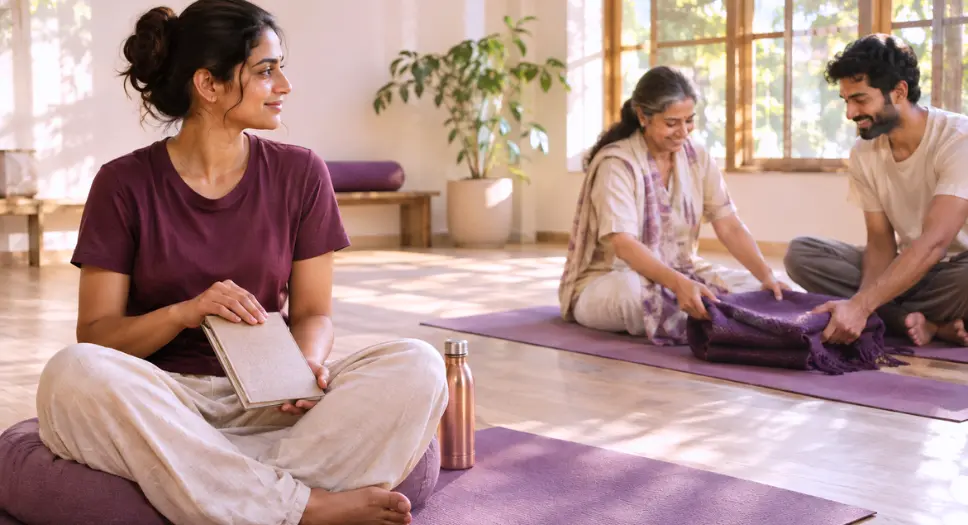
Over time, steady practice of the ten guidelines tends to bring noticeable changes, both inside and outside the studio.
- Calmer mind: Fewer conflicts and regrets leave less mental noise to quiet.
- Better relationships: Honesty, patience and generosity build trust.
- Healthier habits: Cleanliness, moderation and discipline support physical well-being.
- Deeper meditation: A settled life makes concentration much easier.
- Greater self-awareness: Regular reflection reveals patterns before they become problems.
- Resilience: Contentment and surrender soften the impact of setbacks.
None of these results is dramatic overnight. They build quietly, like interest in a savings account.
Frequently Asked Questions

1. Are the five yamas and five niyamas only for yoga teachers?
No. They are for anyone who wants a more thoughtful and balanced life. Teachers carry an added responsibility to model them, but students at every level benefit.
2. Do I need to follow a religion to practise them?
No. The principles are ethical and psychological. Many people of different faiths, and many with none, apply them in daily life. Ishvara pranidhana can be understood in a personal, devotional way or as simple humility before life itself.
3. Which principle should a beginner start with?
Most teachers suggest ahimsa, since it softens the approach to everything else. Begin by treating yourself and your body with kindness during practice.
4. How long does it take to see results?
Many people notice small shifts in a few weeks, such as better sleep or calmer reactions. Deeper change takes months or years of steady effort.
5. Can I learn these principles online?
Yes. Online and offline courses both work well, as long as you have access to an experienced teacher who can answer questions and give feedback.
Conclusion
The teachings of Patanjali remind us that yoga is not a performance on a mat. It is a way of living that begins with how we treat others and how we treat ourselves. The yamas give us a gentle code for relating to the world, and the niyamas give us habits for caring for the inner life. Together they create the stable ground on which posture, breathing and meditation can grow.
You do not need to master all ten at once. Choose one, practise it for a week, and let the experience teach you. Over time, small daily choices add up to a steadier mind and a more peaceful life.
If you feel ready to study these ideas with authentic guidance, explore the courses at Hatha Yoga Institute, a registered yoga school with Yoga Alliance, USA, offering certificate and diploma programs, classes, workshops and retreats rooted in traditional Hatha Yoga.
Looking for a trusted place to begin your yoga teacher training journey? Choose from certificate, advanced and diploma courses at Hatha Yoga Institute, with expert faculty, flexible online and offline options, and a supportive learning community. Learn more