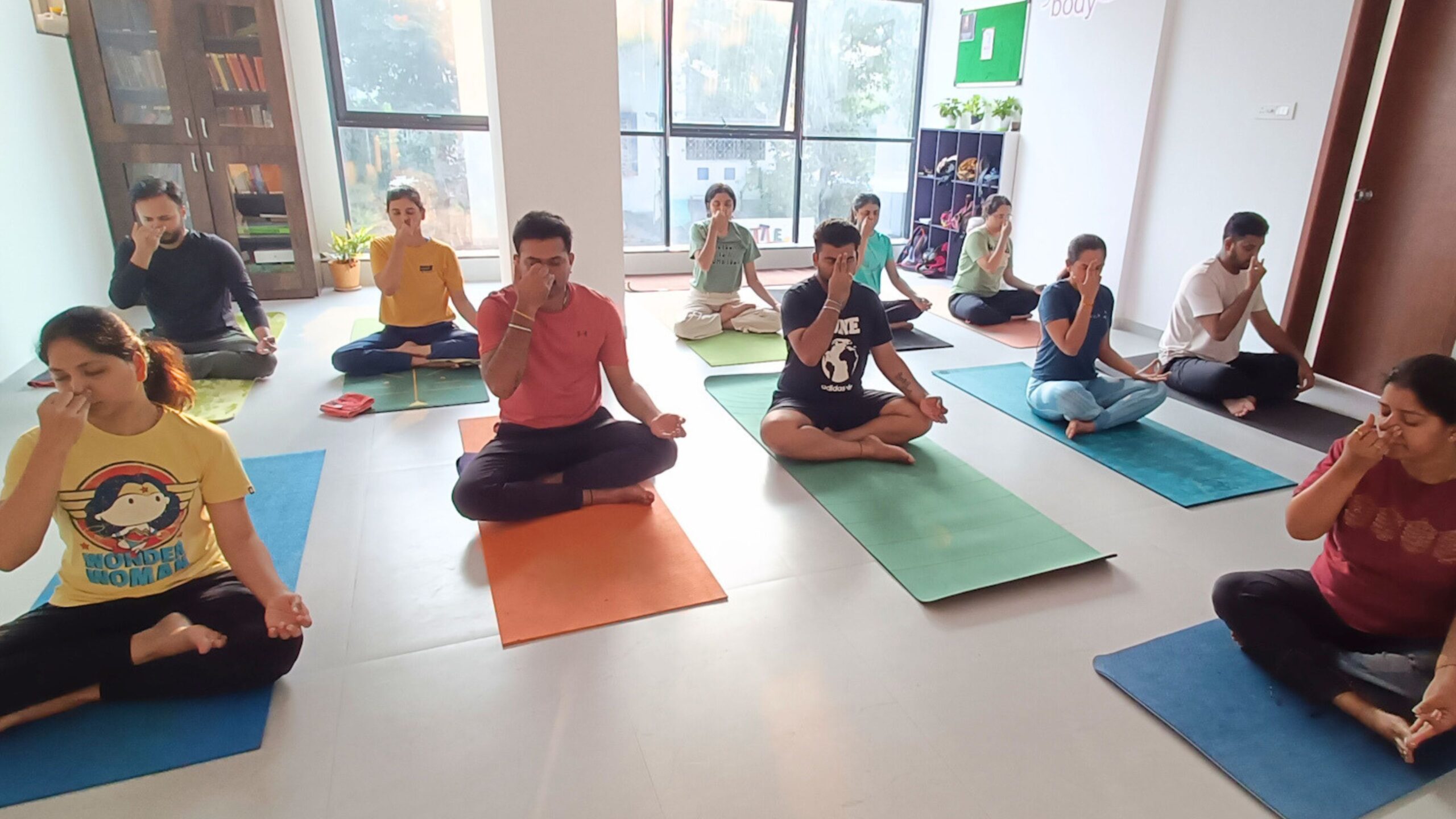
Most people who step onto a yoga mat expect the difficulty to come from the practice itself. They expect tight hamstrings, a restless mind during meditation, or the discomfort of sitting still for twenty minutes. What very few expect is that the real resistance often comes from outside the mat, hidden inside the ordinary habits of daily life.
Classical yogic texts were unusually honest about this. Long before modern studios and teacher training programs existed, the tradition had already mapped out the exact behaviours that dissolve progress. These are known as the six badhak tattva, the six obstructing principles. The word carries the sense of something that blocks, obstructs, or interferes. A badhak factor does not attack your practice directly. It simply drains the energy and steadiness that your practice depends on, until one day you notice that nothing is deepening anymore.
This is not a moral list. It is a diagnostic list. Understanding it gives you a way to look at your own life honestly and ask why your practice has stalled.
Understanding the Meaning of Badhak Tattva
In yogic philosophy, a tattva is a principle or element, something fundamental rather than incidental. When the tradition pairs this word with badhak, it is pointing to six root causes of failure rather than six occasional mistakes.
The teaching is direct in its warning: the whole purpose of yoga can be destroyed by these six characteristics. That is strong language, and it is deliberate. The texts are not saying your practice will be slightly less effective. They are saying the aim of yoga, which is inner stillness and self-knowledge, becomes unreachable when these six patterns dominate your life.
Why These Obstacles Are So Easy to Miss
What makes these obstacles so effective is their ordinariness:
- None of them look like spiritual failures. They look like normal living.
- Each one is socially acceptable and often socially encouraged.
- They operate slowly, so their cost is rarely traced back to them.
- They tend to reinforce one another rather than appear alone.
A practitioner can be extremely sincere on the mat and still lose ground steadily, simply because the other twenty three hours of the day are working in the opposite direction.
1. Atyahara: Overeating and Emotional Consumption

The first obstruction is atyahara, which translates as overeating. In its simplest form it means eating more than the body actually requires. In its subtler form it means emotional eating, consuming food for comfort, boredom, anxiety, or distraction rather than genuine hunger.
The classical concern here is practical rather than aesthetic. A heavily loaded digestive system pulls prana and blood flow toward digestion. The body becomes dull, the breath becomes shallow, and the mind becomes heavy. Anyone who has attempted meditation after a large meal knows exactly what the texts are describing. Concentration becomes almost impossible, and asana practice feels sluggish and uncomfortable.
There is a psychological dimension too. Overeating is usually an attempt to manage an emotional state through the body. Instead of feeling restlessness, we fill it. Instead of sitting with discomfort, we distract from it. Yoga asks for the opposite movement, which is to stay present with what arises rather than smothering it.
Signs Atyahara May Be Affecting Your Practice
- Heaviness, drowsiness, or fog in the hours after meals
- Eating past the point of satisfaction out of habit
- Reaching for food during stress, loneliness, or boredom
- Difficulty in maintaining steady breath during practice
- Feeling that the body is present on the mat but the energy is not
Working With This Obstruction
Working with this obstruction does not require extreme restriction. In fact, rigid dieting creates a different problem entirely, which the fourth obstacle addresses directly. The traditional guideline is moderation and awareness:
- Eat until roughly three quarters full rather than completely full
- Favour simple, fresh, easily digestible food
- Leave a gap of two to three hours between eating and practice
- Eat without screens so the body can register satisfaction
- Notice the emotion present before you eat, not only the hunger
The aim is a body that feels light, clear, and available for practice. That single change often transforms the quality of meditation more than any technique.
2. Prayasa: Over-Exertion and Effort Beyond Capacity

The second badhak factor is prayasa, meaning exertion beyond the required limit of your abilities, whether physical or mental. This is the obstacle that catches ambitious practitioners, and it is deeply misunderstood in modern yoga culture.
Prayasa is not about being lazy or avoiding effort. Yoga clearly requires sustained effort. The obstruction lies in effort that exceeds capacity, effort driven by comparison, impatience, or the desire to achieve a result faster than the body and mind can absorb it.
Physically, this shows up as forcing the body into postures it is not ready for, practising through genuine pain, or maintaining a schedule that leaves no room for recovery. The result is injury, exhaustion, and eventually withdrawal from practice entirely.
Mentally, prayasa is even more common. It looks like straining during meditation, gripping at concentration, or treating the practice as a performance to be won. Effort of this kind agitates the nervous system, which is precisely the opposite of what meditation requires.
Common Forms of Prayasa
- Pushing into deeper postures before the foundation is stable
- Practising long hours while sleeping poorly and eating irregularly
- Treating flexibility milestones as proof of spiritual progress
- Straining the mind to force stillness rather than allowing it
- Ignoring signals of fatigue because rest feels like failure
Building a Sustainable Rhythm
- Work at roughly seventy to eighty percent of your maximum, not at your edge every day
- Prioritise consistency over intensity, since daily moderate practice outperforms occasional extremes
- Build genuine rest into the week rather than treating it as a reward
- Let the breath be the measure, because if the breath is strained, the effort is excessive
Sustained, unforced effort over years produces results that heroic effort over months never will.
3. Prajalpa: Excessive Talking and the Leak of Energy

The third obstruction is prajalpa, which refers to talkativeness, or the habit of speaking continuously. In practical terms this is excessive talking, and it is one of the most underestimated obstacles on the list.
Speech consumes energy. More importantly, it consumes attention. Every conversation requires the mind to gather itself, project outward, and organise thought into words. When this happens continuously, there is very little inner reserve remaining for practice. The mind becomes accustomed to expressing everything immediately and loses the capacity to hold experience silently.
The tradition also points to the content of speech, not only the quantity. Gossip, complaint, argument for its own sake, and constant commentary keep the mind agitated long after the conversation ends. Anyone who has tried to meditate after a heated discussion has experienced this directly.
There is a modern extension of prajalpa that the classical texts could not have named but which fits perfectly. Excessive talking now includes endless messaging, scrolling through comment threads, and the compulsive need to share every thought publicly. The mechanism is identical, which is outward projection that leaves nothing held within.
Indicators of Prajalpa
- Discomfort with silence, and a need to fill every pause
- Speaking before thinking, then replaying conversations afterward
- Frequent participation in gossip, complaint, or debate
- Feeling drained after social interaction without knowing why
- A mind that continues talking internally even when the mouth is closed
Practical Ways to Reduce This Obstruction
- Keep a short period of deliberate silence each day, even fifteen minutes
- Practise mauna, or intentional silence, for a few hours weekly
- Before speaking, briefly ask whether the words are true, useful, and necessary
- Reduce unnecessary digital chatter as seriously as verbal chatter
- Notice how a quiet morning affects the depth of your meditation
Practitioners who reduce excessive talking often report that meditation becomes noticeably easier within weeks. The mind is simply less scattered.
4. Niyamagraha: Rigid Adherence to Rules

The fourth badhak principle is the most surprising one, and it is frequently misread. Niyamagraha refers to excessive adherence to rules and regulations. The teaching states clearly that too much adherence to any rule, whether the rule itself is good or bad, can cause hindrance on the path of yoga.
This seems contradictory. Yoga is full of disciplines, observances, and guidelines. How can following them be an obstacle?
The distinction lies between discipline and rigidity. Discipline serves awareness. Rigidity replaces it. When a practitioner becomes attached to the rule itself, the rule stops being a tool and becomes an identity. The person is no longer practising yoga. They are performing compliance.
Niyamagraha shows up in two opposite ways. Some practitioners become obsessive about routines, diets, timings, and purity to the point where anxiety replaces the peace the practice was meant to cultivate. Others adopt rules carelessly, following external instructions without ever understanding their purpose, which is equally mechanical.
Signs of Niyamagraha
- Guilt or distress when a routine is disrupted by ordinary life
- Judging other practitioners for their choices and standards
- Following instructions strictly without understanding their reason
- Rules that increase anxiety rather than reduce it
- An identity built around being disciplined rather than being aware
The Balanced Approach
- Understand the purpose behind each guideline you adopt
- Hold your discipline firmly but not desperately
- Allow flexibility when circumstances genuinely require it
- Review your practices periodically and ask whether they still serve you
- Remember that the goal is inner freedom, not perfect compliance
A rule that creates tension has already stopped doing its work.
5. Jana Sangha: The Influence of Company

The fifth obstruction is jana sangha, the company of common people. This phrase deserves careful explanation, because it is easily misunderstood as elitism. It is not.
The teaching observes that being in ordinary company generates ordinary feelings such as lust, anger, hatred, attachment, and comparison. A practitioner aiming at steadiness is advised to remain away from these influences. The concern is not about social status or worth. It is about emotional contagion.
We absorb the emotional temperature of the people around us. Spend an evening among people who are anxious and competitive, and the mind adopts that rhythm. Spend time among people who are calm and reflective, and the mind settles accordingly. This is not mysticism. It is simply how nervous systems respond to one another.
Modern practitioners rarely have the option of withdrawing to a cave, and the teaching does not demand it. What it asks is discernment about where you place your attention and with whom you spend your unstructured time.
Where This Obstacle Typically Appears
- Social settings that reliably provoke anger, envy, or craving
- Relationships built primarily on complaint and negativity
- Environments where your practice is mocked or quietly undermined
- Digital spaces engineered to trigger outrage and comparison
- Company that pulls you back into old patterns you have worked to change
Practical Navigation
- Seek satsang, meaning company that supports your direction
- Maintain your responsibilities and relationships without absorbing every mood
- Protect the first hour after waking and the last before sleeping
- Treat your media consumption as company, because it functions the same way
- Notice which interactions leave you settled and which leave you agitated
You are not required to abandon anyone. You are asked to stop being shaped unconsciously.
6. Laulya: Fickleness and the Restless Mind

The sixth and final obstruction is laulya, described as fickle-mindedness. The texts characterise it as a feverishness to satisfy a particular sense, and they name it as a cause of failure because it interrupts the steadiness of a practitioner.
Fickleness is the mind that cannot stay. It jumps from one desire to another, one method to another, one teacher to another, always convinced that the next option holds what the current one lacks. On the surface it appears as enthusiasm. Underneath it is restlessness wearing the costume of curiosity.
This obstacle is particularly relevant today, because we have unlimited access to techniques, styles, and traditions. A practitioner can spend years sampling without ever going deep enough for anything to mature. Depth requires staying, and fickleness makes staying feel unbearable.
Laulya also appears as sensory craving, meaning the urgent pull toward a taste, a sensation, or a stimulation that must be satisfied immediately. Each surrender to that urgency strengthens the pattern, and the mind becomes progressively less capable of sitting with an unfulfilled impulse.
How Fickleness Presents Itself
- Abandoning a practice after a few weeks because results feel slow
- Constantly researching new methods instead of doing the current one
- Intense enthusiasm at the start of anything, followed by rapid fading
- Inability to remain with discomfort without immediately seeking relief
- A sense of restlessness that no amount of change ever resolves
Working With Laulya
- Commit to one method for a fixed period, ideally six months minimum
- Keep the practice small enough that you can sustain it on difficult days
- Track consistency rather than sensation, since sensations fluctuate
- Practise delaying small urges deliberately to build tolerance
- Understand that boredom is often the doorway to depth, not a signal to leave
Steadiness is the quality that all six obstacles ultimately attack, and laulya attacks it most directly.
How the Six Obstacles Reinforce Each Other
These six factors rarely appear in isolation. They form a self-sustaining loop, which is exactly why the tradition treats them as a single teaching rather than six separate warnings.
Consider a typical sequence. Restlessness leads to overeating for comfort. The heaviness that follows makes practice difficult, so the practitioner compensates with over-exertion on better days. Frustration leads to seeking reassurance through excessive talking and social validation. That company generates comparison, which produces either rigid rule-following to prove seriousness, or fickleness and a search for a new method. Each step feels reasonable on its own.
Breaking the Loop
Breaking the loop does not require attacking all six simultaneously. That itself would be prayasa. The more effective approach:
- Choose the single obstacle that is most active in your life right now
- Work on it consistently for several weeks without adding anything else
- Observe how the others weaken as steadiness returns
- Review honestly every month rather than daily
- Treat relapse as information, not as failure
Self-honesty is the real practice here. Most practitioners already know which of the six is theirs. The difficulty is admitting it.
A Simple Self-Assessment

Ask yourself these questions without defending your answers:
- Do I finish meals feeling light or feeling heavy?
- Does my effort in practice feel sustainable or driven?
- How much of my daily speech is genuinely necessary?
- Do my disciplines bring calm or anxiety?
- Does my usual company leave me steadier or more agitated?
- Have I stayed with one method long enough for it to mature?
Whichever question produced discomfort is likely pointing to your primary badhak factor. That discomfort is useful. It is the beginning of correction.
Deepening Your Understanding with the Hatha Yoga Institute
Teachings like the six badhak tattva reveal their full value when they are studied within a structured framework rather than absorbed in fragments. The classical texts assume a teacher, a community, and a progression, because subtle principles of this kind are easily misapplied when studied alone.
At the Hatha Yoga Institute, traditional hatha yoga is taught with attention to both the philosophy and the practice that supports it. Students work through the foundational texts, learn asana and pranayama with proper alignment and progression, and receive guidance on integrating these teachings into ordinary working life rather than only in retreat conditions. Whether you are beginning your journey, deepening a personal practice, or training to teach, structured study with experienced teachers turns concepts like these into something you can actually apply.
If the six obstacles described here felt uncomfortably familiar, that recognition is worth building on. A well-guided course offers the continuity and accountability that makes real change possible.
Closing Thoughts
The six badhak tattva are not ancient rules designed to restrict enjoyment of life. They are precise observations about how attention and energy are lost. Overeating dulls the body. Over-exertion exhausts it. Excessive talking scatters the mind. Rigid rule-following replaces awareness with performance. Unexamined company reshapes emotion. Fickleness prevents anything from taking root.
Remove even one of these consistently, and practice becomes noticeably more alive. Remove several, and the path that seemed blocked turns out to have been open the entire time.
The tradition’s message is ultimately encouraging. If failure has identifiable causes, then success has identifiable conditions. You do not need a rare talent or ideal circumstances. You need steadiness, honesty, and the willingness to stop doing the things that quietly work against you.