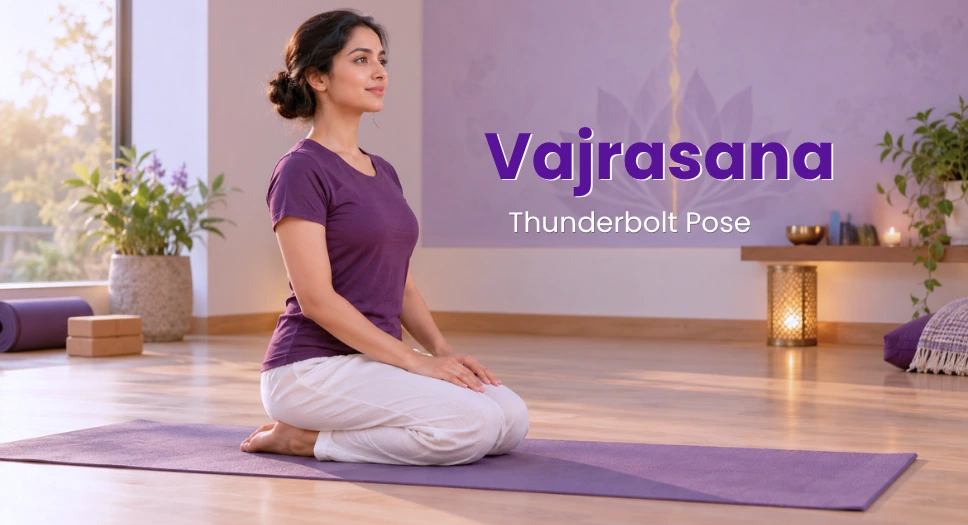
If you have ever watched someone sit calmly on their heels after a meal, spine straight, hands resting on their knees, you have probably seen Vajrasana in action. Unlike most seated postures in yoga that are practiced on an empty stomach, this particular asana breaks the rule entirely. It is one of the few poses that can, and should, be practiced right after eating. That single fact makes Vajrasana stand out among the hundreds of postures taught in traditional and modern yoga systems.
In this article, we will explore the meaning and origin of Vajrasana, a detailed step-by-step guide to performing the vajrasana pose correctly, the many benefits of vajrasana for digestion, posture, and mental focus, and why this simple-looking kneeling posture holds such a special place in vajrasana in yoga philosophy and practice.
What Does Vajrasana Mean?
The word Vajrasana comes from two Sanskrit roots: “Vajra,” meaning thunderbolt or diamond, and “Asana,” meaning seat or posture. Together, it translates to the “Thunderbolt Pose” or sometimes the “Diamond Pose.” The posture is generally categorized as both a sitting and a meditative asana, and — in keeping with its name — it is said to be named for its effects on the body: a firm, stable, “unbreakable” seat.
In Hindu mythology, the Vajra was the weapon of Lord Indra, king of the gods, known for its indestructible strength and lightning-like power. Ancient yogis believed this asana channels and stabilizes the body’s energy in a way similar to how a thunderbolt strikes with focused, concentrated force. It is also said to strengthen the nerves running through the legs, historically referred to as “vajra nadis,” reinforcing the connection between the name and the physical effect of the pose.
This posture is deeply rooted in classical yogic and meditative traditions, appearing in ancient Hatha Yoga texts as a grounding, stabilizing seat that prepares the body and mind for meditation, pranayama, and quiet reflection.
The Vajrasana Pose: A Simple Yet Powerful Posture
At first glance, the vajrasana pose looks almost too simple to be effective. You kneel down, sit back on your heels, keep your spine straight, and rest your palms on your thighs. That is essentially it. But this apparent simplicity is deceptive.
What makes the vajrasana pose genuinely powerful is the alignment it creates. When practiced correctly, it:
- Aligns the spine in a naturally upright position without strain
- Compresses the legs slightly, which is believed to redirect blood flow toward the digestive organs
- Creates a stable, grounded base that is ideal for long periods of sitting
- Requires no props, mats, or special equipment, making it accessible almost anywhere
Because of this accessibility and simplicity, Vajrasana is often the very first seated posture taught to beginners, right alongside Sukhasana (Easy Pose) and Padmasana (Lotus Pose).
Step-by-Step Guide: How to Practice Vajrasana
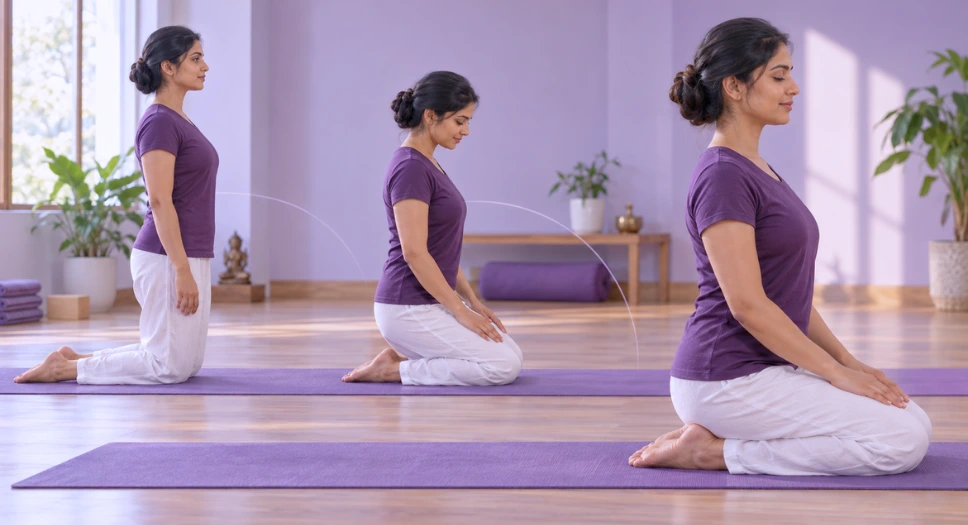
Performing Vajrasana correctly is not complicated, but attention to alignment matters. Follow these steps carefully.
Step 1: Prepare Your Space
Choose a flat, firm surface. A yoga mat or folded blanket underneath your knees can add comfort, especially for beginners with sensitive knee joints.
Step 2: Come to a Kneeling Position
Kneel down on the mat with your knees together or hip-width apart, depending on comfort. Your shins and the tops of your feet should rest on the floor, with your toes pointing straight out behind you and your big toes touching each other.
Step 3: Sit Back on Your Heels
Slowly lower your hips down until they settle into the “pit” formed by your parted heels — in other words, your seat rests between your heels rather than on top of them, with your heels framing your hips on either side.
Step 4: Straighten the Spine
Sit tall. Lengthen your spine from the base to the crown of your head, avoiding any slouching or overarching of the lower back.
Step 5: Position Your Hands
Rest your palms gently on your thighs, facing downward, or turn them upward if you prefer a more receptive, meditative hand position.
Step 6: Relax the Shoulders and Breathe
Drop your shoulders away from your ears. Close your eyes if comfortable, and begin breathing slowly and evenly through the nose.
Step 7: Hold the Position
Beginners can start by holding the pose for one to two minutes and gradually build up to five, ten, or even thirty minutes with consistent practice. It is generally safe to hold Vajrasana for extended periods, unlike many other seated postures.
Using Props for Comfort
Two common trouble spots — the knees and the ankles — each call for a slightly different fix:
- Knee discomfort: Take one or more folded blankets and stack them between your calves and thighs. This cushions the joint and reduces the fold angle at the knee.
- Ankle or toe discomfort: If there’s too much pressure on the toe knuckles, or you can’t comfortably point your toes to lay the front of the ankle flat, place a folded blanket or two under your shins so your toes hang off the back edge, taking the pressure off.
A few more pointers to refine your practice:
- Keep the weight evenly distributed between both knees and heels
- Avoid clenching the jaw or tensing the shoulders
- Never force the pose if there is sharp pain, especially in the knees or ankles
Benefits of Vajrasana: Why This Pose Deserves a Place in Your Routine
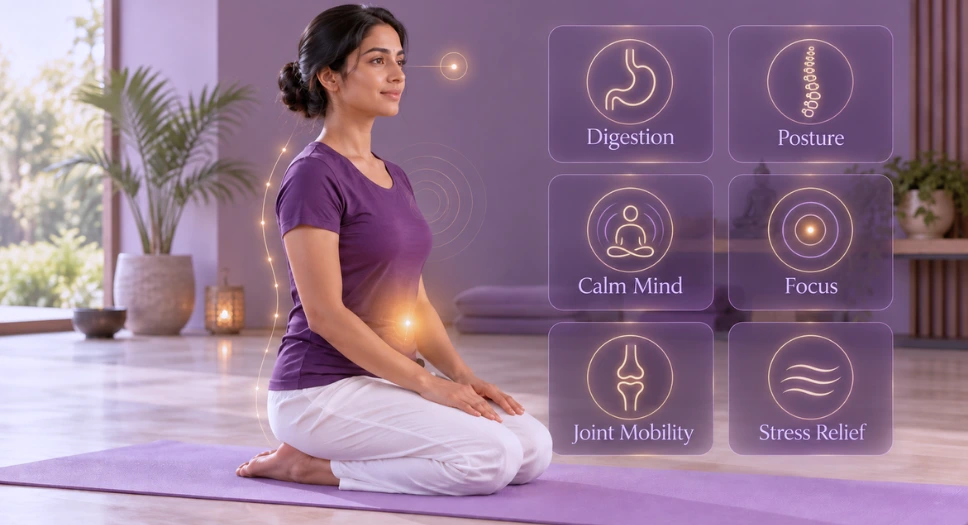
The benefits of vajrasana extend well beyond simple relaxation. This posture is widely credited with supporting digestion, posture, mental clarity, pelvic and reproductive health, and joint flexibility. Let’s break down the major advantages.
1. Improves Digestion
This is perhaps the most well-known of all the benefits of vajrasana. Because it is one of the only yoga poses recommended for practice immediately after meals, sitting in this posture is believed to enhance blood circulation to the digestive tract, supporting peristalsis and helping relieve excess gas, hyperacidity, and even peptic ulcer discomfort.
2. Strengthens the Lower Body and Joints
Regular practice gently strengthens the thighs, calves, and ankle joints, and is traditionally said to help make the knee and ankle joints more flexible while guarding against certain rheumatic conditions in those joints. This is particularly useful for those who sit cross-legged frequently or practice other seated meditative postures.
3. Corrects Posture
Because the pose demands an upright spine without any external support, it naturally trains the body to sit with better posture, both on and off the mat.
4. Calms the Mind
Like most grounding seated postures, this asana has a calming effect on the nervous system. The stillness and steadiness of the pose make it an excellent preparation for meditation and pranayama practices.
5. Reduces Stress and Anxiety
The slow, controlled breathing typically paired with this posture activates the parasympathetic nervous system, helping to ease tension and promote a sense of calm.
6. Supports Reproductive and Pelvic Health
This posture is traditionally credited with toning the pelvic joints and muscles and easing menstrual disorders and other reproductive discomforts. As with any pelvic-focused practice, it’s worth approaching gently and adjusting to your own body.
7. Eases Sciatica Discomfort (in Mild Cases)
Several yoga-health sources describe Vajrasana as helpful for lower back pain and sciatic discomfort, likely because the upright, supported spine takes pressure off the lower back. This applies to general or mild sciatic pain — if you have severe sciatica or active nerve pain radiating down the leg, this pose can aggravate it and is best avoided until a doctor or physiotherapist clears you.
8. May Support Healthy Blood Sugar Levels
A number of sources note that Vajrasana stimulates the pancreas and liver, and some describe short-term improvements in fasting glucose readings with regular practice. It’s a reasonable addition to a diabetes-friendly routine, but not a substitute for medical management.
9. Aids in Weight Management
When practiced after meals as part of a consistent routine, it may support metabolic function over time, complementing a balanced diet and active lifestyle rather than replacing them.
10. Improves Concentration
Because the body becomes so still and stable in this posture, it removes physical distractions, allowing the mind to settle more easily into focus — a favorite among students and professionals who want a quick mental reset.
To summarize the key advantages at a glance:
- Supports healthy digestion, and relief from gas, hyperacidity, and peptic ulcer discomfort
- Strengthens and adds flexibility to knees, ankles, and thighs; traditionally said to guard against rheumatic joint issues
- Encourages upright, healthy posture
- Reduces stress and calms the nervous system
- Enhances focus and mental clarity
- Tones pelvic joints and muscles; eases menstrual cramps
- May ease mild sciatic and lower back discomfort (severe cases should avoid it)
- May support healthy blood sugar levels as part of a broader routine
- Requires no equipment and can be done almost anywhere
The Students Who Carried His Legacy Worldwide
Perhaps the clearest evidence supporting his reputation as the Father of Modern Yoga lies in the extraordinary list of students he taught, many of whom became influential teachers in their own right.
Some of his most notable students include:
- K. Pattabhi Jois, who developed and popularized Ashtanga Vinyasa Yoga, a system that became highly influential in modern dynamic yoga.
- B.K.S. Iyengar, who developed Iyengar Yoga, known for its emphasis on precision, alignment, sequencing, and the use of props.
- Indra Devi, an important early female student who later helped introduce yoga to Western audiences, including through her work with Hollywood figures.
- T.K.V. Desikachar, his son, who continued and developed his father’s later individualized and therapeutic approach.
Each of these students absorbed different aspects of his vast teaching, and each went on to build distinct approaches to yoga. Despite their differences in style and emphasis, their connection to Krishnamacharya represents one of the most important teacher-student lineages in twentieth-century yoga.
Vajrasana in Yoga: Its Unique Place Among the Asanas
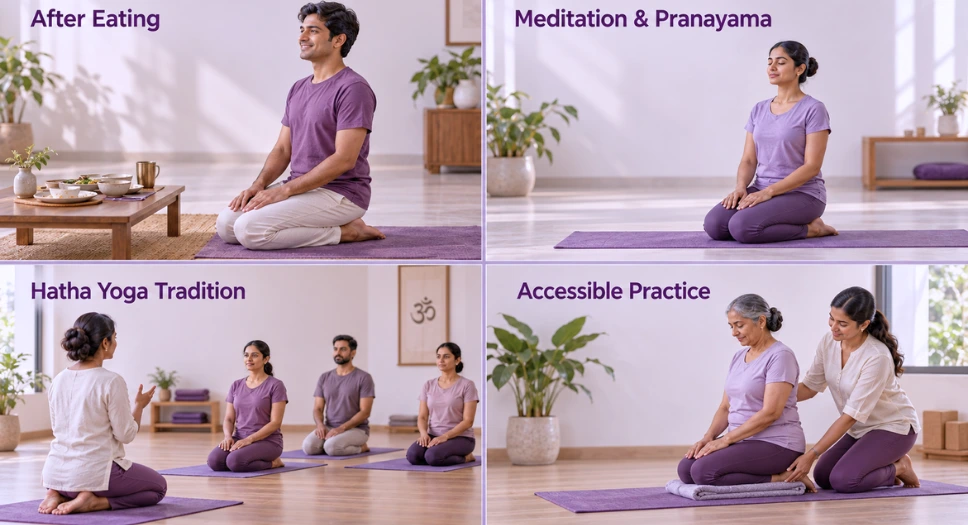
The Only Pose Recommended After Eating
Most yoga postures, especially twists, forward folds, and inversions, are traditionally practiced on an empty stomach because they compress or stretch the abdominal region in ways that can cause discomfort after eating. Vajrasana is the exception. Its gentle, upright kneeling structure does not compress the stomach in a harmful way, which is why yoga teachers across generations have recommended it as a post-meal seated posture.
A Gateway to Meditation and Pranayama
This pose is frequently used as a seated base for pranayama (breath control) practices and meditation, particularly for those who find cross-legged postures like Padmasana or Siddhasana challenging on the knees or hips.
Rooted in Hatha Yoga Traditions
This posture holds a respected position within classical Hatha Yoga, where seated postures are treated as tools to prepare the body for longer periods of stillness — reflecting the broader philosophy that physical steadiness is the foundation for mental and spiritual steadiness.
Accessible to Nearly Everyone
Unlike more physically demanding postures that require significant flexibility or strength, this pose is approachable for beginners, seniors, and even those recovering from certain injuries, provided knee sensitivity is taken into account.
Vajrasana Compared to Other Seated Postures
- Sukhasana (Easy Pose): A cross-legged posture that’s comfortable for long meditation sessions but doesn’t offer the same digestive benefits.
- Padmasana (Lotus Pose): Requires significant hip and knee flexibility, making it less accessible for beginners compared to the kneeling structure discussed here.
- Siddhasana (Accomplished Pose): Primarily used for advanced meditation and pranayama, but again demands more flexibility than a simple kneeling seat.
- Vajrasana: Requires no special flexibility, can be practiced immediately after eating, and still provides a stable, upright base for breathing and reflection.
Common Mistakes Beginners Make
- Sitting with a rounded or slouched back instead of keeping the spine tall and lifted
- Resting hips on top of the heels rather than letting them settle into the gap between the parted heels
- Forcing the knees into a fully folded position too quickly, without warming up the joints
- Ignoring early signs of knee or ankle discomfort instead of adjusting with the right blanket placement
- Holding the breath instead of maintaining slow, steady breathing throughout the pose
- Practicing for too long, too soon, before the knees and ankles have built up flexibility
Frequently Asked Questions
1. Can this pose really be done right after a meal?
Yes. It is one of the very few postures in yoga specifically recommended for practice shortly after eating, typically for five to ten minutes, to support the digestive process.
2. How long should a beginner hold the pose?
Start with one to two minutes and slowly build up. Many experienced practitioners comfortably hold it for thirty minutes or longer once the knees and ankles have adapted.
3. Is it suitable for people with knee problems?
Anyone with existing knee issues, arthritis, or a history of knee surgery should approach this posture cautiously and ideally seek guidance from a qualified instructor before attempting it regularly.
4. Does it help with weight loss?
It’s not a high-intensity posture, but its potential digestive and metabolic support, combined with a balanced diet and regular movement, can complement broader weight management goals over time.
Precautions and Who Should Be Careful
- Individuals with foot, ankle, or knee stiffness, osteoarthritis, or a slipped/prolapsed disc should approach this posture cautiously and ideally under guidance, or avoid it
- Pregnant practitioners can generally practice with the knees spread wider to avoid pressure on the belly, though later-stage pregnancy calls for extra caution and a qualified instructor’s guidance
- People with a hernia or other intestinal issues should only practice this pose under the supervision of an experienced instructor, as it can put pressure on the abdomen and potentially worsen the condition
- People with varicose veins should limit how long they hold the pose, since kneeling compresses the leg veins and can aggravate symptoms
- Severe sciatica or active nerve pain is a reason to skip this pose until a doctor or physiotherapist has cleared you
- If you experience numbness, tingling, or sharp pain in the legs or feet, come out of the pose gently and stretch the legs before trying again
On piles (hemorrhoids) specifically: most yoga-health sources actually recommend Vajrasana as helpful for piles, since it can support pelvic circulation and regular bowel movements — the opposite of treating it as something to avoid. If you have an active, painful flare-up, though, easing into the pose gently (or skipping it until it settles) is the sensible approach.
Listening to the body is essential. A gentle, gradual approach will always yield better long-term results than forcing the body into a position it is not ready for.
Tips to Deepen Your Practice
- Practice for five to ten minutes daily after your main meal for digestive benefits
- Combine the pose with slow diaphragmatic breathing for a calming effect
- Use the correct blanket placement (between calves and thighs for knee pain, under the shins for ankle/toe pressure)
- Gradually increase your holding time rather than forcing long durations early on
- Pair it with gentle knee and ankle stretches before and after your session
A Note From Hatha Yoga Institute
If this exploration of postures, breathwork, and mindful movement has sparked your curiosity, the Hatha Yoga Institute offers structured, teacher-led programs designed for practitioners at every level, from complete beginners learning foundational seated postures to advanced students preparing for teacher certification. With a strong emphasis on classical alignment, breath awareness, and traditional Hatha Yoga philosophy, the institute provides a supportive environment to deepen not just your physical practice, but your overall understanding of yoga as a holistic discipline.
Final Thoughts
Simple in form yet rich in benefit, this kneeling posture proves that yoga does not always require complex, physically demanding shapes to be effective. Its unique status as a post-meal pose, combined with its grounding and calming qualities, makes it a valuable addition to any yoga practice, whether you are a complete beginner or a seasoned practitioner looking for a reliable seated foundation.
Understanding the meaning, mastering the steps, and appreciating the many benefits of this posture can help you approach your practice with more intention and awareness. Like most things in yoga, consistency matters more than intensity, and even a few minutes a day can bring noticeable results over time.