In the vast and ancient tradition of yoga, some poses carry a significance far beyond their physical appearance. Tadasana, commonly known as Mountain Pose, is one such posture. At first glance, it might appear deceptively simple — you are simply standing. But as any experienced yogi will tell you, there is nothing simple about truly standing in Tadasana. This is the pose where the journey into yoga begins, where the body learns alignment, where the mind discovers stillness, and where the practitioner understands that even stillness requires intention, effort, and awareness.
Whether you are a complete beginner stepping onto the mat for the first time or a seasoned practitioner revisiting the fundamentals, Tadasana Mountain Pose deserves your full attention. It is the root from which all other standing poses grow. Understanding Tadasana yoga means understanding the body’s relationship with gravity, balance, and breath.
This blog will take you deep into the world of Tadasana — its meaning, technique, key points, benefits, contraindications, and its role as the cornerstone of yoga practice.
What Is Tadasana? About Tadasana
Before we get into the how, let us understand the what and the why. About Tadasana — the word itself holds the key to understanding the pose.
Tadasana is a Sanskrit word formed by combining two words: “Tada,” meaning palm tree, and “asana,” meaning pose or posture. In many modern yoga systems and the Iyengar tradition, Tadasana is also commonly referred to as Mountain Pose — a posture of absolute stillness, groundedness, and stability, much like a mountain. In classical Hatha Yoga traditions, Tadasana is more specifically known as Palm Tree Pose, where the practitioner rises onto the toes with arms extended overhead, embodying the tall, elegant stretch of a palm tree rooted deeply yet reaching skyward.
Both interpretations carry value and together offer a fuller picture of what this foundational asana is about Tadasana — being both rooted and elevated, stable and expansive, grounded and growing.
In this blog, we explore Tadasana pose yoga through both these lenses, because understanding both enriches your practice at every level.
Tadasana: Understanding the Name, Meaning and Origin

Meaning:
“Tada” means “palm tree.” The Tadasana pose is named so because of the appearance and technique of the posture — when practiced in its classical form, the body stretches upward in the full elongated elegance of a palm tree, balanced on the toes, arms raised, the entire body forming one long, continuous line from the soles to the fingertips.
Type:
Tadasana can be categorized as both a standing asana and a balancing asana. It requires the active engagement of nearly every muscle group in the body, even though the outward movement is minimal. It demands balance, concentration, and the kind of inner stillness that is often harder to achieve than any dramatic bend or twist.
This dual classification is significant. As a standing pose, it teaches proper postural alignment. As a balancing pose, it cultivates focus, mental calm, and proprioceptive awareness — the body’s ability to sense itself in space.
Tadasana Mountain Pose: The Two Forms You Should Know
Form 1 — Mountain Pose (Tadasana as Standing Foundation)
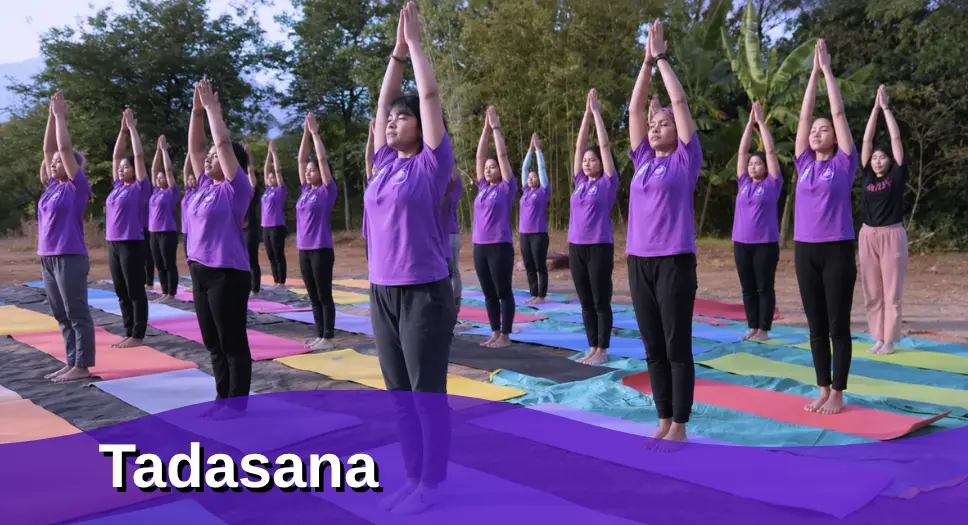
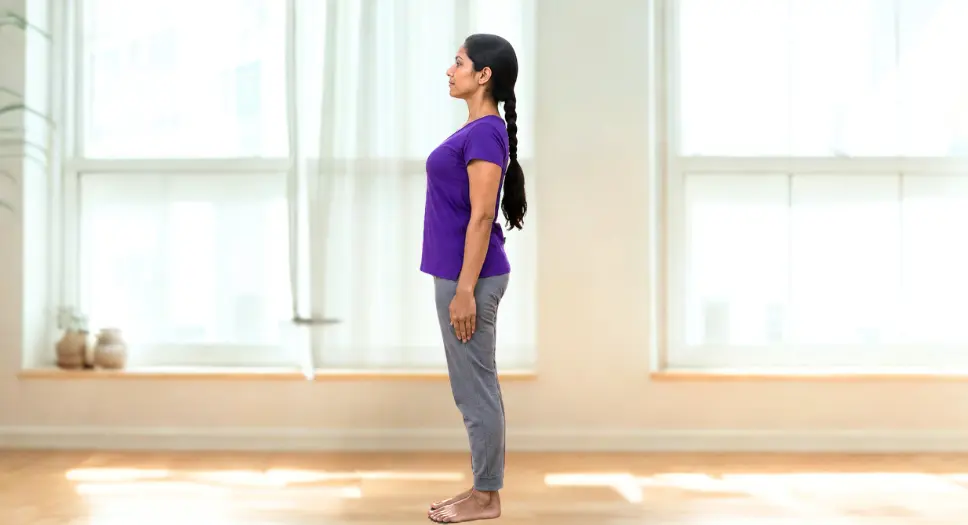
In many contemporary yoga schools, Tadasana Mountain Pose refers to standing upright with both feet together or hip-width apart, arms by the sides, spine long, and gaze directed forward. It is the neutral starting position from which all standing poses emerge and to which all standing poses return.
Here, the emphasis is on:
- Grounding all four corners of both feet evenly into the floor
- Gently engaging the thighs without locking or hyperextending the knees
- Lengthening the spine naturally from the tailbone to the crown of the head
- Rolling the shoulders back and down, away from the ears
- Allowing the arms to rest alongside the body with palms facing forward or inward
- Keeping the chin parallel to the floor and the gaze soft and forward
- Breathing slowly, deeply, and fully
Even in this apparently static form, Tadasana Mountain Pose is a full-body exercise in awareness. If you pay close attention, you will notice that the body is never truly still — micro-adjustments happen constantly as the muscles work together to maintain alignment and balance.
Form 2 — Palm Tree Pose (Classical Tadasana)
In its classical form, as described in traditional Hatha Yoga texts, Tadasana involves rising onto the toes with arms extended overhead. Here is how it is practiced step by step:
Step-by-Step Instructions:
- Stand erect with your feet together, arms alongside the body. Let the spine be tall and the breath steady and natural.
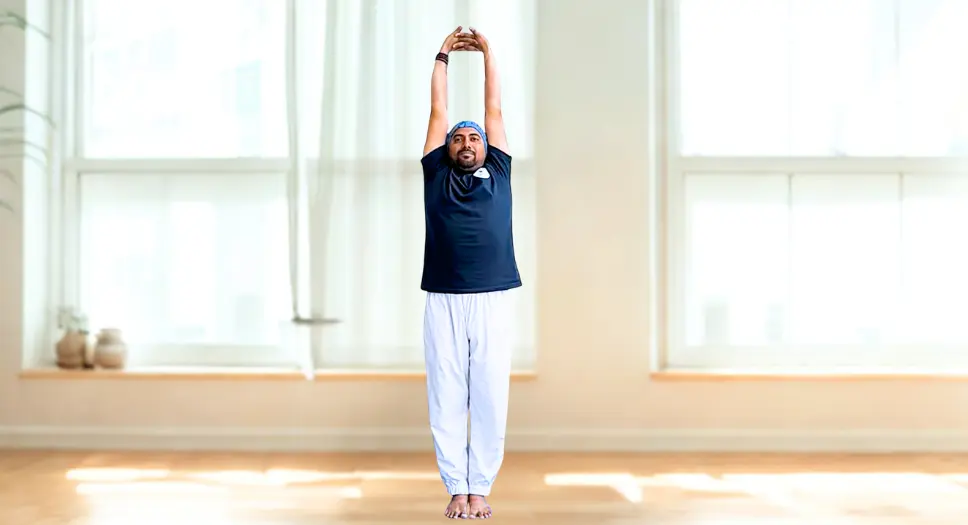
- As you inhale slowly and deeply, begin to raise both arms above the head. Interlock the fingers and turn the palms upward to face the ceiling.
- Simultaneously, rise up onto your toes, lifting the heels gently off the ground. The entire weight of the body is now borne by the toes.
- Stretch the whole body upward — from the toes to the fingertips. Feel the elongation through the feet, legs, hips, abdomen, chest, arms, and up through the crown of the head. Every part of the body participates.
- Fix your gaze at a steady point slightly above eye level, directly in front of you. Keep the eyes focused and unwavering throughout the hold.
- Hold the position for a few comfortable breaths, maintaining the full stretch and the balance.
- To release, breathe out slowly and simultaneously lower the heels back to the ground while bringing the arms down alongside the body. Return to the starting position with control.
- Once you are comfortable with this practice, try it with your eyes closed. Practicing with closed eyes significantly deepens the balancing challenge and enhances mental focus and inner awareness.
This is the full classical expression of Tadasana pose — a beautiful fusion of grounding and reaching, of effort and ease.
Key Points to Remember During Tadasana Practice
These key points will help you practice Tadasana Mountain Pose safely and effectively:
- The weight of the body is borne by the toes. Distribute the weight evenly across all the toes rather than tilting to one side or gripping with the toes.
- The whole body is stretched from the toes to the head. Think of the body as one continuous upward line of energy. Every part — feet, calves, thighs, hips, abdomen, spine, chest, arms, neck, and head — actively participates in the stretch.
- While releasing, bring down the heels while breathing out. Always coordinate the movement with the breath. Inhale to rise, exhale to return. Never hold or force the breath during practice.
- During the whole practice, the eyes should remain steadily fixed at a point in front, slightly above the head level. This focal point (drishti) anchors the mind and supports physical balance.
- If it is easy for you, try with your eyes closed. Removing the visual reference point encourages the nervous system to rely on internal balance mechanisms, deepening both the physical and meditative quality of Tadasana pose considerably.
- Keep the arms close to the ears when raised overhead. Avoid letting the arms flare outward, which can create unnecessary compression in the neck or diminish the quality of the spinal stretch.
- Maintain a soft micro-bend in the knees. Do not lock or hyperextend the knee joints. The muscles should be gently engaged, not rigid.
- Breathe throughout. Many practitioners instinctively hold the breath when working on balance. Resist this. A steady, rhythmic breath is what makes Tadasana yoga sustainable and deeply beneficial.
Benefits of Tadasana Mountain Pose
The benefits of Tadasana yoga are wide-ranging, touching the physical body, the mind, and the body’s internal systems. Here is a detailed and accurate look at what consistent practice offers:
Physical Benefits:
- Full-Body Stretch and Renewed Energy: Tadasana gives a good stretch to the feet, legs, hips, abdomen, arms, chest, and spine. This comprehensive stretch produces a feeling of freshness, boosts energy levels, and enhances alertness. It is one of the most efficient full-body resets available in yoga.
- Postural Improvement: If you have a tendency to hunch or slouch — which is increasingly common due to sedentary lifestyles and prolonged screen use — practicing Tadasana can help improve posture significantly. By training the body to find and sustain its natural upright alignment, it counteracts the rounding of shoulders and the forward collapse of the chest.
- Spinal Health and Suppleness: Tadasana is particularly good for bringing suppleness and strength to the spine. A well-aligned, supple spine is central to good health in yoga philosophy. This makes Tadasana yoga beneficial in managing back-related conditions such as sciatica and postural back pain. Note: Anyone with a diagnosed spinal condition should consult a qualified yoga teacher or healthcare provider before practicing.
- Support for Growing Children: One traditional benefit attributed to Tadasana is its potential to support healthy skeletal development in growing children and adolescents. The full-body stretch along the spine and legs helps decompress joints and encourages the body to reach its natural growth potential. This benefit is most relevant for those whose bones are still developing.
- Improved Balance and Ankle Strength: Rising onto the toes and holding the position builds ankle strength, improves neuromuscular coordination, and sharpens the body’s proprioceptive awareness. These improvements support balance in all other physical activities as well.
- Functional Core Strengthening: Sustaining the upright stretch in Tadasana pose requires constant, subtle engagement of the core muscles — the deep abdominals, the spinal extensors, and the pelvic floor. Over time, this builds genuine functional core strength.
Mental and Energetic Benefits:
- Physical and Mental Balance: Tadasana creates a clear sense of physical and mental balance. This sense of equilibrium can be further enhanced when Tadasana pose is practiced with closed eyes. The mind learns to find its own center without depending on external reference points.
- Calming the Nervous System: The act of standing tall in Mountain Pose, breathing fully, and maintaining steady focus has a measurable calming effect on the nervous system. It gently activates the body’s parasympathetic response, reducing physiological stress and promoting mental clarity.
- Cultivating Present-Moment Awareness: Tadasana pose yoga is meditation in the form of stillness. The sustained, detailed awareness required to hold the pose correctly trains the mind to stay in the present moment — a quality that carries over meaningfully into everyday life.
- Natural Energy Boost: Despite its quietness, Tadasana is genuinely energizing. The full-body stretch and conscious breathing stimulate circulation and support lymphatic flow, leaving practitioners feeling refreshed and clear-headed.
Therapeutic Application:
Tadasana is one of the poses used during the practice of Shankhaprakshalana — a traditional yogic intestinal cleansing kriya — as it helps stimulate peristalsis, the natural wave-like muscular contractions that move content through the digestive tract. This is a lesser-known but well-documented therapeutic application of Tadasana yoga within classical Hatha Yoga.
Better posture, a steadier mind and stronger legs come from practising with understanding, not just repetition. If you want to learn the science behind each pose, our Certificate Course RYS 200 (YCB Level 1) teaches you the why behind every asana. Learn more about the 200 hour course
Tadasana as the Foundation of All Standing Poses
The title of this blog is not an exaggeration. In Tadasana Mountain Pose, every principle of alignment that matters in yoga is present and teachable:
- Foot placement and grounding
- Knee alignment and gentle muscular engagement
- Hip neutrality and pelvic balance
- Natural spinal elongation
- Shoulder positioning and chest openness
- Neck and head alignment
- Steady gaze (drishti)
- Coordinated breath
When a student learns to feel and embody these alignments in Tadasana, they carry that blueprint into every other standing pose. Whether it is Virabhadrasana (Warrior Pose), Trikonasana (Triangle Pose), Vrksasana (Tree Pose), or any of the many other standing postures found across yoga traditions, the alignment principles first established in Mountain Pose Tadasana form the living foundation.
This is why in Ashtanga Yoga, Iyengar Yoga, and most Hatha Yoga lineages, sequences begin and end in Tadasana. It is the neutral state — the home base — to which the body consciously returns after each exploration. Think of Tadasana as the comma between the sentences of a yoga sequence. It is the moment of integration, of recalibration, of checking in before moving forward.
Its presence in practice is not decorative. It is structural, intentional, and essential.
Contraindications: Who Should Practice with Caution
While Tadasana is among the most accessible poses in yoga, there are specific conditions that require caution:
- Insomnia: The energizing nature of Tadasana, particularly the classical balancing variation, may aggravate sleeplessness when practiced in the evening. Those with insomnia are advised to practice in the morning hours.
- Low Blood Pressure (Low BP): Rising onto the toes and stretching the body upward in Tadasana pose can cause a temporary drop in blood pressure in susceptible individuals. If you experience dizziness at any point during the pose, stop the practice immediately, lower yourself carefully, and rest in a comfortable seated or lying position.
- High Blood Pressure (High BP): The overhead arm position combined with the balancing effort in Tadasana creates a mild cardiovascular demand. If you experience headache or excess strain in the brain or head during practice, stop immediately. Those with uncontrolled high blood pressure should practice only under the supervision of an experienced and qualified yoga teacher.
- Migraine: The combination of the overhead arm position and the balancing challenge in Tadasana can trigger or worsen migraine symptoms. Avoid Tadasana during an active migraine episode. Even between episodes, practice mindfully and stop immediately if any head pressure, visual disturbances, or neck tension arises.
If you have any of the conditions listed above, please consult your physician and a qualified yoga instructor before beginning or continuing Tadasana practice.
Tadasana Yoga in Daily Life
One of the most practical and beautiful aspects of Tadasana is its accessibility beyond the mat. You do not need a yoga studio, a special mat, or extra time. You can bring the principles of Tadasana yoga into any moment of your day when you happen to be standing.
While waiting, cooking, or pausing between tasks at work, take a breath and check in:
- Are my feet grounded evenly on the floor?
- Is my spine long and naturally upright?
- Are my shoulders relaxed and open, not hunched forward?
- Is my chin level, neither dropped nor lifted?
- Am I breathing?
That moment of conscious standing is Tadasana. And in that moment, wherever you are, you are practicing yoga.
Tips for Beginners
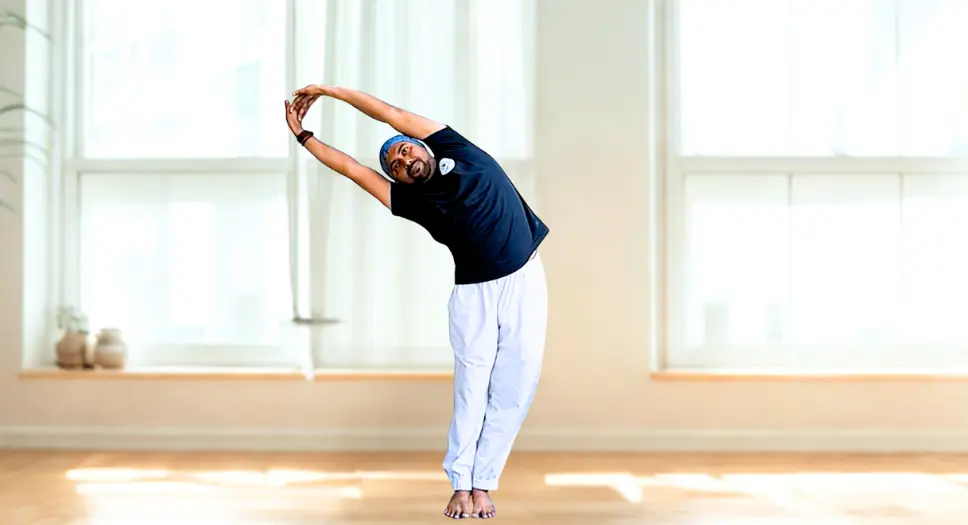
If you are new to Tadasana pose yoga, these tips will help you build confidence and a safe foundation:
- Begin with feet hip-width apart rather than together. A wider base makes balance more manageable as you build ankle and foot strength in Tadasana.
- Practice near a wall initially. Rest the fingertips lightly on the wall for support when rising onto the toes, reducing the fear of falling.
- Use a mirror to observe your alignment until you develop a reliable internal sense of Tadasana Mountain Pose.
- Start with short holds of five to eight breaths and gradually increase as strength and stability improve.
- Be patient with the balance. Rising onto the toes in Tadasana challenges the ankles and the body’s vestibular system. Both adapt and improve with consistent, regular practice.
- Always warm up the ankles, calves, and feet gently before practicing the classical balancing variation of Tadasana.
If yoga has become more than a hobby, you can turn it into a profession. Hatha Yoga Institute offers the Diploma Course RYS 200 + 300 (YCB Level 1+2+3), along with Mudra Yoga, Face Yoga and Pregnancy Yoga Teacher Training courses for those who want a specialised career path. Learn more about our teacher training courses
Conclusion
Tadasana Mountain Pose is proof that in yoga, simplicity is never the same as ease. It is a posture that asks you to stand — fully, completely, and consciously — and in doing so, teaches you more about your body, your mind, and your breath than almost any other pose can.
Whether you practice the modern Mountain Pose version — grounded, stable, present — or the classical Palm Tree Pose variation — stretched, balanced, and rising — Tadasana yoga offers a lifetime of exploration within its elegant simplicity.
Tadasana is the beginning and the end. The foundation and the destination. The stillness from which all movement flows and to which all movement ultimately returns.
Start here. Stand here. Let the mountain within you rise.
Deepen Your Practice with Hatha Yoga Institute
If reading about Tadasana has inspired you to explore Tadasana pose yoga and the broader world of yoga more seriously, Hatha Yoga Institute is the place where your journey truly begins.
Rooted in the authentic classical tradition of Hatha Yoga, Hatha Yoga Institute offers structured, expert-led programs for students at every level — from complete beginners discovering poses like Tadasana for the first time to advanced practitioners seeking to deepen their understanding of yoga philosophy, pranayama, and classical asana sequences.
What makes Hatha Yoga Institute different is the emphasis on correctness and understanding. You will not just be told what to do — you will understand why. Every pose, including Tadasana Mountain Pose, every breath, and every principle is taught with clarity and care, ensuring that your practice is not only effective but genuinely safe and sustainable for the long term.
Whether you are looking to improve your posture through Tadasana yoga, manage stress, build a consistent yoga routine, or pursue a deeper spiritual path through yoga, Hatha Yoga Institute offers the guidance, community, and knowledge to support you every step of the way.
Come as you are. Leave transformed.
Visit us at www.hathayogainstitute.com to explore our upcoming batches, workshops, and certification programs. Your mountain is waiting.